
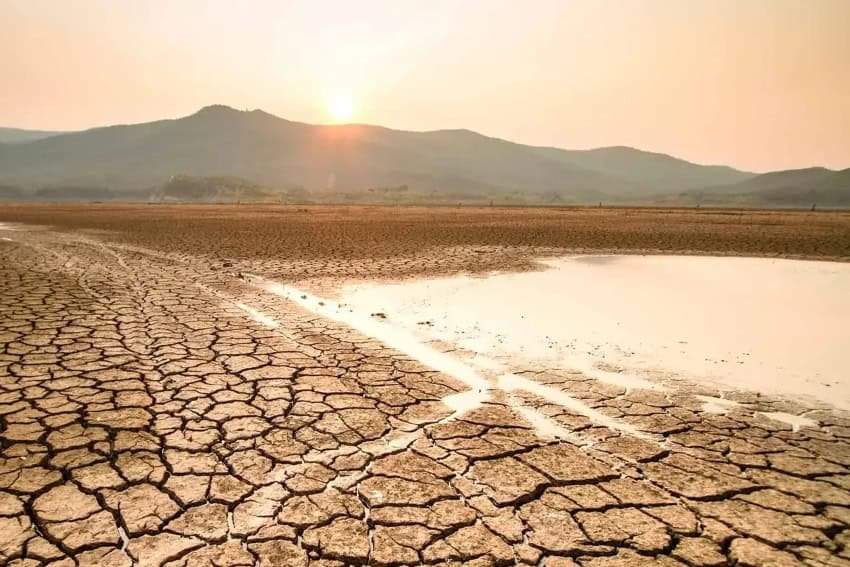
After a year of unusually abundant rainfall, Mexico’s much-reported water crisis appeared to ease. Reservoirs rebounded. Drought maps shrank. The immediate pressure lifted in cities like Mexico City and Guadalajara.
Now, with out-of-season rains falling across parts of the country, a new question is emerging: Is this relief — or a warning sign of a climate system growing more erratic? Scientists say the answer is more complicated — and more concerning.
Longer droughts, briefer deluges
At the end of March, just 7.4% of Mexico was classified as being in drought, down from 40% in January 2024, according to the National Meteorological Service. But this whiplash between drought and deluge is not a sign of recovery, experts say.
It’s a warning.
New research into Mexico’s long-term climate patterns suggests the country is entering a more volatile water era: longer, more intense droughts punctuated by short bursts of heavy rainfall — events that often fail to replenish water systems.
At the same time, groundwater — Mexico’s most critical reserve — is being depleted faster than it can recover, while rising temperatures accelerate evaporation. Meanwhile, rapid urban expansion is disrupting the natural water cycle.
Even in years of good rain, the underlying trajectory is clear: Mexico is getting drier.

Lessons from the past: A paleoclimatologist takes the long view
National Autonomous University of Mexico (UNAM) paleoclimatologist Priyadarsi Roy studies how rainfall and drought have shaped Mexico over tens of thousands of years. What that long view reveals, he says, is not stability, but contrast.
“Mexico has a very heterogeneous climatic system,” he said, with arid regions in the north and humid zones in the south — a pattern that has persisted for millennia.
Drought, too, is nothing new. Historical records show prolonged dry periods in the 1950s and again in the 1990s.
But in the last two decades, Roy said, something about Mexico’s climate has suddenly changed.
“Since the last 20 years, droughts have been much more persistent and much more intense,” he said.
The implications are not simply theoretical: During Mexico’s drought in the 1990s, migration from Mexico to the United States doubled. Looking ahead, Roy and others’ projections suggest millions could be displaced by water scarcity in the coming decades.
“Possibly up to 6 million people … will migrate because water resources will be depleted,” Roy said.
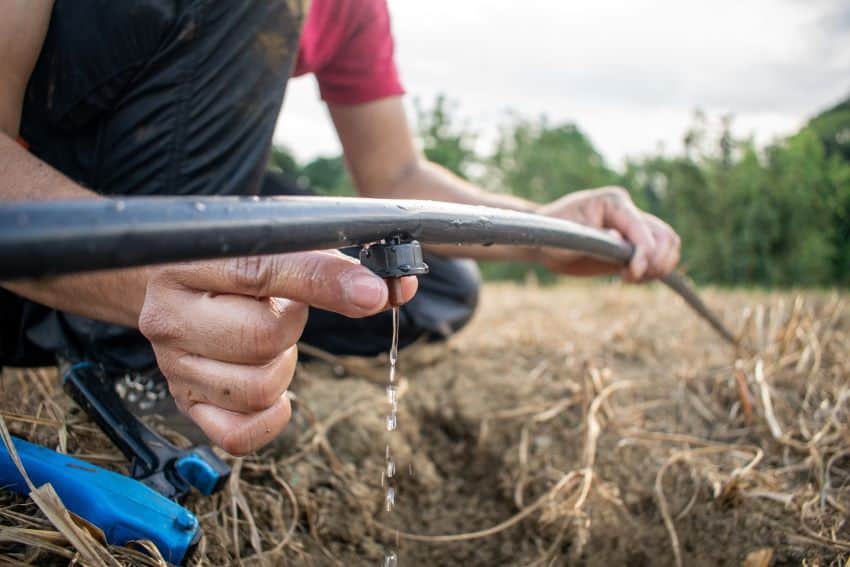
The pattern has repeated over millennia. Ancient Mesoamerican cities — including major urban centers — were abandoned during prolonged droughts.
Roy points to Cantona, a city in present-day Puebla that once supported tens of thousands of people before being abandoned when water supplies failed. The pattern repeats across much of Mesoamerica, where entire networks of cities declined during repeated dry periods.
“People left everything and moved to a region where there was water available,” he said.
Shifting storm patterns and rising temperatures: A ‘lethal combination’
Climate change is not just intensifying storms — it is reshaping where they go.
Roy was among the investigators in a study that points to a growing “alberca caliente,” or hot pool, stretching across the Atlantic — a band of water above roughly 28.5°C that has expanded with global warming.
As it grows, storms are increasingly forming farther out at sea and tracking northward, toward the United States and skipping Mexico, or else dissipating in the Atlantic before reaching Mexico. While this means fewer hurricanes are making landfall in Mexico, it also means that the large amounts of rainfall on the periphery of hurricane systems are bypassing Mexico as well — and not replenishing the water sources in those areas.
“Those precipitation systems are not coming to Mexico anymore,” Roy said. “So Mexico is getting drier.”
The consequences are compounded by rising temperatures, which cause water to evaporate more quickly — even when rain does fall.
“We are having less precipitation … and the precipitation that we are getting … is getting dried out,” Roy said.
The combination — fewer storms reaching land and faster water loss — is, in Roy’s words, “a lethal combination.”
A water-management system out of sync with Mexico’s reality
Paradoxically, even when rain does arrive, much of it is lost.
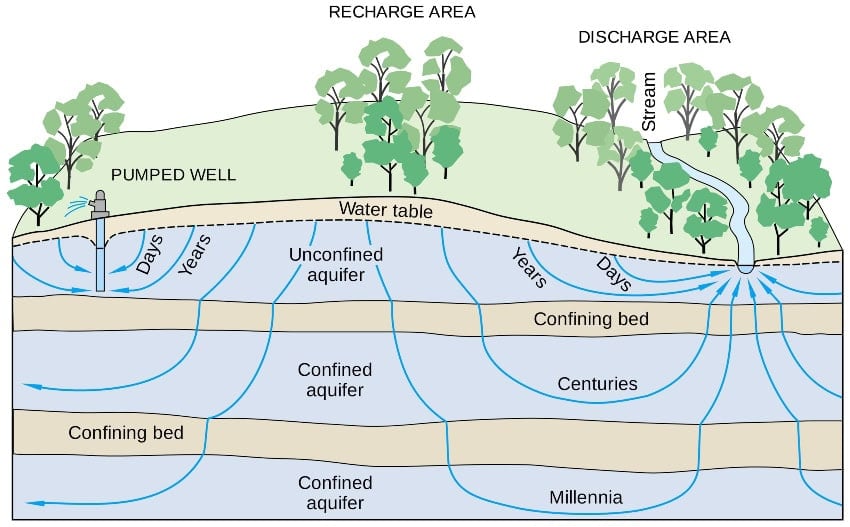
Mexico’s water supply depends heavily on slow processes like infiltration and aquifer recharge — systems that require steady, moderate rainfall over time. But increasingly, precipitation is arriving in short, intense bursts.
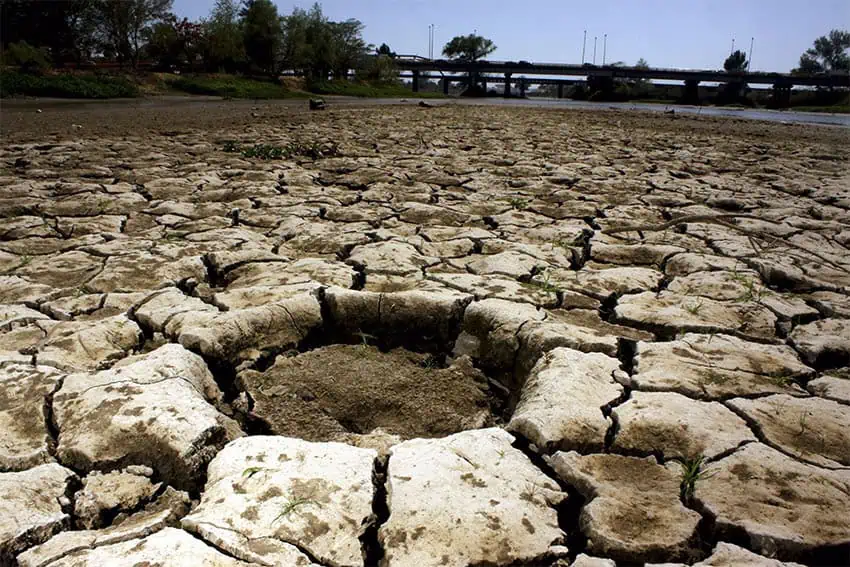
When rain falls too quickly, it runs off instead of soaking into the ground — contributing to flooding without replenishing depleted reserves.
In cities, that loss is amplified.
“In Guadalajara, up to 60% of the rainwater is lost,” said University of Guadalajara water expert Arturo Gleason, who has spent decades studying urban water systems in Mexico and abroad.
The problem, he argues, is not just climate. It is how Mexico manages water.
For decades, Mexico’s response to water scarcity has been to build more infrastructure — dams, aqueducts and pumping systems designed to bring water from farther away.
“That school of thought — the ‘mega-project’ — continues to permeate, even to this day,” Gleason said.
But that model is increasingly mismatched with today’s climate reality.
Across northern and central Mexico, groundwater has become the backbone of the water supply. But rising temperatures, reduced vegetation and shifting rainfall patterns are limiting water recharge — even as demand continues to grow.
At the same time, the systems that deliver water are aging and underfunded.
“The pipes and equipment … are operating beyond their useful life,” Gleason said. “It is becoming increasingly difficult to provide good quality (water) and adequate volume.”
Even where water exists, it is becoming harder to deliver — and harder to trust as safe for use.
The role of urban expansion
The problem is also being intensified by how cities are built, said Gleason.
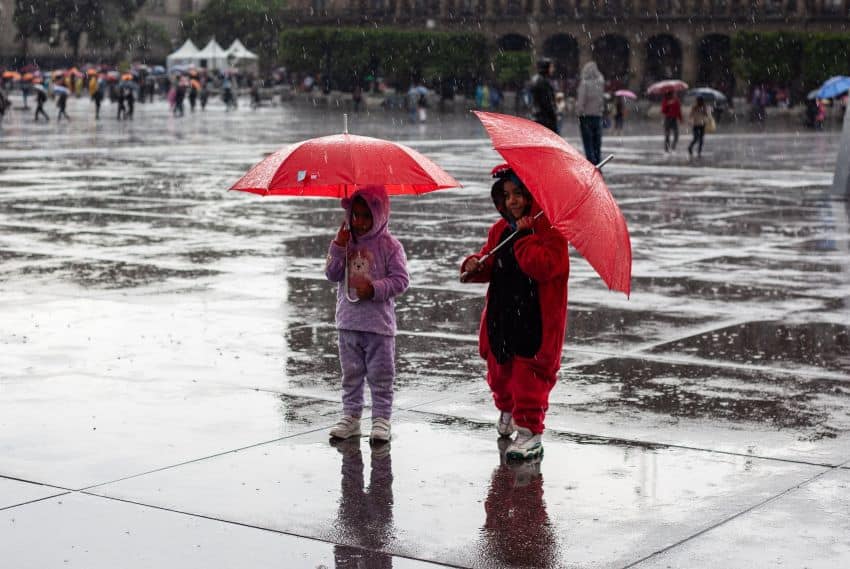
Deforestation and the spread of concrete that have come with urban expansion in Mexico are disrupting the natural water cycle.
“The moment you deforest … and cover the ground with concrete, you change the local climate,” Gleason said.
With urban expansion, vegetation that once helped retain moisture and promote rainfall has been removed. Soil that once absorbed water is sealed beneath pavement. The result is a paradox seen across Mexico: Cities suffer intense flooding during storms but struggle with water shortages the rest of the year.
What a different model could look like
For Gleason, the solution is not simply a technical one implemented by experts — it needs to be systemic and cultural, involving citizens.
Over decades of research and advocacy, he has promoted a different approach — one that works with the natural water cycle rather than against it.
That means capturing rain where it falls — in homes, neighborhoods and, critically, in green spaces designed to allow water to infiltrate and recharge aquifers.
It means restoring vegetation, protecting recharge zones at the local level and reducing impermeable surfaces that cut rainwater off from the soil that would absorb it.
And it means rethinking the role of citizens.
“It’s not the system for the sake of the system,” he said. “It’s generating a culture of water management.”
Rainwater harvesting systems, he argues, should not be isolated government programs, but part of a broader transformation — one that engages the citizenry through education, incentives and long-term maintenance.
Lessons from elsewhere
Gleason’s work has taken him abroad, where he has seen alternative models in action.
In Germany, he studied systems designed not to consume rainwater but to retain it — keeping it within urban landscapes to reduce runoff and protect water quality.
Cities there map their territory in detail, determining where water should be absorbed, stored or redirected — and requiring developers to incorporate those systems into new construction.
In Australia, cities like Melbourne have gone further, adopting what are known as “water-sensitive urban design” strategies — integrating water management into every layer of urban planning.
These systems treat rainfall not as a nuisance to be drained away but as a resource to be captured, stored and reused.
In Mexico, this sort of progress is uneven. Monterrey, for example, has made significant advances in wastewater treatment and reuse, achieving near-total treatment of its wastewater — a rare benchmark nationally.
But such examples remain the exception.
Why solutions fall short
Even where solutions exist, scaling them remains a challenge.
Programs like rainwater harvesting have expanded in cities like Guadalajara. But Gleason says they often lack the long-term vision needed to succeed. Systems are installed — but not maintained. Citizens are given tools — but not the training or incentives to use them effectively.
“It’s a lifestyle,” he said of rainwater harvesting. “And that hasn’t been built.”
Without a cultural shift, he argues, the responsibility for water remains externalized — something managed by utilities rather than shared across society.
A narrowing window for action
If current trends continue, the consequences across Mexico could be severe.
“I think it’s a widespread shortage,” Gleason said. “It’s not just the volume — it’s the quality.”
As water sources become increasingly contaminated and infrastructure struggles to keep up, cities may face rising health risks, higher costs and deepening inequality in access to safe water.
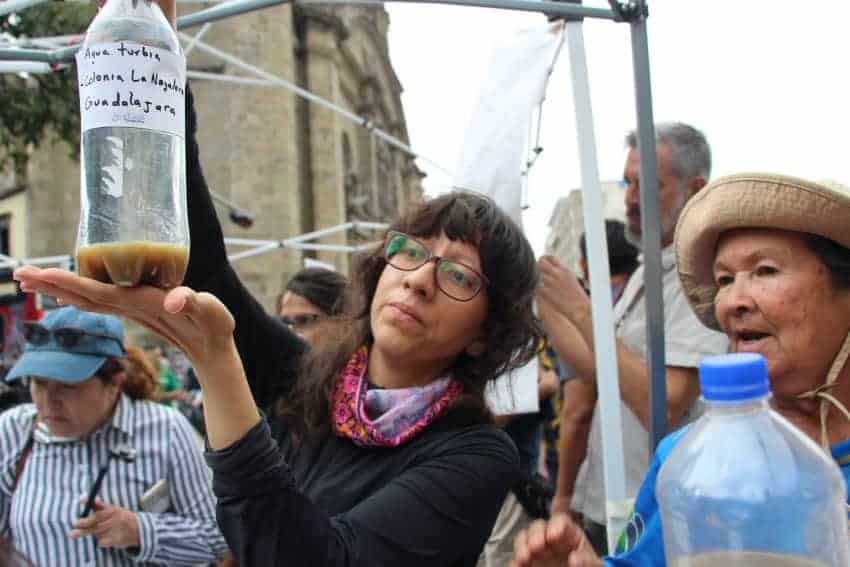
“We are entering chaotic scenarios,” he said — a warning that echoes recent street protests in Guadalajara over water shortages and contaminated, foul-smelling tap water.
At the same time, the window for action is shrinking.
“We are now entering a reduction phase,” he said — a stage where options become more limited and solutions more costly,” he explained.
What must come next
Still, neither Roy nor Gleason sees the future as predetermined. But both point to the same conclusion: the current trajectory is unsustainable.
The path forward will require more than infrastructure, they say.
It will require restoring ecosystems, modernizing systems and fundamentally rethinking how water is valued — not as an unlimited resource to be extracted, but as a finite cycle to be protected.
And it will require something more difficult still: a shift in public consciousness — from consumption to stewardship. Because the question Mexico now faces is no longer simply whether it has enough water, but whether it can adapt — quickly enough — to the reality of having less.
Tracy L. Barnett is a Guadalajara-based freelance writer and the founder of The Esperanza Project.
