
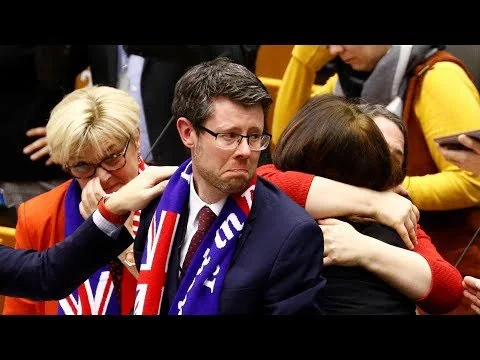
MUSIC rang out across the European Parliament’s wood-panelled hall as ministers held each other’s hands, swaying to the gentle lull of ‘Auld Lang Syne’.
The ballad, sung tearfully by hundreds of MEPs on January 29, 2020, was Brussels’ tribute to Britain as it enacted its historic decision to leave the Union.
It was the result of a vote taken four years earlier, when nearly 52% of Britons backed Brexit in a move that sent shockwaves rippling across Europe.
It has now been ten years since that fateful day on June 23, 2016 – and, in the meantime, British citizens appear to have had a dramatic change of heart, recent polling shows.
According to a survey by the European Council on Foreign Relations (ECFR), most people in the UK believe Brexit has had a negative impact on issues they care about – including the cost of living (66%), the economy (65%), youth opportunity (57%), illegal immigration (56%) and trade (56%).
The same study showed Europeans would welcome the UK back into the Union with open arms, with 66% of respondents across 15 countries saying they ‘strongly supported’ or ‘tended to support’ Britain’s return.
As geopolitical tensions and military conflicts fuel economic uncertainty across the globe, former PM Sir Keir Starmer repeatedly called for stronger relations with Europe.
Spanish prime minister Pedro Sanchez has echoed the sentiment, saying Spain would ‘absolutely’ support British membership of the EU.
As nostalgics continue to hope Britain might one day reverse course on its historic decision to leave the bloc, the Spanish press provides a useful snapshot of how UK immigrants in Spain feel about Brexit.
Here is The Olive Press’s round-up of the best stories of the week – ten years on from a vote that changed the lives of 400,000 British residents now living in Spain.
The loss of freedom of movement – RTVE
Ten years after Brexit, many Britons living in Spain say the most significant change has been the loss of free movement, once a defining benefit of European Union membership.
What was previously a straightforward right to live, work, study and relocate across Europe now often requires visas, residency permits and additional administrative hurdles.
Londoner Glen Mundy worked in Spain as a language teacher between 2006 and 2010, then returned in 2018 after Brexit, this time as a retiree.
“It changed everything – we were no longer European citizens,” he told RTVE News.
“Suddenly, we felt more like foreigners here. Not because of the Spanish people, though – our friends and the people here have always treated us the same,” he added.
Geopolitical uncertainty has strengthened pro-European sentiment – La Vanguardia
As US–UK relations come under heightened strain amid the war in Iran and the escalating Strait of Hormuz crisis, many Britons now see the EU as a more reliable partner than the US on security, defence and economic stability, La Vanguardia says.
Even Europe’s far-right parties view the United Kingdom’s return more favourably, with a reported 72% of British respondents believing the EU would rush to Britain’s aid in the event of war.
“The international climate, and above all the weakening of the transatlantic alliance, has opened a window of opportunity for Britain’s return to the EU,” Xavier Mas de Xaxas writes.
“The public, which often moves well ahead of politicians on such issues, sees this quite clearly.”
The lost decade of Brexit – El Pais
Ten years after the Brexit referendum, the promised gains of sovereignty and prosperity have largely failed to materialise, according to an opinion piece in El Pais.
Brexit imposed a lasting economic cost on Britain, the editorial claims, reducing growth and leaving the country poorer than it might otherwise have been.
Politically, the vote ushered in years of instability, with successive governments struggling to define a coherent post-Brexit strategy or restore public confidence.
El País also links Brexit to a broader rise in populism, arguing that anti-immigration rhetoric and distrust of institutions have deepened social divisions across Britain.
The Schengen rules – Majorca Daily Bulletin
British expats in Mallorca and elsewhere in Spain are increasingly talking about Brexit in practical terms, Majorca Daily Bulletin writes, especially the restrictions it placed on how long they can stay in the EU.
Much of the frustration centres on the Schengen 90/180-day rule, which has made extended stays far more complicated than before Brexit.
Discussion about Brexit has shifted in Spain from abstract politics to everyday inconvenience, particularly for retirees and seasonal residents navigating new bureaucratic limits.
At the same time, it suggests there is growing political noise around the idea of the UK rejoining the EU, or at least easing mobility rules, although actual policy change remains distant.
EU nationals in the UK – Agencia EFE
Much like Britons in Spain found themselves stranded in a limbo of administrative uncertainty almost overnight, around three million EU nationals faced similar hardships in the UK.
Long-term EU residents in the UK have had to regularise their status through digital-only systems that many find difficult to navigate.
Carlos Soler Montes, who chairs the Society of Spanish Researchers in the United Kingdom (CERU), told EFE he had been certain Britain would vote to remain on June 23, 2016.
Before the referendum, he said, dozens of his colleagues at a conference in Reading were preparing to celebrate a pro-EU victory.
“Instead, the next day, the conference felt like a funeral. Nobody could believe what had happened,” he recalled.
Over the past ten years, he added, scores of young colleagues from CERU have returned to Spain – some out of concern, others out of disappointment.
Click here to read more International Affairs News from The Olive Press.
