
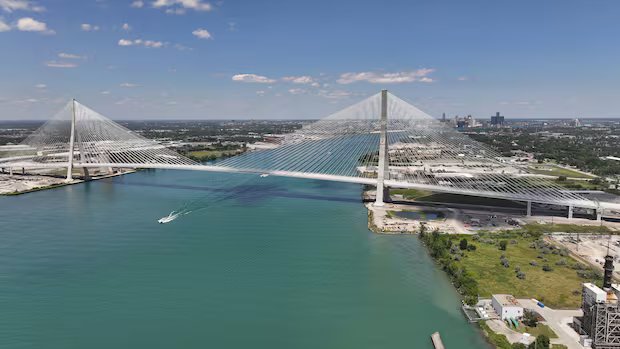
After 25 years of planning, seven years of construction and months of delays, the first trucks are finally set to roll over the Gordie Howe bridge on Monday.
In tow will be some of the billions of dollars worth of goods that pass through the Windsor-Detroit corridor, which the bridge will help get to their destinations faster — saving time and money.
“There’s a tremendous opportunity here in dollar terms, but also in terms of what our future looks like, just embodied in that one bridge,” said Moshe Lander, an economics professor at Concordia University who studies international trade.
But just how much time and money are we talking about?
Here’s what you need to know.
850,000 hours per year saved
The existing Blue Water Bridge, Ambassador Bridge and Detroit-Windsor Tunnel have supported massive amounts of trade for decades. But they’re near capacity, which Canadian Trucking Alliance CEO Stephen Laskowski says has led to congestion.
He says lines at customs plazas on both sides of the Ambassador Bridge have grown longer over the years. And the route leading to that crossing on the Windsor side also takes drivers through a dozen or so stoplights.
But with three lanes of capacity going in each direction, the Gordie Howe is expected to speed things up significantly.
The new bridge is expected to take 44.5 per cent of the commercial traffic that passes through the Windsor-Detroit corridor, according to a January filing from the U.S. Department of Homeland Security establishing the route as an official port of entry.
The opening of the new Gordie Howe bridge is widely expected to change the way billions of dollars worth of goods and millions of travelers cross between Canada and the U.S. But a recent U.S. government analysis puts a number on just how significant the traffic impact could be at the busiest international trade corridor in North America. The CBC’s Emma Loop reports.
The Gordie Howe route also directly connects two major American and Canadian highway networks — the 75-series highways in the U.S. with the 400-series highways in Ontario.
While the new bridge might only shave off a few minutes from each trip, that time adds up. It’s estimated to save truck drivers some 850,000 hours per year in wait times.
Laskowski’s organization estimates the new bridge will save trucking companies between $20,000 and $100,000 a month, depending on the size of their fleet.
Lower tolls on the Gordie Howe compared to the Ambassador Bridge will shave a few bucks off of that cost, according to Laskowski, while less time spent idling in traffic will mean savings on fuel and wages.

$1B in daily trade
Given a third of all trade that happens between the U.S. and Canada passes through this corridor, the bridge could have some serious benefits for the economy writ large.
Canada and the U.S. already ship about $1 billion daily through the Windsor-Detroit corridor, according to an estimate from Invest WindsorEssex, making it the busiest international land border crossing in North America.
“It’s mind-boggling,” said Lander.
As is the case for auto manufacturing, parts often cross the border multiple times before ending up in a finished product that’s sold in either country.
That compounds any time savings from a single border crossing, says Sandy Baruah, CEO of the Detroit Regional Chamber of commerce.
Any delays from a slow crossing can hold things up at factories too, says Baruah, so another bridge to keep things moving would prevent delays from having a domino effect.
“In today’s hyper-competitive global market, any efficiency that can be gained is a big deal.”
And if businesses aren’t spending as much to truck products around that could mean they don’t raise prices as quickly, which Lander says could mean “inflation kept under tabs.”
Beyond that, Lander says it’s an important sign to businesses of just how important the trading relationship between Canada and the U.S. is and the fact that it’s not going anywhere — politics aside.
Despite U.S. President Donald Trump’s continued tariff threats — including the most recent 50 per cent levies on a range of Canadian products — Lander says the geography of the two countries means not trading simply isn’t an option.
“They are in our backyard. We are in their backyard. It’s not going away.”
A $6.4B price tag
Despite the benefits, Canada will have to begin paying back the bridge’s hefty price tag.
While the bridge is owned by the governments of Canada and Michigan jointly, Canada paid the entire $6.4 billion cost to get it built. But that hasn’t prevented debate about who should get the funds once the bridge is open.

In February, U.S. President Donald Trump threatened to block the bridge’s opening until his country was “fully compensated for everything we have given them,” in a social media post complaining about Canada.
The bridge’s first crack at opening last month was later stalled at the request of the United States, in order to work out a handful of issues.
The two countries have since reached a new deal to open the bridge to travellers starting July 27 under altered terms about where toll revenue goes.
For the first 15 years under that agreement, toll revenue will be used to pay for the bridge’s maintenance and operating expenses. The rest of the money will be split, with Canada getting half and the other half going to an economic development fund controlled by the U.S. government.

The proposed agreement surrounding the opening of the Gordie Howe International Bridge connecting Windsor, Ont., to Detroit, was released amid escalated tariff threats by U.S. President Donald Trump.
The initial 2012 deal between the countries would have seen Canada collect all of the tolls and use the revenue in order to pay down its debt. Only once Canada’s debt was dealt with would Michigan start splitting revenue.
Comments by Carney made before the text of the agreement was made public led to confusion about the money-sharing agreement and criticism from opposition parties.
The Prime Minister apologized on Thursday for the confusion but said that, either way, the terms of the deal would have “a very marginal impact on the overall economics” because revenue will be small in the first few years until traffic ramps up.
