
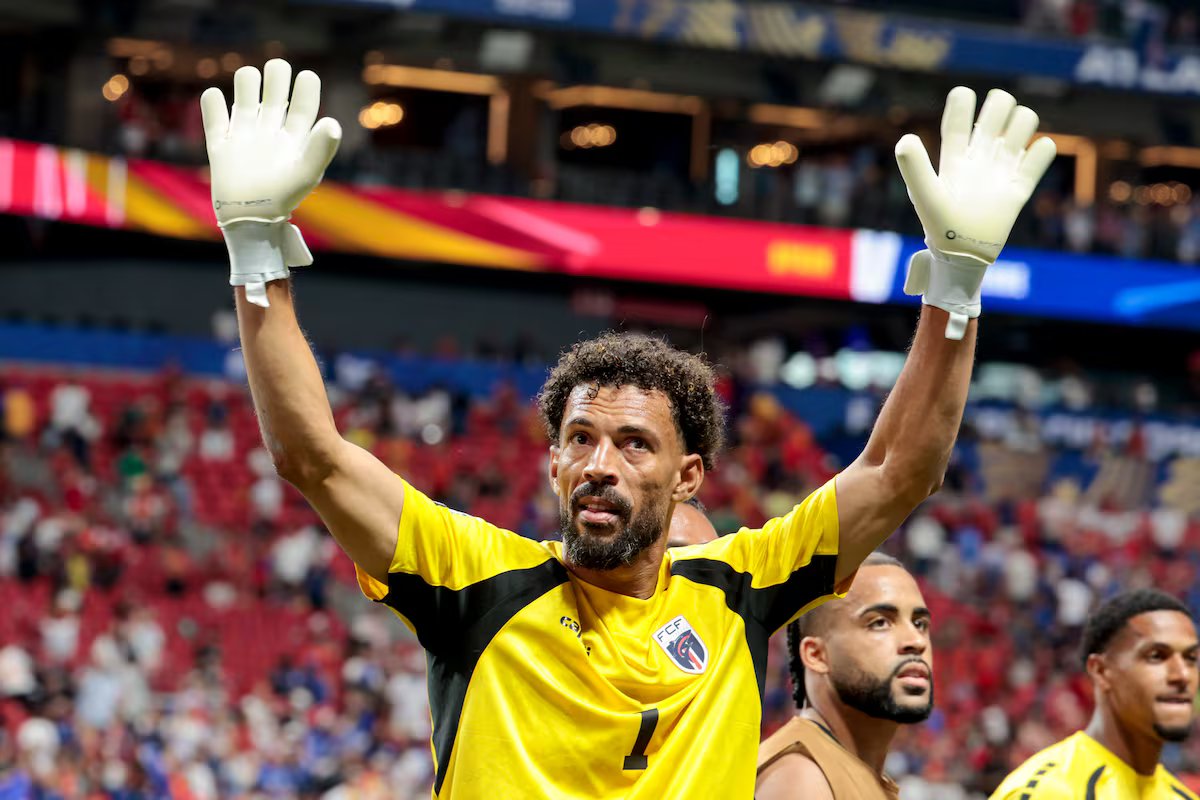
The impact of the Trump administration’s immigration policy on the World Cup continues to spark controversy. In the run-up to the tournament, an Iraqi photographer was turned away on arrival in Chicago and a Somali referee was denied entry after being declared inadmissible on landing in Miami, despite holding a valid visa. This week brought a new episode: Cape Verde goalkeeper Vozinha, the star of his team in their surprise draw against Spain, cried after Monday’s match because his mother could not attend such a historic moment. She could not afford the visa costs to accompany her son to the United States.
The controversy has reached the U.S. Congress in Washington, D.C., where House Democratic leader Hakeem Jeffries asked the secretary of state, Marco Rubio, to intervene so Vozinha’s mother can see her son play. “No mother should miss the chance to see her child make history. I have asked Secretary of State Marco Rubio to do everything in his power to ensure that she can attend Cabo Verde’s next match on Sunday,” the lawmaker wrote on his X account on Tuesday.
“I cried after the game because I grew up with my grandparents when I was a kid, and they could not be there,” Vozinha said after Monday’s match. “They passed away a few years ago. My mum could not be here either for a visa issue, and the money we had to pay for it. We did not manage to do this in time,” he added.
In January, the U.S. government added Cape Verde to a list of countries whose citizens must post a refundable bond of up to $15,000 before traveling to the country, on top of the visa fee. A State Department official told The Athletic that “there is no record” the goalkeeper’s mother had applied for a visa. “All family members of players may qualify for visa-bond waivers, and the Department is actively reaching out to this player’s family to help them with visa processing,” the official quoted by the specialist outlet added.
On Tuesday, the State Department confirmed it is in contact with Vozinha’s family to facilitate his mother’s immigration procedures ahead of Cape Verde’s second World Cup group game against Uruguay on Sunday. The State Department said U.S. authorities are in direct contact with the player’s family to assist with the consular process.
According to a source familiar with the case, the goalkeeper’s mother does not currently have a valid passport and is in the process of obtaining one as part of the necessary procedures to be able to travel.
Civil rights groups have been warning for months that incidents like these would ultimately affect the tournament, which will be held over the coming weeks in the United States, Mexico, and Canada, with the U.S. hosting the bulk matches amid an unprecedented anti-immigrant offensive launched by the White House.
In the weeks before the World Cup kicked off, pro-immigrant groups staged protests in several U.S. host cities, and more than 200 organizations signed a travel advisory warning international visitors about U.S. immigration policies. Activists are demanding that FIFA and local authorities guarantee fans will not be exposed to immigration raids when attending matches or World Cup events.
In Miami last week, a group of activists took their demands directly to FIFA at a press conference outside the grand gilded gate of the Mediterranean-style building that houses the organization’s headquarters in Coral Gables, an affluent neighborhood in the South Florida city. “Soccer has the power to bring families and nations together. What we are seeing instead is fear and chaos,” said Yarelis Méndez-Zamora, policy coordinator for the American Friends Service Committee. “We warned there would be arbitrary detentions, that people could be denied entry to the United States, racial profiling and more. All of that is happening.”
The complaints gained renewed force after the case of Somali referee Omar Artan became known: he was turned away on arrival at Miami International Airport despite holding a valid visa and FIFA accreditation. U.S. authorities declared Artan inadmissible and he was excluded from the tournament. Somalia is on a long list of countries whose citizens were banned from traveling to the U.S. under Trump. “If a referee selected by FIFA with a valid visa can be denied entry on arrival in Miami, what message does that send to millions of fans, families, and visitors from around the world who are considering traveling to the United States?” Méndez-Zamora said.
The activist added that the expansion of travel restrictions pushed by Trump has been contradictory as the country tries to host an international event. “To successfully host an event of this magnitude, you have to be a welcoming host,” she said. “This year more teams than ever are participating in the World Cup, but 39 countries are affected by travel bans or restrictions. You cannot host one of the world’s biggest international events while at the same time barring entry to nearly a quarter of the planet.”
In response, FIFA president Gianni Infantino addressed the issue at a press conference: “We are not the kings of the world who can rule over governments and police forces. We are a sports organization. We do our best with the means that we have to do as much as possible,” Infantino said. “It is unfortunate what happened to Omar, the referee from Somalia,” he added.
FIFA did not directly answer this newspaper’s questions about possible immigration operations or activists’ demands to establish immigration authority-free zones around World Cup stadiums and events. In an email, the organization said the safety of participants and fans is its top priority and that it is working with federal, state and local authorities to coordinate tournament security measures. It also said it trusts that the United States, Mexico, and Canada will guarantee a “safe and welcoming” environment for attendees.
For its part, the Department of Homeland Security, which oversees U.S. Immigration and Customs Enforcement (ICE), said in a statement that its “highest priority” is “the safety and protection of the American people and the millions of visitors.” “International visitors who legally come to the United States for the World Cup have nothing to worry about. What makes someone a target for immigration enforcement is whether or not they are illegally in the U.S.,” said the department’s acting deputy secretary, Lauren Bis.
Sign up for our weekly newsletter to get more English-language news coverage from EL PAÍS USA Edition
