
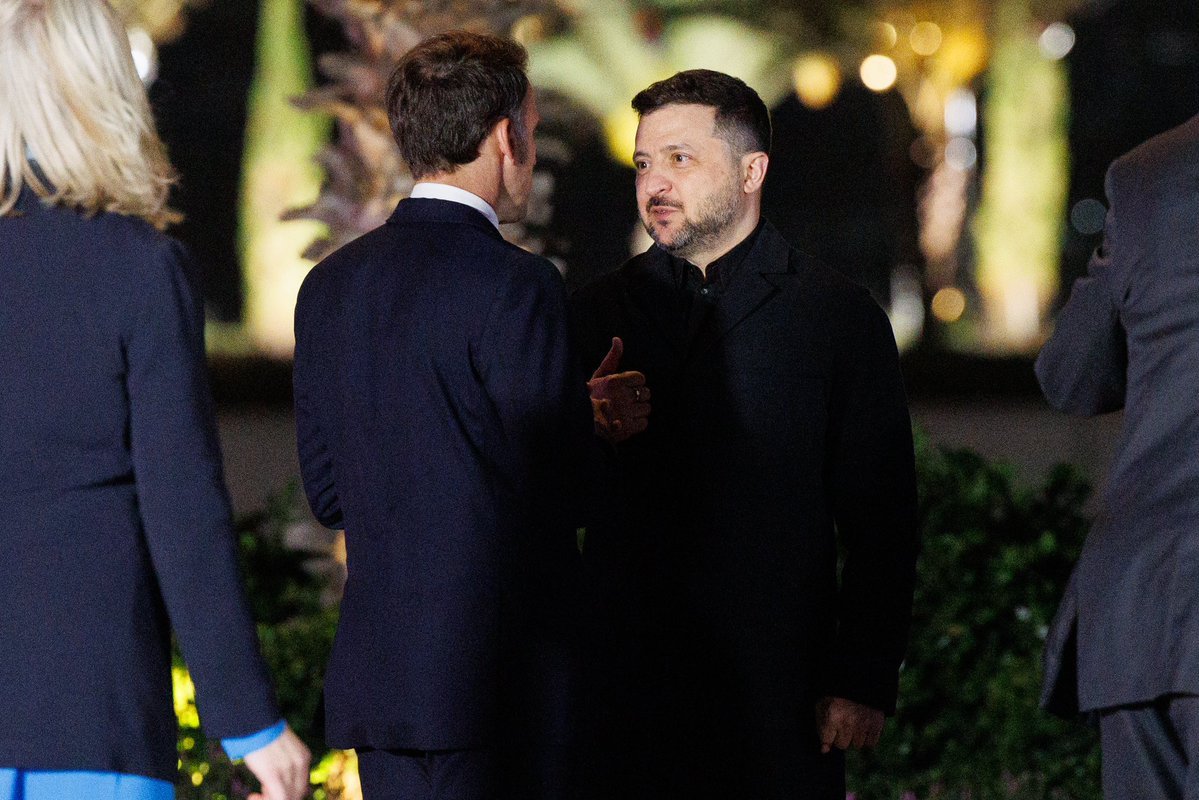
Greetings! Emmanuel Macron announced his latest diplomatic engagement with Volodymyr Zelensky on Thursday, sharing details of their meeting during the informal European Council sessions in Cyprus.
The French President took to social media to outline the substance of their discussion. He wrote: ‘Pleased to meet with President @ZelenskyUA again on the sidelines of the informal European Council in Cyprus.’
Macron expressed satisfaction with recent European financial commitments to Ukraine. According to his statement, the release of a significant European loan package represents what he called ‘a very strong signal of our determination to continue standing by Ukraine’s side.’ The timing of this announcement coincides with ongoing discussions about long-term European support strategies.
The meeting also addressed the European Union’s latest sanctions framework. Macron noted that leaders reached agreement on ‘the 20th package of sanctions’ against Russia. He characterized this development as ‘a clear message to Russia’ regarding European resolve.
Observers might note the careful diplomatic language employed in Macron’s statement. His framing presents European actions as both supportive of Ukraine and communicative to Russia, allowing readers to draw their own conclusions about the effectiveness of these dual approaches.
The two leaders discussed what Macron described as ‘comprehensive’ topics during their Cyprus encounter. Their conversation covered defense cooperation initiatives, strategies to ‘further increase pressure on Russia’s war economy,’ and coordination within what he termed ‘the Coalition of the Willing.’
Macron’s reference to the Coalition of the Willing connects to broader multilateral efforts involving various European and international partners. Different stakeholders may view these coordination efforts through varying lenses, depending on their perspectives on collective security arrangements and diplomatic approaches.
The French President concluded his statement with assurances about European commitment levels. He declared: ‘Our support will not weaken, either today or tomorrow. Europe keeps its promises, and it will stand firm.’
This messaging appears designed to communicate both internal European unity and external resolve. Whether such statements influence ongoing diplomatic calculations remains a matter for individual assessment.
The Cyprus meeting setting reflects the informal nature of many high-level diplomatic exchanges. European Council gatherings often provide opportunities for bilateral discussions alongside formal agenda items.
Macron’s social media post received notable engagement, accumulating over 2,500 likes and 400 retweets within hours of publication. The response suggests significant public interest in European diplomatic developments.
Both leaders continue to navigate complex international relationships while managing domestic considerations. Their ongoing dialogue reflects broader patterns in contemporary European diplomacy, where multiple priorities must be balanced simultaneously.
Readers may evaluate these developments through their own analytical frameworks, considering various perspectives on international relations, economic policy, and regional security arrangements. The diplomatic record provides factual information while leaving room for diverse interpretations of strategy and effectiveness.
