
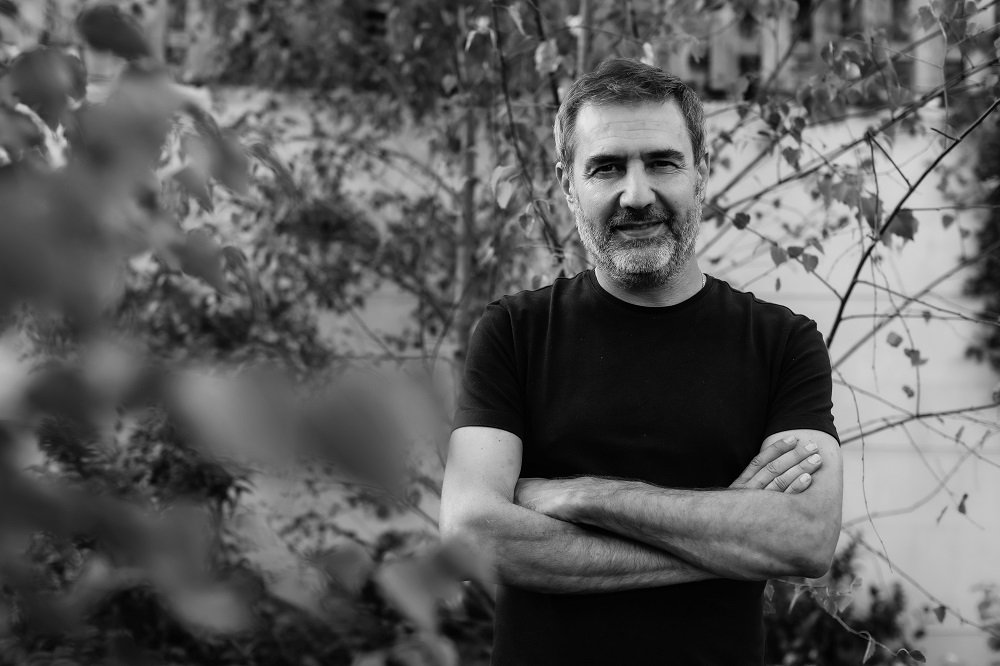
– One of the Spanish names behind Sirāt heads to Cannes with Óliver Laxe’s new project, among others, driven by curiosity and a desire to keep forging international connections
Catalonia’s Xavi Font was a musician before becoming a producer, and a finance professional before becoming an artist. He tells us about this – and about his expectations for European Film Promotion‘s Producers on the Move initiative at Cannes – as well as his company ZuZú Cinema and the works he has championed, such as those by Óliver Laxe (Sirāt), Jaume Claret Muxart (Strange River) and Carla Subirana (Sica), among others.
Cineuropa: Does working at a bank and then as a musician help when you become a producer?
Xavi Font: I studied international trade, and I’m good at it, although I felt a bit out of place there. I’d long wanted to make a living from music, and I still do. Because I was producing as a hobby at first, I was able to take risks, since that wasn’t what was putting bread on the table for my family. When you’re a filmmaker, you put your skills at the service of the movie, and put everything you’ve got into it; it’s natural. Being aware of your limitations means you can work around them and build a team with people who don’t have them; that’s how I refined the way I help directors, whether that means stringing together musical notes or numbers.
What guiding idea or editorial line did you have when you set up your company?
The first step was to carve out a space for it, building bridges between Catalonia and Galicia. Its mission is to make films that haven’t been made before. I don’t want rehashes; I want exploration, not formulas, because when you chase a trend, you always end up being late to the party.
Why did you apply to Producers on the Move?
I look to the future with optimism, and I like connecting with emerging producers whose projects question the industry. Beyond visibility and contact with key industry players, I’m really keen to get to know this generation of producers. It’s also about what we can contribute: we have a project called Petróleo that we started when no one was talking about the energy crisis. We planned to shoot in Venezuela, but we had to change tack because of Trump’s measures. Still, we feel alive when tackling issues that affect us: it’s rewarding to talk face to face about them and show no fear. It’s also rewarding to build a tribe and support each other as producers.
How important are international alliances to you?
So far, we’ve co-produced with France, Germany and Latin America. Cannes is a global market, and if you make the most of it, you save time and travel: you can forge new connections. On Óliver Laxe’s new project, we want to work with big-name international actors, and I don’t have experience with that, so I’d like to talk to people who do. We’ll need to look for partners, and not only for business reasons.
This year, there’s a majority of women taking part in Producers on the Move.
And what producers they are, with spectacular CVs! Producing is about care, and women have historically taken on care work, even if I wish I could say it was men. Producing means accompanying, knowing your place and being useful to the director. The best revolutions are quiet ones; that’s how they take root more deeply.
The Spanish presence at Cannes is spectacular this year – what do you think it’s down to?
Movistar Plus+ sought out specific projects and filmmakers, doubling their budgets, and that has ushered in a new paradigm. It’s a spearhead, with many voices behind it. That has opened up a new dimension that we weren’t in previously – and Cannes is the proof – where there’s a direct correlation with sales that, in turn, generates momentum in the international awards race. Public funding has helped, too. Now it’s up to us to redefine ourselves in this new paradigm; it’s a shared responsibility.
What are your expectations for Producers on the Move, and which projects are you bringing along?
I’m going to listen to my colleagues, and I’m bringing four projects with me. Petróleo is a film directed by Álvaro Pulpeiro, which was recently shot in Colombia; we are co-producing it with that country and with France. Also, there’s Ugeres, our first series. A pre-sale with a major broadcaster would be helpful; with this, we want to take our film-production model into television. It will be directed by Portugal’s Carlos Amaral, its creator, and we are talking to Galician helmer Sonia Méndez so that she can also direct an episode. Then there’s Laxe’s new project, still without a final title: we are looking for international partners and major channels, imagining what the co-production structure could look like as we work on development, since the script hasn’t been written yet. And lastly, there’s a film about the Canal d’Urgell, for which I’ve written a treatment. Urgell is a dryland area in Catalonia that, thanks to the canal, was transformed into irrigated land in the 19th century. It’s my first work as a screenwriter, and I’ll likely be encouraged to co-direct it.
(Translated from Spanish)
