
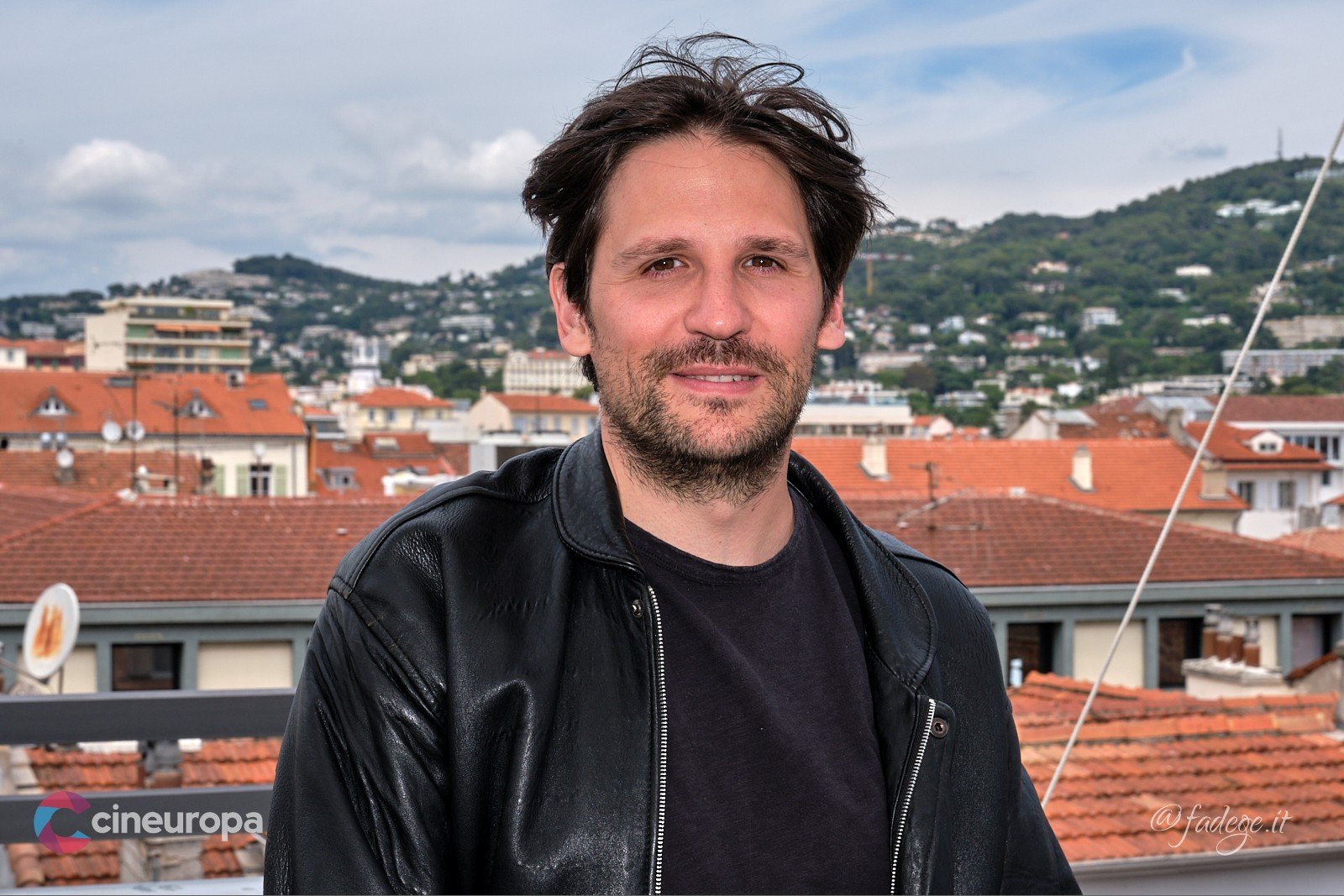
“The more you grow up, the more you understand how the world is bigger than you thought”
– CANNES 2026: The debuting director, first seen as an actor in Mia Hansen-Løve’s Eden, gives us further insight into his heartbreaking coming-of-age drama
(© 2026 Fabrizio de Gennaro for Cineuropa – fadege.it, @fadege.it)
Félix de Givry’s Goodbye Cruel World begins with the unthinkable. Otto (Anatomy of a Fall’s Milo Machado-Graner) has informed his entire class at school that he’s going to end his life, yet steps back from the brink and hides whilst his family and the authorities begin searching for him. Léna (Jane Beever), a kind schoolmate, shelters him in an empty room at the small hotel her mother runs, and a bond, tinged with guilt and complicity, starts forming between them.
With a memorable leading role in Mia Hansen-Løve’s Eden behind him, de Givry has now established himself as a filmmaker, collaborating with his producing partner Ugo Bienvenu on the Oscar-nominated animation Arco. We spoke to de Givry before the movie’s premiere as the closing-night film of the Cannes Critics’ Week.
Cineuropa: How did you pivot from acting to directing films, and how did the idea for Goodbye Cruel World proceed from that?
Félix de Givry: I think meeting Mia Hansen-Løve on Eden helped me discover filmmaking in general – more so filmmaking than acting. The whole experience made me realise that I wanted to become a director more than an actor. I also met Ugo Bienvenu on Mia’s film, and he’s my partner in our production company, Remembers; on the side, we made Ugo’s film Arco, which was a big success.
In Goodbye Cruel World, Otto was originally going to be 18, and just wanted to leave his parents and disappear, which is his legal right. But for the final version, I made the character a bit younger and more connected to my teenage years. There is the same autobiographical starting point – I was also bullied at school. But the rest is fiction.
One of the most interesting aspects of the script is how it gradually cedes perspective from that of Otto to that of Léna.
It was always the story of a duo. Still, I thought that Marie [Marie-Stéphane Imbert, the film’s co-writer] would be more like the character of Léna, and Otto would be more like me. But the further we got through shooting, the more I understood it was kind of the opposite because Léna’s character is about being connected to the real world. So, the character that was disappearing was also meeting someone, and they were able to disappear together.
There have been many films on this topic, the choice to end one’s life, but we haven’t always seen this angle. And we’re allowed to come to our own conclusions about the character’s mindset.
There was a lot of suicide surrounding me at that age, and maybe even concerning myself, although I didn’t make an attempt. It’s Truffaut who said, “Anyone who says adolescence is the best years of your life is a liar.” And I really, deeply connect to that. For me, that age was my worst nightmare. There’s a sense where you’re trapped in a prison inside, say, three classrooms and some streets around your secondary school – and I really felt at that age that I would be stuck there forever. You have definite ideas of what life is when you’re in that very strange zone between childhood and adulthood. I did an interview with a journalist last year, and it was very interesting because she said most coming-of-age films start with teenage “lightness”. Coming of age is really about facing up to how serious and grave the world is. Yet the more you grow up, the more you understand how the world is bigger than you thought it was.
Goodbye Cruel World evokes those great, older French auteur films, particularly Mouchette and The Devil Probably by Robert Bresson. Françoise Lebrun’s voice-over is also important…
The whole experience of my film, I’ve come to understand, is that it’s hard to digest. And what I love about those films – and Bresson and Truffaut are very different – is how they’re movies about cinema. There’s certain, specific stuff in those films that are lacking in today’s – it has disappeared, perhaps because of the existence of more realistic and naturalistic cinema.
It can be more ironic, but also more down to earth, like you get with a handheld camera. It’s the idea that the closer we are to the real, the better it is. Although I love the Dardennes, for instance, who do this, it’s been a trend since the year 2000. Lyrical cinema, let’s say, has been overtaken. I miss this because I miss the experience of going to a “film” – having the music and the opening credits, with the idea of the suspension of disbelief. It’s a story, and you’re leaving reality. Now, lots of films begin with the sound of a train station. People are obsessed with not interrupting reality. I don’t only love movies from the 1970s, but I’ve come to understand that’s why those films move me and stay with me. Perhaps people will see mine and say it’s just a bland copy of those other ones, but it’s just what I like.
