
– CANNES 2026: Javier Ambrossi and Javier Calvo’s pic intertwines three timelines to explore how desire survives history’s attempts to erase it
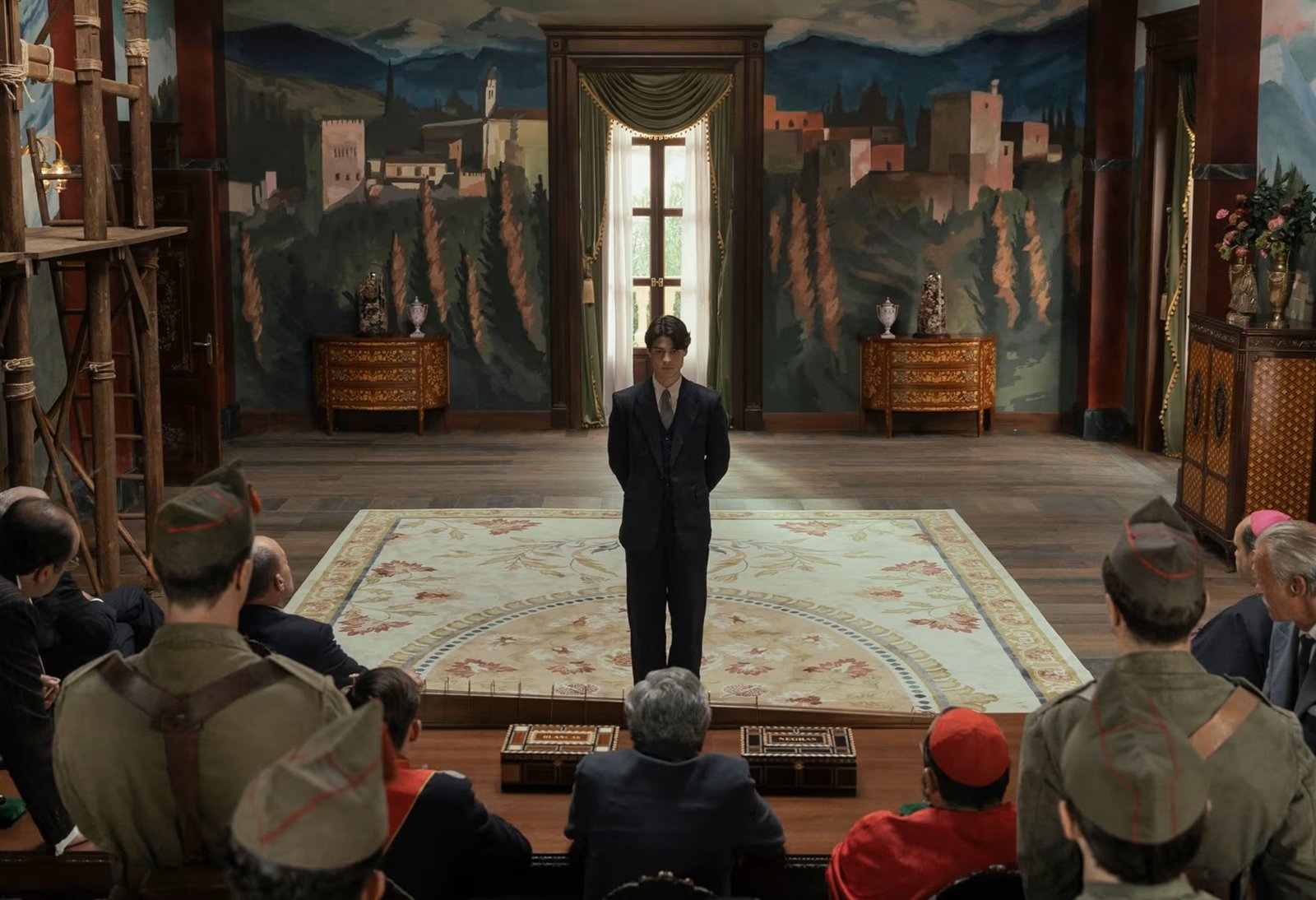
Milo Quifes in The Black Ball
In their first competition outing at Cannes, directorial duo Javier Ambrossi and Javier Calvo – collectively known as Los Javis – deliver a sprawling, emotionally ambitious work that attempts to bridge personal identity, historical trauma and inherited silence across nearly a century of Spanish history. Adapted from Federico García Lorca’s unfinished text of the same name and drawing inspiration from Alberto Conejero’s play La piedra oscura, The Black Ball ultimately proves rewarding and often moving, even if it occasionally struggles under the weight of its own scale.

Set across three timelines – Republican Spain in 1932, the Civil War in 1937 and contemporary Spain in 2017 – the film follows a constellation of interconnected lives whose emotional and political echoes gradually reveal themselves. Rather than relying on straightforward chronology, Los Javis embrace fragmentation and delayed revelation, constructing a narrative puzzle that steadily gains emotional force until a late twist recontextualises much of what preceded it.
The screenplay’s most notable achievement lies precisely in how elegantly these temporal jumps are handled. Editing becomes one of the film’s strongest assets: transitions between eras are consistently clear, fluid and inventive, allowing the audience to navigate shifting emotional registers without losing momentum. What could have become an overcomplicated exercise instead unfolds with surprising ease.
Visually, The Black Ball embraces a luminous palette. Bright colours dominate both the contemporary and the period segments, and the directors resist the temptation to render historical suffering exclusively through muted tones. Only one brief section adopts black-and-white cinematography, standing apart as a visual interruption that underlines memory and absence, rather than nostalgia.
Raül Refree’s score initially feels close to overwhelming, pushing emotional cues with unusual insistence. Yet as the film unfolds, the music reveals itself to be more carefully calibrated than first impressions suggest, becoming increasingly attuned to the atmosphere of individual scenes and helping guide the gradual movement from melodrama towards something more poetic and contemplative.
Performance-wise, the ensemble is uniformly strong. Guitarricadelafuente gives Sebastián (a soldier in the 1937 timeline) a compelling combination of restraint and vulnerability, portraying a man divided between duty and the painful discovery of his own identity. Carlos González’s Alberto (a scholar in the 2017 timeline) becomes the emotional anchor of the contemporary strand: determined, controlled and quietly courageous as he uncovers uncomfortable truths about his family while navigating an increasingly difficult relationship with his mother, played with characteristic complexity by Lola Dueñas. Meanwhile, Miguel Bernardeau’s Rafael (Sebastián’s prisoner) injects the film with tenderness and conviction, embodying someone who continues to believe in love despite everything history places in his path. Finally, Milo Quifes‘s Carlos (the lead of the 1932 timeline) is imbued with the right dose of fear and sensitivity.
While Penélope Cruz doesn’t leave a memorable impression in her limited screen time, Glenn Close arguably steals her scenes as a professor of Spanish Literature, bringing sparks of warmth and understated wit.
If there is a recurring issue, it is duration. At 157 minutes, The Black Ball occasionally overstays its welcome. Certain sequences feel more illustrative than dramatically necessary and could have been tightened without sacrificing thematic depth. The lack of polish is visible not in the film’s ideas, but in its willingness to linger.
Yet this work’s emotional and political resonance remains difficult to dismiss. Without becoming didactic, Los Javis suggest that rights and freedoms cannot be treated as permanently secured, and that countless stories of love risk remaining buried, rather than being allowed to flourish. In an era marked by the visible rise of reactionary politics across Europe, The Black Ball finds contemporary relevance without forcing parallels.
The Black Ball is a Spanish-French co-production staged by Movistar Plus+, Suma Content, El Deseo, Le Pacte and Atresmedia Cine y Televisión. Goodfellas is in charge of its world sales.
Photogallery 21/05/2026: Cannes 2026 – The Black Ball
19 pictures available. Swipe left or right to see them all.
