
It’s been nine years since Andrei Zvyagintsev‘s last film, Loveless. In that time, he’s been sorely missed from the cinemasphere, with both Loveless and his 2014 feature Leviathan being two of the finest films of the 21st century. Both are monuments to a very specific kind of Russian unhappiness, the domestic and the political knotted tightly together. His work aligns neatly with the first line of legendary Russian auteur Leo Tolstoy’s Anna Karenina. “Happy families are all alike; every unhappy family is unhappy in its own way.” A long wait, then, and one spent wondering whether Zvyagintsev, who survived catastrophic Covid complications that left him with 90% lung damage, would ever make it back to a festival screen. Finally, at Cannes, the answer has arrived. Minotaur is tremendous.
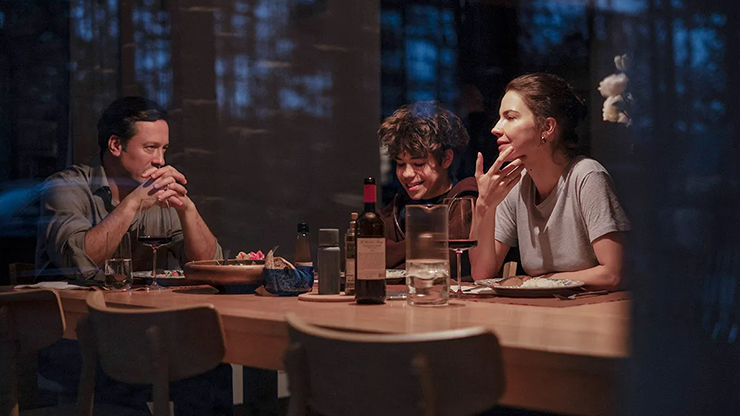
The family in Minotaur is just as unhappy as any of Tolstoy’s morose dynasties. The title is an obvious nod to Greek myth, the legendary monster with the head and tail of a bull and the body of a man. Imprisoned in a labyrinth, the beast is fed a periodic tribute of young Athenians until the hero Theseus navigates the maze to slay him. A metaphorical Minotaur, the male lead Gleb (Dmitriy Mazurov) is a high-powered businessman residing in a lavish home with his wife, Galina (Iris Lebedeva) and teenage son Seryozha (Boris Kudrin). Nobody mentions the war directly, but any mention is unnecessary. It’s ever-present in the character’s day-to-day lives, an undercurrent trickling through the fabric of the film.
The central mechanism clicks in when Gleb and his fellow local business heads are summoned by the mayor and told that Moscow requires more men for the front. Gleb arrives at a solution: advertise for fourteen truck drivers, offer them double the going rate, get them on the official payroll, and let the draft take them before he ever has to pay. Evidently, it’s a mirror for the mythological Minotaur’s fourteen sacrifices, though we can’t help feel that Gleb sees this less as a sacrifice and more as bureaucratic paperwork, essential to get over and done with.
This act is repellent enough, but then Gleb discovers his wife may be having an affair, and the film’s second hour begins. It’s here that Minotaur reveals what it’s truly made of. In true Zvyagintsev fashion, the first hour is a meticulous, architectural setup. The second hour grips you by the throat. At Cannes, the audience was laughing and gasping in roughly equal measure as Gleb’s subsequent deeds take hold in an extended centrepiece of almost unbearable tension. For Gleb, committing atrocious acts is nothing new; it’s simply the most straightforward path available to him.
In an earlier scene, Seryozha confesses he’s being bullied at school, and Gleb’s response is to grab him by the lapels and demonstrate how to threaten his classmates viciously enough to make the threat land. “You need to make him scared.” It’s a sinister mimicry of ten-a-penny father-and-son scenes, but in this case, the father is transmitting toxicity down the line. It’s a type of toxic masculinity which exists in every culture, writ large in the context of the Russo-Ukrainian war. It suggests we’ve created a generation of men who only know conflict as the solution to any given problem, which they’ll transfer to future generations without a second thought. Not only that, we’ve bestowed them with immense power and influence to boot. Throughout the film, we await a metaphorical Theseus to come along and save the day, but suspect that nothing is capable of slaying Gleb. Society has rendered him untouchable, and he doesn’t so much as relish it as take it as an accepted fact.
Mazurov and Lebedeva are both outstanding, and Zvyagintsev‘s direction is as precise and merciless as ever. Like Leviathan and Loveless before it, Minotaur is not a film that wants to send you out into the evening feeling restored. It’s another gem from a director working at the height of his powers, even if, as with so many of his films, there is little remotely uplifting here. It portrays a society of cloudy grey bleakness, hope all but eradicated. You’ll likely leave convinced that the world is a slightly more sinister place than it was two hours ago, but with Zvyagintsev, that’s the point. It’s profoundly thought-provoking.
★★★★★
UK release TBC / Dmitriy Mazurov, Iris Lebedeva, Boris Kudrin, Varvara Shmykova / Dir: Andrei Zvyagintsev / MK Productions, CG Cinéma, Razor Film Produktion, Forma Pro Films, Arte France Cinéma, LEAF Entertainment
Discover more from
Subscribe to get the latest posts sent to your email.
