
– The final day of the Global Summit on Gender Equality in Cinema showed how, after almost ten years of #MeToo, the sexual violence and inequalities faced by women are still a structural problem
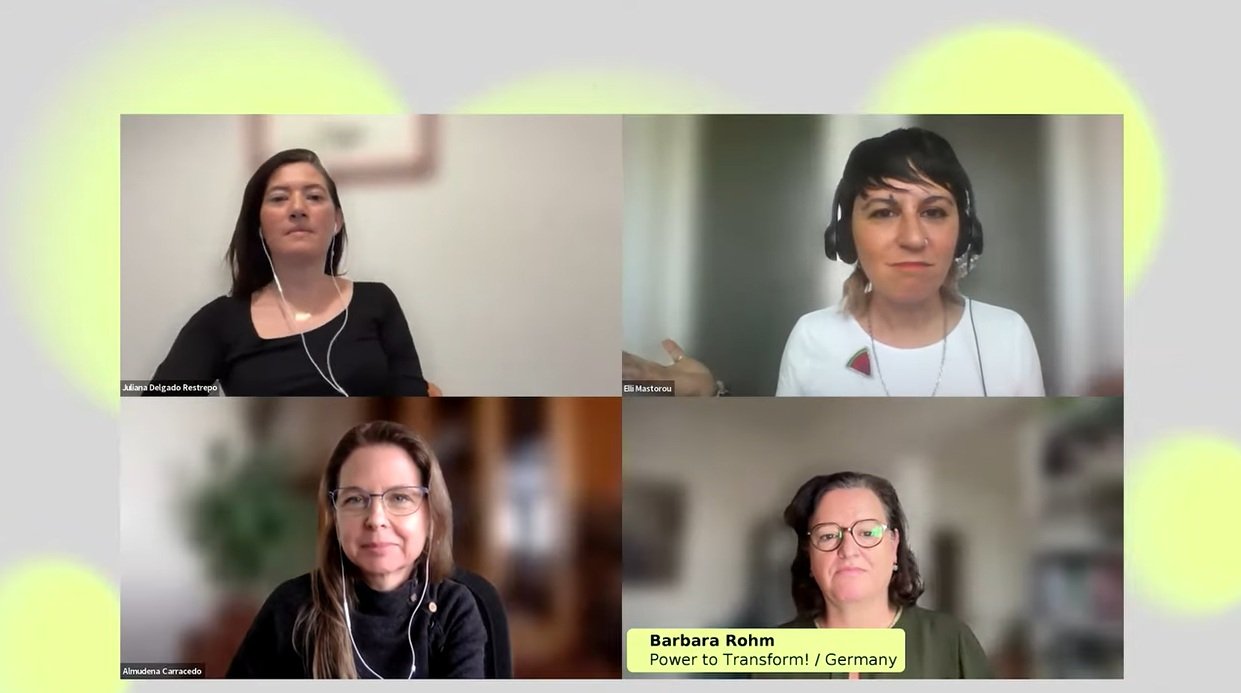
Clockwise from top left: Juliana Delgado, Elli Mastorou, Barbara Rohm and Almudena Carracedo during the online summit
The figures that were revealed at the third online round-table during the Global Summit on Gender Equality in Cinema, moderated by Elli Mastorou (Elles Font des Films, Belgium), were hard to digest. They came from three very different countries (Germany, Spain and Colombia) but led to the same conclusion: violence and abuse are structural problems in the film industry. The participants in the event were Barbara Rohm (Power to Transform!, Germany), Juliana Delgado (RecSisters, Colombia) and Almudena Carracedo (coordinator of the CIMA report “After the Silence: Impact of Abuse and Sexual Violence Against Women in the Film and Audiovisual Industry”).
In Spain, 60.3% of women working in the audiovisual industry have experienced sexual violence. In Colombia, a 2019 survey by the RecSisters collective found that every one of the 147 women surveyed had suffered some form of sexual violence in the workplace. Verbal harassment, physical assault and digital abuse are present across sets, festivals, academic institutions, and indeed every space where the industry operates. Carracedo highlighted some other figures: 92% of women who experienced abuse and violence did not report it, because there is no trust inherent in the system.
Carracedo stated: “Sexual violence in the film industry is normalised and absorbed as an occupational hazard. Women professionals don armour before entering a set or a meeting room. When women do speak out, it is they, not the perpetrators, who lose work, credibility and their place in the industry. The report puts this plainly: there is a system of impunity, made possible by precarious labour, interpersonal dependency and the constant pressure not to ‘endanger’ the production.” The silence is not individual, but collective. And breaking it requires structural change, more than isolated acts of courage.
Participants shared initiatives from their respective countries aimed at making the industry safer. In Spain, there is the Equality Observatory and the Ministry of Culture’s Protocol Against Sexual Violence in the Cultural Sector. Colombia boasts the journalistic project “Yo te creo, colega” (lit. “I believe you, colleague”), which has documented 260 cases of abuse since the early 2000s. Germany’s most significant response to date is Themis, an independent, confidential support centre for film, theatre and music professionals, co-founded by Barbara Rohm in 2018. Its founding logic was simple: internal complaints offices already existed at every major broadcaster and production company, but the culture of silence meant that no one used them. Independence was the only way to build trust. Themis offers free legal and psychological counselling, allows full anonymity and can file formal complaints directly with employers. But Rohm’s most compelling insight came from a pattern regarding who was actually reaching out: a significant share of people making contact are not survivors, but witnesses – people who saw something happen and had no idea what to do.
The seminar closed with a master class given by Cheryl Dunye, the iconic, queer, African American director of The Watermelon Woman (1996). She shared why she needed to make such a film: it all began with an absence. When you are invisible, what do you need in order to prove that you exist? She called on the participants to make a movie that doesn’t exist yet, so that others will have a reference. The Watermelon Woman came about precisely because of this omission: the intention was to fill history’s gaps with the identities it forgot to include. “I made it because I needed a cinematic language that would show what the archive was hiding. I made it because I had to, and when you shoot a film that doesn’t exist, you have nothing to lose. You can only gain from it.”
Following this two-day event, participants left with a shared conviction: the fight is long, and it’s often frustrating – and that’s exactly why it is more necessary than ever. Standing together across borders, continents and industries is paramount because this is not just about cinema or creativity, but about cultural democracy. As long as women are underrepresented, we will miss out on an entire world of imagination.
