
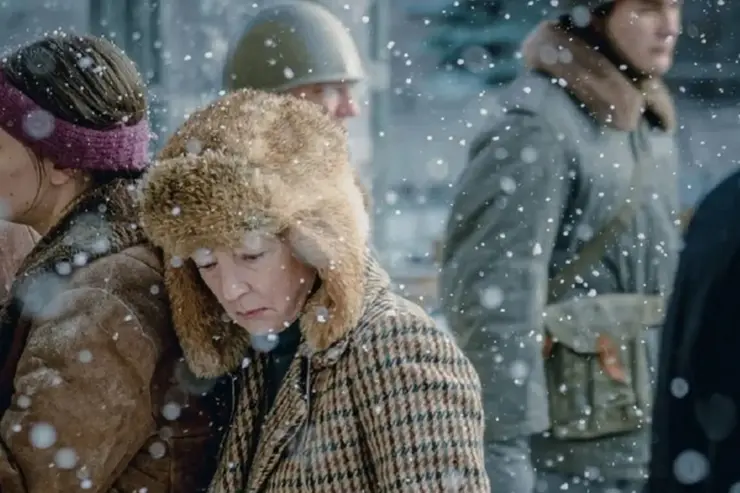
Based on a short story by Olga Tokarczuk called “Professor Andrews Goes to Warsaw,” Winter of the Crow is set in 1981 Warsaw, where Doctor Joan Andrews (Lesley Manville), an established professor of psychology, is travelling from England to present her groundbreaking ideas on schizophrenia at the local university. But when her talk is disrupted, she gets a glimpse of the political unrest and protests that are taking place in the country. When the country enters martial law while she is visiting, Andrews finds herself stuck in a foreign city with people who do not speak or understand her language, while the secret police is actively after her.
The film is a well-made thriller packed with tension as we follow the main character in a foreign land where she doesn’t know or understand the threat after her, due to the language and cultural barriers. Telling the story entirely from her point of view is a very successful choice because it adds an element of the unknown to events. While at times predictable and unoriginal, especially with the repetitive cuts to black, the editing really helps create the tense pacing of the movie that will have audiences on the edge of their seats from the opening of the movie.
The film establishes the atmosphere of 1980s Poland very well, potentially due to the fact that the director herself has a personal connection with this story, thanks to her own memories of living in Poland during the Cold War. This is thanks to its beautiful cinematography and its masterful use of colours, which excellently portray the grey, snow-filled, cold, and unfamiliar climate of the Polish capital under the Cold War. The camera often films the protagonist alone in a foreign country where she doesn’t understand the language, with medium close-up shots framed by a furry hat and, oftentimes, by an icy and snow-filled landscape.
This one raises a lot of questions about empathy, individuality, and the power of singular action under a totalitarian regime, especially and vitally, for those of us in the audience who may have never experienced the latter, but it doesn’t answer any of them. While leaving the audience to ponder and find its own answers is a strong point of the movie, I wish the film had told us a little bit more about the faith of the characters the viewers have spent the entire film with. This is especially evident because all the main characters are very compelling and fascinating to watch. With their own ideologies, negative sides and at times flawed logic, they are wonderfully human and even relatable at times in the way they face adversities and find the courage to keep going.
Overall, Winter of the Crow is a film that will have audiences holding their breath as the story unfolds and we learn more about the danger that the professor and the other characters she meets in Warsaw are under after the martial law is enforced by the secret police. The film also opens a window into a very relevant moment in 1980s Poland that many people in the audience may not have been familiar with by telling a story that is both personal to the character development of the protagonist and universal to the history of the country at large.
★★★★
In cinemas soon / Lesley Manville, Tom Burke, Rhianne Barreto, Andrzej Konopka, Sascha Ley, Miron Jagniewski / Dir: Kasia Adamik / Hanway Films
Discover more from
Subscribe to get the latest posts sent to your email.
