
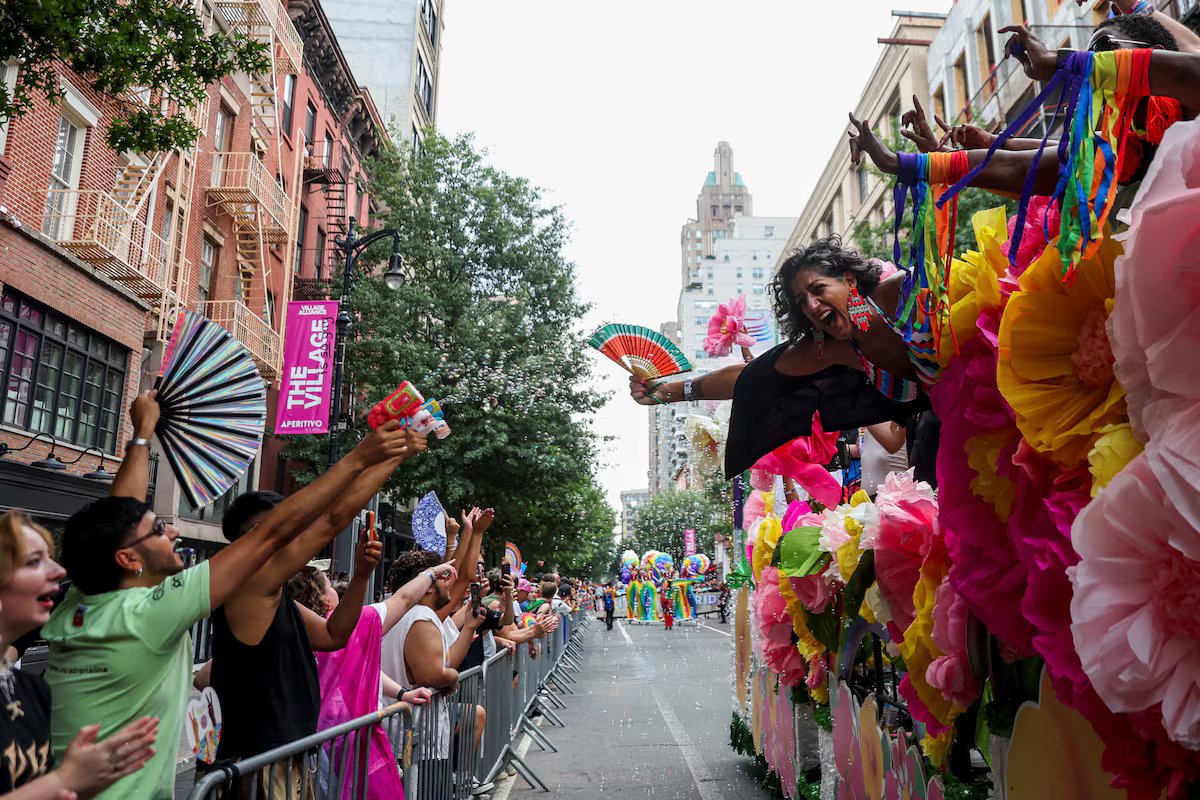
Hundreds of thousands of people took to the streets of New York this Sunday to celebrate diversity and equality for all citizens, regardless of their sexual orientation or gender identity. The city’s parade, one of the largest in the world, comes at a time when LGBTQ+ people — especially trans people — are seeing hard-won gains reversed.
Anne arrived in New York more than 30 years ago with the woman who is now her wife to live more freely as a lesbian. She speaks of a paradoxical situation in which, in cities like New York, the LGBTQ+ community lives with great ease, surrounded by allies, while in the rest of the country, the situation is becoming increasingly hostile. “What Trump is doing is terrible — he wants to use our community to polarize society,” she says.
Joaquin Mostany, a 48-year-old from Palencia who works in New York at JP Morgan and married an American seven years ago, acknowledges that these are not good times for the community, but believes that is precisely why people must demonstrate and be visible. “At my company in New York and in my usual environment, you don’t notice the rollbacks. But just leave the city and you can see how more conservative people in this country feel empowered,” he says, after getting down from his company’s float at the end of the parade in the West Village.
Venezuelan Wendel Oviedo leads the band Sonidos de Orgullo, part of the NGO América Diversa, which seeks to support the Latino LGBTQ+ community arriving in New York. He believes participation is especially important this year and pays tribute to his fellow Venezuelans who are suffering the consequences of Wednesday’s two earthquakes.
For the first time in a long while, polls show that respect for gay people and especially for transgender individuals is declining. A recent Gallup poll found that the percentage of Americans who believe same-sex marriage should be legal has fallen to 65%, down from a high of 71% in 2023. Fewer people also say that same-sex relationships are acceptable: 62%, the lowest level in a decade, according to the Annual Survey of Values and Beliefs. This reversal is largely driven by one segment of the population: Republican voters — particularly male Republican voters.
Republicans have made opposition to anything related to transgender issues one of their major cultural battles, with Trump declaring on his first day in the White House that only two sexes exist, determined by biology.
Some conservative politicians are even toying with the idea of overturning same-sex marriage, which was established by the Supreme Court 11 years ago. If such a step were taken — one with unpredictable consequences — it would follow the model of abortion rights, which ceased to be federally protected across the United States after a 2022 ruling by the Court, now in the hands of a conservative supermajority.
In the face of these setbacks, Pride demonstrators responded this Sunday with dancing and joy, but also by showing their determination not to take a single step back.
The parade commemorates the 1969 riots at the Stonewall Inn, widely seen as the beginning of the modern LGBTQ+ rights movement. The march began at noon at 26th Street and Fifth Avenue and made its way through Greenwich Village, ending at the iconic Stonewall Inn bar. Earlier this year, the location was also the site of another push by the Trump administration, which sought to remove the rainbow flag on the grounds that it was not an official emblem. After protests and outrage from local groups and politicians, Republicans backed down, and the flag remains hanging there.
Among those leading the parade were comedian Bowen Yang, who worked on Saturday Night Live and hosts the podcast Las Culturistas; actress and model Dominique Jackson, known for her role in the series Pose; and Peppermint, the first transgender contestant on RuPaul’s Drag Race.
Mamdani backs transgender community
The celebration in the streets coincided with Mayor Zohran Mamdani’s message of support for the transgender community. New York City Hall announced on Friday that it will invest $15 million to improve care for young people undergoing gender-affirming treatments, at a time when some of the city’s major hospitals have stopped offering these services to minors.
The funds will be used to support a dedicated pool for such services in hospitals, to create a telephone and online support line for trans youth, and to back scientific research into barriers to healthcare access for transgender people.
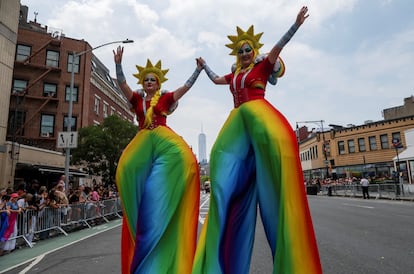
“Every New Yorker should have the freedom to live as themselves and access the health care they need,” Mamdani said in a statement. “As the federal government attacks transgender people and attempts to intimidate patients, families and providers, New York City is stepping up.”
Two of the city’s major hospitals, NYU Langone and Mount Sinai, decided this year to suspend services such as puberty blockers and hormone therapies for minors after the Trump administration pushed measures to withdraw federal funding from institutions that provide these services to people under 18.
Sign up for our weekly newsletter to get more English-language news coverage from EL PAÍS USA Edition
