
Tucked in the mountains of Malinalco, just past the Morelos border, is a gastronomic experience unlike anything I’ve experienced.
There’s no signpost on the road. The gate’s wooden, hand-hewn and weathered by the sun. Beyond it, up a dirt track, lies a vegetable garden, featuring what could be Mexico’s best produce. Past that, a traditional smoke kitchen built into nature hosts chefs from around the world.
Among them, Rancho Tehuan has become an unmissable underground culinary destination. It exists between tensions: conservation and renewal, rewilding and cultivation, ancient Mexican techniques and modern Michelin chefs.
For owner Pierre Koboloff, that’s all by design
“Tehuan is a bridge between worlds,” he tells me on a walk with no cell service. I get his point; across the Morelos field, I hear a chef — flown in from India — lighting the wood-burning fogón he’ll soon be cooking on.
First, a crisis
It’s an unlikely outcome for a rancho that’s hidden, seemingly, on purpose.
Thirteen years ago, Koboloff — a French entrepreneur — ran out of steam in Mexico City. “I entered into a personal crisis,” he says as he explains the plants we walk among. Fed up with chasing status, recognition and money, “I felt an uncontrolled attraction to nature.”

It led him to a beat-down 40-hectare tract a two-and-a-half hour drive away.
“I needed to reinvent myself,” he pauses, looking out at the mountains around us. “And I literally fell in love with this land.” Never mind that Rancho Tehuan, at the time, was “completely destroyed” by a herd of 80 cattle and previous owners who had sold off the best wood, rocks and resources.
Without experience, “but with a clear and loving intention,” Koboloff began to rehabilitate the land. Painstakingly, he planted 14,000 endemic trees along with native flora, and built a house from reclaimed stones. Then he stopped.
“After three years, I realized: Let nature be itself.”
Today, nearly half of Rancho Tehuan is a natural reserve. Rare plants and wildcats returned after decades away. Letting nature be itself, Koboloff says, “Healed this land as well as myself.”
Only then could it begin to grow.
An obsession with seeds
When Koboloff arrived, he spent about a year doing nothing but watching the weather, the rains and what he refers to as the terroir of the land. He then picked a plot for a vegetable garden and plowed it with bulls — “to respect the soil,” which is volcanic — before preparing to plant.

What followed was an obsession with seeds. “The seed has everything in it,” Koboloff says, handing me a fresh-off-the-vine cherry tomato. He compares the work of finding the right ones to starting a family. “Most people don’t realize it’s the exact same for vegetables.”
He chased the purest, untouched varieties around the world and eventually found them in the south of France. “Nothing to do with the fact that I’m French,” he smiles. “Life took me there to find these seeds.”
A decade later, 75% of what’s planted at Rancho Tehuan is saved from seeds grown on the property itself; what Koboloff calls “highly resistant, highly resilient and with exceptional levels of durability, texture and flavor.”
The result is vegetables sourced by Mexico City’s top restaurants — he’s been working with Rosetta, Meroma and Choza, among others — and Rancho Tehuan’s traditional smoke kitchen.
Pure fire
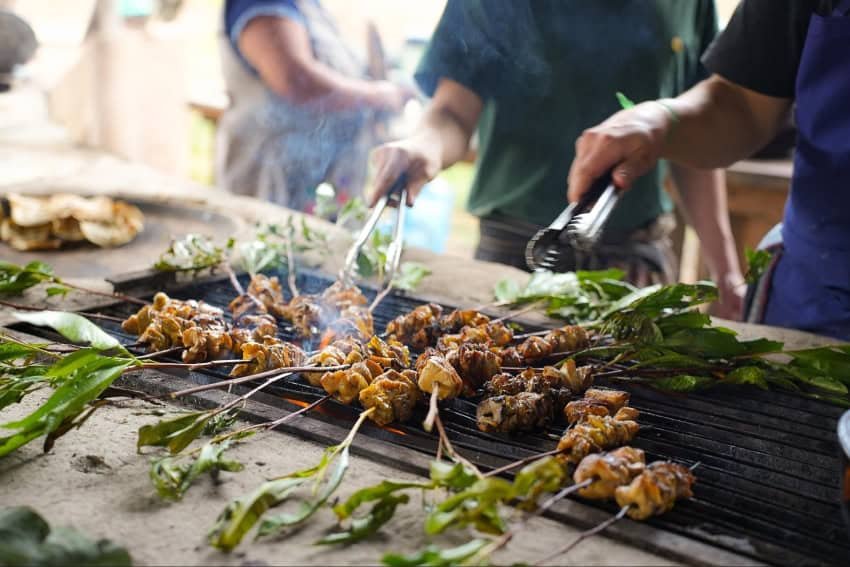
The smoke kitchen runs on pure fire. Everything is cooked in clay, served family-style on clay plates, with wooden utensils.
Built five years ago, from materials sourced entirely on the property, the smoke kitchen is modeled on the traditional kitchens of Oaxaca and Chiapas. Koboloff calls it “the ancestral kitchen of the future,” originally meant for friends and family.
It has become something else.
In the last five years, Rancho Tehuan has hosted more than 120 lunches with renowned chefs from across Mexico and around the world. Whether Contramar’s Mariana Villegas or Luxembourg’s Charly Biwer, almost every chef he hosts, Koboloff says, tells him it’s a singular experience in their life (“True!” Delhi’s Anshul Pundir yells from the kitchen).
The challenge — and the appeal — is the fire itself.
There’s no thermostat or timer; the flame moves with the wood, weather and wind. Returning to the kitchen, I find Biwer waiting for the fogón to cool; the comal was in flames just moments before. “Cooking on fire is a more patient way of doing things,” he says with a smile.
That’s just the first challenge.
Chefs decide the menu on a walk in the garden that morning. As Biwer puts it, farm-to-table is a playground that forces creativity, as well as an entirely different kind of cooking from the fast-paced kitchens he grew up in.
Supplemented by “talented neighbors” with beef, pork, chicken and trout, along with corn from the milpas of Palpan, just down the road, every plate the comal puts out is a spontaneous collaboration combining numerous elements: the garden, the neighbors, the milpas, the cocineras, the chef and the fire.
Building a culinary bridge
At 60, he’s thinking about legacy. In the last year, he’s begun inviting what he calls “conscient people” — those who’ve fallen in love with Tehuan — to become permanent custodians of the land. Houses are planned, again from the ranch’s own materials. The three cabañas will scale to seven or eight. The smoke kitchen will host workshops on the ancestral cooking techniques of southern Mexico, taught by the cooks who carry those traditions.
When he speaks about how the past 11 years have changed him, the language gets simpler. “I became a better person, thanks to nature,” he says. “Better. More conscious. More careful.”
The philosophy he keeps returning to — “live in nature, not with nature” — isn’t a slogan. It’s a small correction that offers a worldview earned by a decade of paying attention.
The proof is Rancho Tehuan itself. A mountainside that had been mined for its stones, now a sanctuary where rare plants have returned. A kitchen built from what was nearby, drawing chefs from continents away. A man who left the city, and a city that now comes to eat at his table.
Tehuan means together
For Koboloff, that spontaneous spirit is in the name: Tehuan, in Nahuatl, means “together.”
Which is something you feel at the table, the guesthouses if you stay overnight, the rancho itself. At the lunch I attend, we’re all part of the chef’s discoveries; the bridge that Koboloff described earlier. Between ancient technique and modern chef, this mountain and the world is built, plate by plate, at his table.
As dusk falls, I ask Biwer what he’s taking from his time here. His answer, which comes immediately, isn’t about food. “Pierre shows me that there are so many different lifestyles, that doing something meaningful really matters in life.”
I’m reflecting on it all as I walk back to the unmarked gate.
The night’s alive with the chirping of crickets and croaking of frogs, and I’m trying to memorize what I’m leaving. The smell of fire, the quiet and the tomatoes I popped like candy — it’s already a memory by the time I’m back home.
Yet, weeks later, in the city, I realize that the taste of my time there remains. How Rancho Tehuan is the rare kind of place that shows you what living differently can look like, and how one man can change his life to build a bridge between worlds.
How a bridge like that doesn’t just end at an unmarked gate in Morelos but follows you home, if you let it.
Logan J. Gardner formerly worked for Netflix Original Film in Content Strategy and Analysis. Today, he is a Mexico City-based content strategist, writer, photographer and filmmaker. Sign up to receive his newsletter, Half-Baked, peruse his blog or follow him on Instagram for more.
