
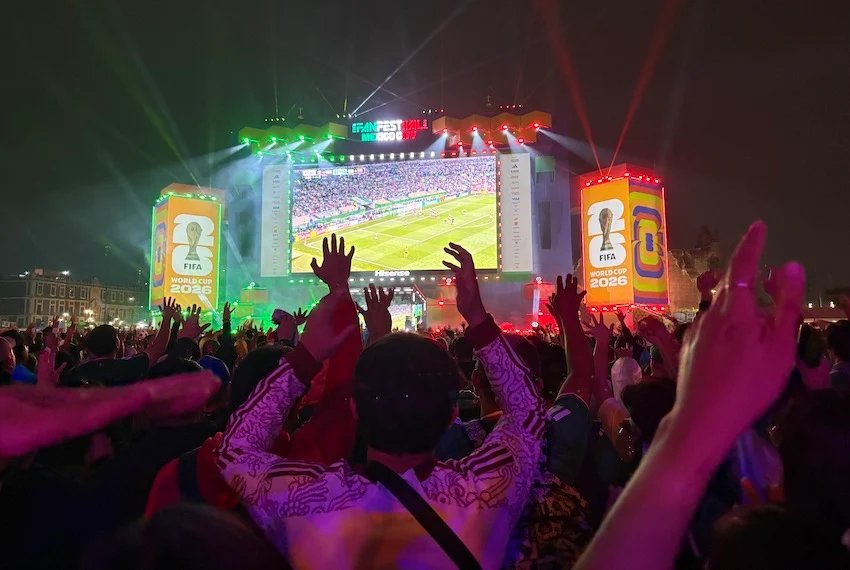
I had already been standing in the Zócalo for four hours on Tuesday. It was pouring rain, lightning was striking nearby and I was running on less than five hours of sleep without a drop of caffeine.
Hundreds of thousands of rowdy Mexico fans surrounded me as we waited for El Tri’s Round of 32 bout against Ecuador to begin. Unfortunately, the storm caused the game to be delayed another hour, much to the dismay of the attendees at the FIFA Fan Festival.
At this point I was almost ready to leave. The day had started at 6:15 in the morning when I woke up to catch a 7:30 bus from San Miguel de Allende to Mexico City. After spending the early afternoon exploring Colonia Centro, we arrived at the Zócalo nearly four hours before the game was set to begin, just to make sure we would have a spot.
I had only been in Mexico for 10 days. I arrived in San Miguel de Allende in late June to start a nine-week journalism internship with Mexico News Daily. Now here I was in a city of 23 million people, surrounded by hundreds of thousands watching Mexico on the world stage. It was almost unimaginable at first, but when I stepped out onto the streets I was greeted by towering buildings and street vendors. I saw beautiful architecture and monuments. Tourists and locals were intermingling, shopping and eating. It could have been New York or London or Tokyo. But it was Mexico City.
Still, I had some help. My coworker María Ruiz Hernández and her friend — who were both born and raised in Mexico — decided to make the trip with me. They are not soccer fans, and had not watched a single game since the 2022 World Cup, but here they were, partying with their compatriots about the beautiful game.
After hours in the Zócalo, our water supply was running low. A trip to the bathroom could have caused us to lose our spot, and the rain was still pouring down. Every muscle in my body was telling me to go back to the Airbnb and get some much-needed rest.
But I am glad I didn’t leave.
The eruption from the crowd as soon as Estadio Azteca appeared on the giant screen in front of the National Palace was unlike anything I had heard before. These people, soaking wet and surprisingly sober, had been waiting on their feet the whole afternoon. But the second Mexico’s fans saw their team take the field, the energy felt like another world.
El grito de gol se hizo presente en el corazón de la CDMX.
Así se vivió este momento en el #FIFAFanFestival. ⚽️🎉#Somos26 #SomosMexicoCity pic.twitter.com/X1gtn1kmC4
— FIFA World Cup 26™️ Mexico City (@MexicoCity26) July 1, 2026
I am no stranger to large and rowdy crowds for sporting events. I attended the Chicago Cubs World Series parade and rally when I was 11 in 2016, which ended a 108-year championship drought and saw around five million people descend on downtown Chicago. It was one of the biggest gatherings of human beings in history, and the second-largest in the history of the Western Hemisphere, second only to Argentina’s celebrations after winning the 2022 FIFA World Cup.
And still, the energy in Mexico City felt different.
Despite the crowds, the passion, the energy and the rowdiness, it never felt unsafe. I made sure to keep a close watch on my phone and other belongings, but I was surrounded by people young and old. Infants played with their mothers while the elderly danced with teenagers. There was no need to feel unsafe and no one had a malicious intent; they were just there to cheer on their national team.
Mexico’s national anthem was deafening and the countdown to kickoff was filled with suspense. It was nothing like a sporting event in the United States, where the national anthem is only murmured, chants are few and far between and sports bring people together by city or university instead of country. The cheering started early and never wavered.
Pandemonium erupted in the 22nd minute when Julián Quiñones launched a rocket past the Ecuadorian goalkeeper. Foam was sprayed, tears were shed and thousands upon thousands of people began to realize their team could win a knockout stage game for the first time in 40 years.
The energy did not let up for 90 minutes. Every corner kick, every shot, every clearance and almost every pass were met with cheers, chants and screams.
And finally, after an extended stoppage time, the final whistle blew, and the crowd broke into song. We made our way out of the square and back towards the Alameda. Every block from Avenida Juárez down to The Angel of Independence was packed with green-clad fans as far as the eye could see.
1 million celebrants crowd downtown Mexico City after a historic World Cup win
People of all ages poured into the streets. Fans were thrust into the air. There was music and dancing. Fireworks and smoke. Packed taco and churro stands. But still, I felt safe. These were not people set on destroying; they were set on celebrating. They were celebrating national unity, a knockout stage win and pride in their culture. There was no judgement; everyone was there to party.
Tragically, four people died in the ensuing celebrations, but that was merely a sliver of the entire scene.
Over one million people gathered on Reforma Avenue to celebrate. Not a championship or even a big upset, but a round of 32 game where Mexico was the favorite. Super Bowl celebrations in the States have the joy and the fireworks, but they don’t have the same passion. In Mexico, it truly is different.
Last week, I set out on a mission to discover why more people don’t travel to Mexico, why it is overlooked and what it is truly like on the ground. Soccer will probably never be a big selling point to Americans, and massive crowds might attract even fewer tourists. But there is still nothing like the passion, the dedication and the commitment to Mexican soccer that exists on the streets of Mexico City.
Still, I saw almost no foreigners joining the party at the Zócalo or out on the streets. Maybe the required early arrival or risk of petty theft scared people off. Maybe the sheer number of Mexican fans just hid the foreigners in the crowd. Either way, I couldn’t help but think the rest of the world was missing out on the biggest party on the globe.
I’m glad I saw it. I’m glad I stayed. I’m glad I experienced the joy that soccer can bring, especially in Mexico. It might not be for everyone, but it is certainly worth a visit.
Jared Tucker is a summer intern at Mexico News Daily in San Miguel de Allende and a rising senior at the University of Washington in Seattle, where he is the sports editor for The Daily UW. He was previously a fellow at TheFulcrum.us, where he covered public participation in American democracy.
