
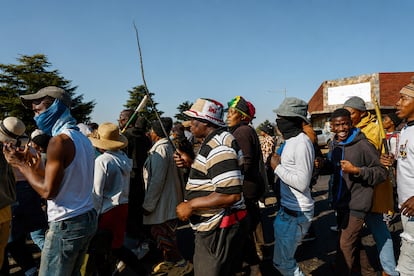
The chants are perceived as a distant murmur. They filter through the low-rise houses of Katlehong, a working-class neighborhood in eastern Johannesburg, South Africa. Gradually, a hundred or so people come into view, waving wooden sticks in the air. Brandishing South African flags, they dance and chant slogans in Zulu against illegal immigration.
A man with a megaphone rallies the crowd. Before they reach her, a young woman — with her hair gathered in a cascade of fine braids — hurriedly closes the door of her house, a humble, single-story structure protected by metal bars.
On the first Thursday of protests by South Africa’s anti-immigration groups, the demonstrators are scouring the neighborhood for undocumented immigrants. They’ve vowed to take to the streets every week to pressure President Cyril Ramaphosa’s administration to expel all undocumented immigrants from the country. This comes after months of marches, threats and attacks against foreigners. Similar demonstrations are taking place in neighborhoods and cities across the country, with Durban and Johannesburg as the main centers.
However, things are different compared to what happened on June 30, when thousands of people (according to estimates in the South African press) took to the streets. That was after their ultimatum — which these groups issued to the government — had expired. On Thursday, July 9, on the other hand, the day ended without major disturbances or large gatherings. Rather, the small, scattered demonstrations drew groups of around 50 to barely over 100 people.
The objective seems to have changed: it’s no longer simply about demonstrating, but rather about undertaking what have come to be known as “door-to-door” campaigns. That is, going house to house to find foreign citizens and urge them — sometimes politely, sometimes forcefully — to leave the country. And, unlike other episodes of racial tension in the country’s history, the protagonists of these protests are, for the most part, Black South African citizens who are targeting Black immigrants.
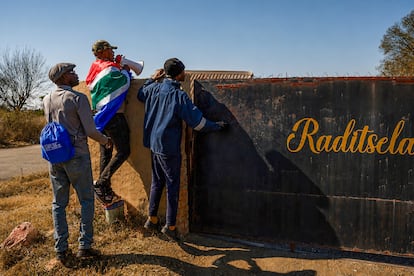
In the township of Katlehong, the march stops in front of a vacant lot surrounded by a concrete wall. Several old buses are barely visible. A neighbor warns: “Sothos from Lesotho live here!” Then, three men climb the low wall and peer over; others begin banging on the large metal gate with their sticks, while the rest chant slogans. No one responds from inside. After several tense minutes, the march continues. “There are definitely people inside,” a straggler protests, as the rest keep walking.
“The idea isn’t to hurt anyone,” insists Patrick Dube, a neighborhood representative, as he marches alongside the others. “We want them to go back to their country, get their papers in order and return legally.” Dube argues that the violence that occurred during other similar protests was due to people who “misinterpreted” the movement and took the law into their own hands.
However, there have been so many cases in which South African citizens have forced immigrants to show their papers — or have even evicted them from their homes under the pretext of their irregular status — that numerous public officials, including President Cyril Ramaphosa himself, have had to reiterate that, under South African law, immigration control duties are strictly to be carried out by the authorities.
Ramaphosa has acknowledged that there’s a problem with irregular immigration and has promised to tighten its enforcement. But, at the same time, he has condemned vigilantism and insisted that citizens cannot replace the state.
The main driving force behind the campaign is Jacinta Ngobese-Zuma. She’s the leader of a movement called March & March, which collaborates with other anti-immigration organizations. On social media, their message has spread like wildfire. They’re demanding that the government strengthen border controls, expedite the deportation of undocumented immigrants, and reserve access to employment and public services for South Africans. Ngobese-Zuma has managed to unite popular discontent over issues such as unemployment (exceeding 30%), corruption and high crime rates by blaming immigrants, even though they represent only 4% of the approximately 63 million people living in the country.
During a rally held on Thursday, July 9, in Durban, Ngobese-Zuma insisted that the demonstrations will continue every Thursday until the government takes action. “The government has been asleep on the job for too long. If we had a government that was responsive and listened to what the people want, then we wouldn’t have the problem of being on the streets today,” she says. The leader, moreover, rejects the notion that her movement is xenophobic.
While the marches continue to spread through different neighborhoods, the number of people choosing to leave South Africa is also increasing. The Malawian government reported this past Thursday that more than 38,000 of its citizens have returned from South Africa in recent weeks for safety reasons. Zimbabwean authorities, for their part, estimate that more than 60,000 people have returned since the start of the crisis.
Like in Katlehong, marches are taking place in other areas of Johannesburg, but these aren’t as peaceful. The tension has erupted into violence in Dunnottar, a town in the eastern part of the Johannesburg metropolitan area, home to a large community of Ethiopian, Somali, Pakistani and Bangladeshi immigrants, some of whom run small grocery stores selling imported goods
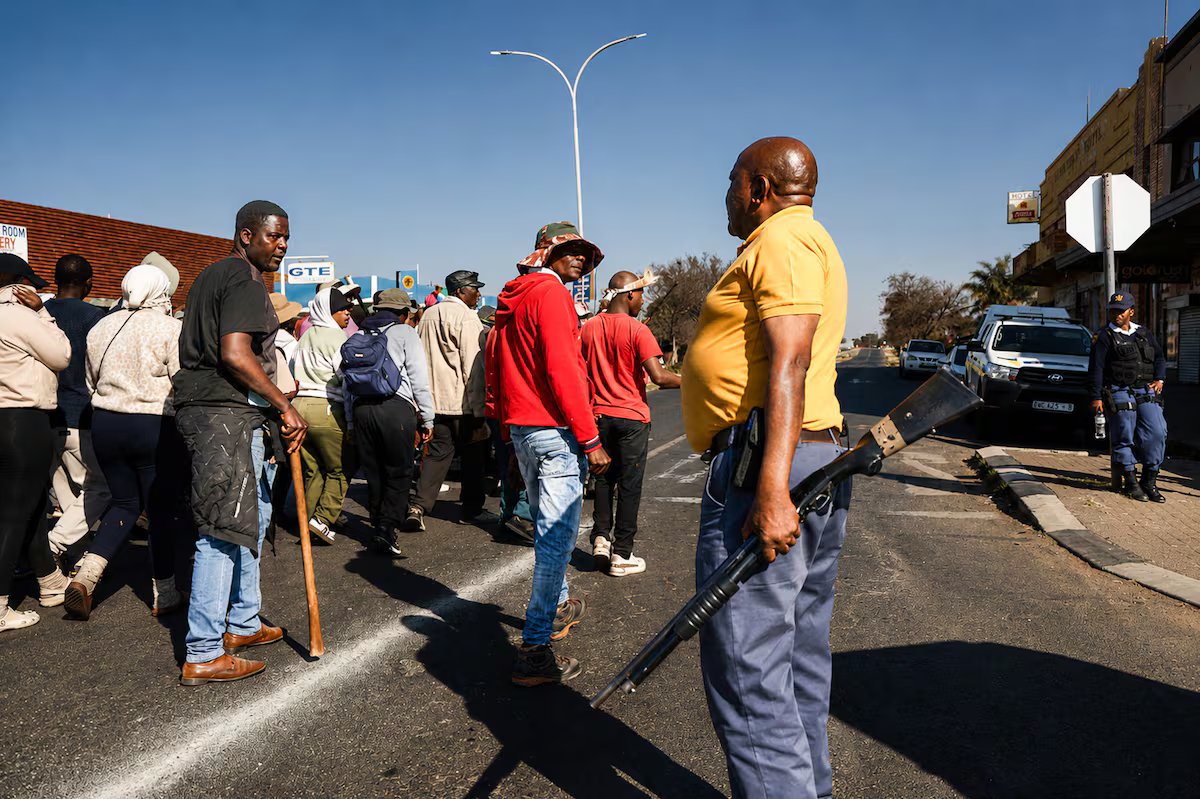
On July 9, the pavement of a central street was littered with broken glass after about 50 protesters attacked foreign-owned businesses with stones and bottles. The shopkeepers defended themselves, leading to a pitched battle that ended with police intervention. Among the migrants, three suffered minor injuries and went to the police station to file a report. This is according to Ali Hussein, a Bangladeshi who owns a neighborhood supermarket. He says he has lived in the country for almost 20 years: his wife and children are South African, while he himself holds a South African passport.
“They say we come to take their jobs, but we provide work for South Africans and offer a service to the community with our businesses,” he laments. A young South African man who was also present (and who preferred not to give his name) confirmed this: “I work for a foreigner and I think what’s happening is a disgrace.”
Meanwhile, the 50 or so enraged citizens eye the immigrants suspiciously from across the road, barely 70 feet away. Some are armed with sticks, broom handles and even leather whips. The police, positioned between the two groups, have deployed eight vehicles, a truck and a dozen officers. Still, the rioters are undeterred.
After a while, the group sets off again, shouting slogans in Zulu against the merchants, which Hussein understands. “They’re insulting our mothers,” he says. For a few minutes, it seems like the situation might spiral out of control again: the group advances toward the police cordon, continuing to chant slogans and dance. That is, until the head of the operation pulls out a shotgun from one of the vehicles, confronts several protesters and orders them to turn around. Finally, the march continues down the street.
Similar scenes unfolded this past Thursday in other parts of the country, such as in the townships of Soweto and Alexandra, where — according to Reuters — protesters dragged people from their homes, accused them of being undocumented and handed them over to the police.
Back in the township of Katlehong, many residents watched the march from behind their fences. Some filmed with their phones. Others applauded enthusiastically when the group stopped in front of another house where, they said, a foreigner lived. Behind the fence, a tiny barbershop made of corrugated metal sheets was also visible. “We neighbors know where the immigrants live; people warn us,” Dube explains.
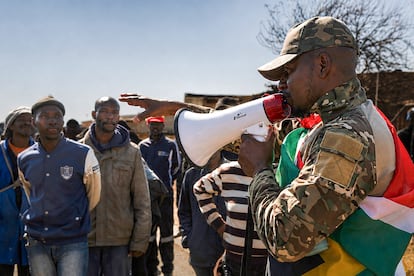
The ritual repeats itself. The man with the megaphone rallies the crowd. Several people bang on the fence with their sticks. No one comes out. Dube maintains that the problem isn’t just the immigrants, but also the companies that — according to him — hire them in order to get away with paying lower wages. “We’ll have to go and talk to them, too,” he says. “Maybe next Thursday, at the next demonstration.”
A few feet away, Dube and a neighbor knock on the door of another house. This time, a woman answers, claiming to be South African. They ask her to report any undocumented immigrants in the neighborhood if she knows of them. She nods silently and shuts the door.
“We just want the law to be enforced,” says Dube, at the end of the march. But in Dunnottar, Hussein points to the broken windows of his supermarket and responds: “I already obey the law.” Between these two statements lies one of the major tensions currently gripping South Africa — a tension that, for now, shows no sign of being resolved.
Sign up for our weekly newsletter to get more English-language news coverage from EL PAÍS USA Edition
