
Listen to this article
Estimated 4 minutes
The audio version of this article is generated by AI-based technology. Mispronunciations can occur. We are working with our partners to continually review and improve the results.
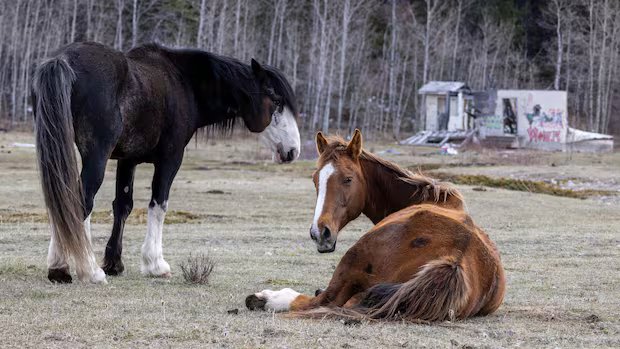
It’s hard to miss the horses on the way to the mountains.
They’ve established free-roaming populations throughout the foothills and grasslands of Alberta’s eastern slopes, with herds of wild horses almost guaranteed to be seen off Highway 1 west of Calgary year-round.
But the abundance of what the Alberta government calls “feral horses” has reached “unacceptable” levels, according to the province’s horse management strategy.
Results from the province’s annual feral horse survey released in April suggest there are at least 2,072 wild horses in Alberta’s six equine management zones — the highest number ever counted — with population levels in the Sundre, Ghost River, Elbow and Clearwater zones “not ecologically sustainable.”
Forestry and Parks Minister Todd Loewen said controlling horse populations is necessary to keep them from having too much of an impact on grazing areas for cattle and wildlife.
The province’s feral horse management framework, established in 2023, lists removal from the wild, putting horses up for adoption and administering contraception to mares as strategies for horse population control.
In equine management zones where the horse population exceeds the threshold and is designated “unacceptable” by the province, management options include licensed capture and putting horses up for sale.
The Alberta government considers the horses stray animals rather than wildlife.
Sundre data disputed by advocacy group
The population threshold in the Sundre equine management zone is 1,000 horses. The province’s latest count suggests at least 1,303 horses live there — the highest number ever counted in the area and the first time since 2018 the threshold has been surpassed.
But a wild horse advocacy group that does its own population surveys in the area is casting doubt on the province’s data.
“The only people that really know what’s going on out there is us,” said Darrell Glover, founder of the Help Alberta Wildies Society. “We’re out there constantly. It’s what we do full time, and we know the dynamics of the wild horse herds.”

The advocacy group does its own aerial survey of the Sundre zone’s horse population. Glover, who has been a pilot for half a century, says the group counted 1,005 horses this year — just over the province’s population threshold but significantly lower than the government’s findings.
Last year, the provincial survey counted 855 horses in the Sundre zone.
Glover said that increase of more than 50 per cent is “physically and biologically impossible.”

Loewen said the government’s methodology for the annual horse count hadn’t changed this year, but that better weather conditions may have made finding horses easier for the province’s helicopters and ground search crews.
“We only count them when we see them, and with good snow conditions then we’re more likely to see them,” Loewen said. “But there have been population increases generally over time anyways.”
Glover said there is strong public support for Alberta’s wild horses and opposition to their removal from the landscape, pointing to the Help Alberta Wildies Society’s Facebook following of nearly 700,000.
A petition circulated by the advocacy group last year, calling for the province to protect free-roaming horses by designating them as a naturalized wild species rather than stray animals, was presented at the Alberta Legislative Assembly after getting more than 15,000 signatures.
“The government will be quick to tell you that a horse is a horse is a horse,” Glover said. “They don’t care which family gets broken up. They don’t care which colt loses its mom. They don’t care as long as they’re removed.”

Wild horses have long been a presence in Alberta. Many ranchers see them as nuisances and some want them off the land. Wild Horses of Alberta Society, a non-profit organization, is dedicated to saving these animals and finding new homes for them. They’ve joined forces with veterinary students from the University of Calgary to manage their populations.
But Loewen said, “We want to keep feral horses on the landscape.”
“The Alberta government, and myself as the minister, are really the only ones on the landscape that actually provide honest, serious protection to the feral horses,” he said, pointing to regulations keeping people from poaching or illegally capturing them.
Loewen said the province is in the process of getting federal approval to use contraception on horses this year.
He said he could not confirm whether horse capture efforts are currently underway.
