
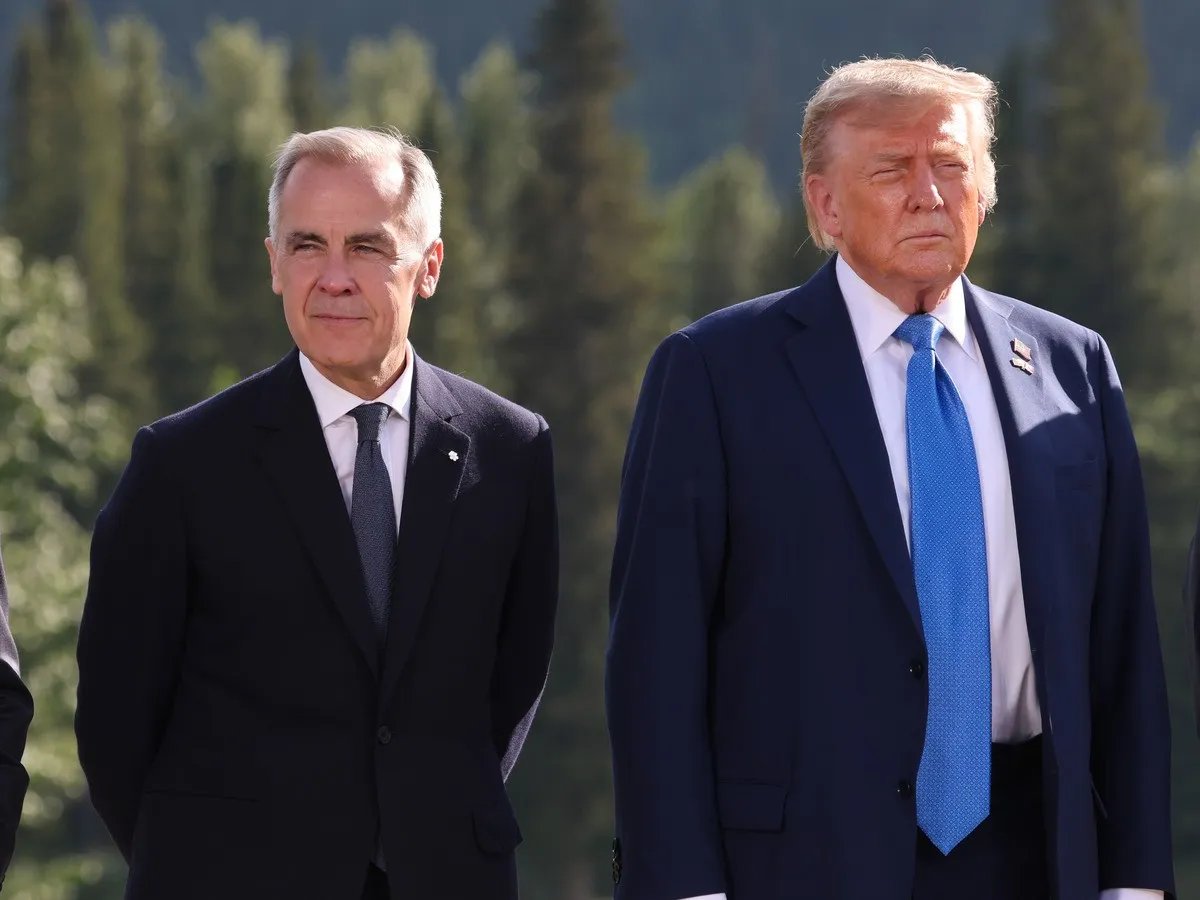
Release the deal, Prime Minister Carney. Canadians deserve to know the precise details that led to a full on, unprecedented trade war with President Donald Trump’s America in the last week.
While Canada’s abrupt departure from trade talks very well may have been inevitable and defensible, Carney affronts all of us with his failure to demonstrate — beyond a shadow of doubt — that this was the case.
A Department of Finance news release from Aug. 25 states that: “Canada has negotiated intensively and in good faith with the United States… In recent days, however, the U.S. proposed new terms that were not in Canada’s best interest, basically, asking too much of Canada, and offering too little in return. Canada therefore suspended negotiations rather than accepting a bad deal that would undermine Canadian workers, businesses, strategic sectors, and our national interest. Canada did not choose this trade conflict, but we need to respond to provide a level playing field to our businesses.”
The release goes on to detail Canadian counter-tariffs and $7.5 billion in government funding to Canadian businesses and workers, mainly through loans and income support. (Which brings up a rather unsettling flashback to former prime minister Justin Trudeau’s money-printing habit during the COVID-19 pandemic. Here we go again, eh?)
Nowhere in the government announcement are the exact details about why Carney instructed his negotiation team to pack it in and come home, without a deal. “Asking too much and offering too little in return” is hardly more than a platitude. It’s not a good enough explanation for any of us, and certainly not for the thousands of Canadians facing financial downfall as a result of the trade war.
The highest-resolution details we Canadians can find, thus far, about the breakdown in negotiations are contained within a New York Times story from Tuesday. Its authors spoke to anonymous government sources from both countries. One Canadian negotiator claimed that the Americans were attempting to rehash “settled” topics in the eleventh hour, while American sources claim that the Canadians were the ones doing this. The Trump administration was allegedly attempting to “dictate Canada’s steel tariffs on other countries,” which, if true, is obviously unacceptable. Canada apparently backed out of discussions over re-starting the Keystone XL pipeline, a project that, had it been revived, would likely have been poison for Carney’s approval rating.
Unsurprisingly — and easy to believe — neither side agreed on steel, aluminum, or auto tariffs. And then there’s the French language debate: no, not the 1990s one, but a new on e— whether the U.S. could force Canada to repeal online content legislation that favours Canadian (and French) content on American-owned platforms.
Trump has outright accused Carney of lying about the French issue. While Carney has publicly claimed that the tentative trade deal contained “threats to French language and culture,” Trump has said that notion is both untrue and “stupid.”
The U.S. president posted on social media, with his signature lack of decorum, to say that : “This lie was made up by a weak and ineffective Prime Minister in an attempt to gain political support, which he has totally lost, from the people of Quebec.”
One wonders why Carney has yet to prove Trump wrong by revealing whatever draft deal was on the table before he halted negotiations. Who wouldn’t want to prove that they were not, in fact, lying, given such an easy out? After being name-called, no less.
Shuv Majumdar, Conservative shadow minister for Canada-U.S. relations, demanded in a letter addressed to the government this week that Carney release the deal. “The Prime Minister said he would have a deal by July 21, 2025, and still does not have one. He said he would ‘negotiate a win,’ ‘handle President Trump,’ and get an even better deal than we had before. There have been no wins. U.S. tariffs on Canada are far higher than when the Prime Minister took office,” he wrote.
Intentionally or not, Majumdar raises what is perhaps the most pressing question: what is motivating Carney?
Even though diplomatic decorum usually precludes the release of non-final agreements, do not dismiss as paranoia the idea that Carney walked away from trade negotiations, at least in part, to launch “Elbows Up 2.0.” It’s no secret that the Liberal party won last year’s election for two reasons: because Carney was parachuted in to replace a beleaguered Trudeau, and because large numbers of Canadians have been awash in a communal, anti-Trump ecstasy that forms the lifeblood of Carney’s allure. (“Nothing brings people together more than mutual hatred,” as Henry Rollins once said .)
Carney couldn’t get a deal with Trump, and perhaps a Conservative government would have fared no better — but it certainly plays to Carney’s base to puff up his chest, flip the poker table over and storm off.
Canadians deserve to know the truth. Show us the deal.
National Post
