
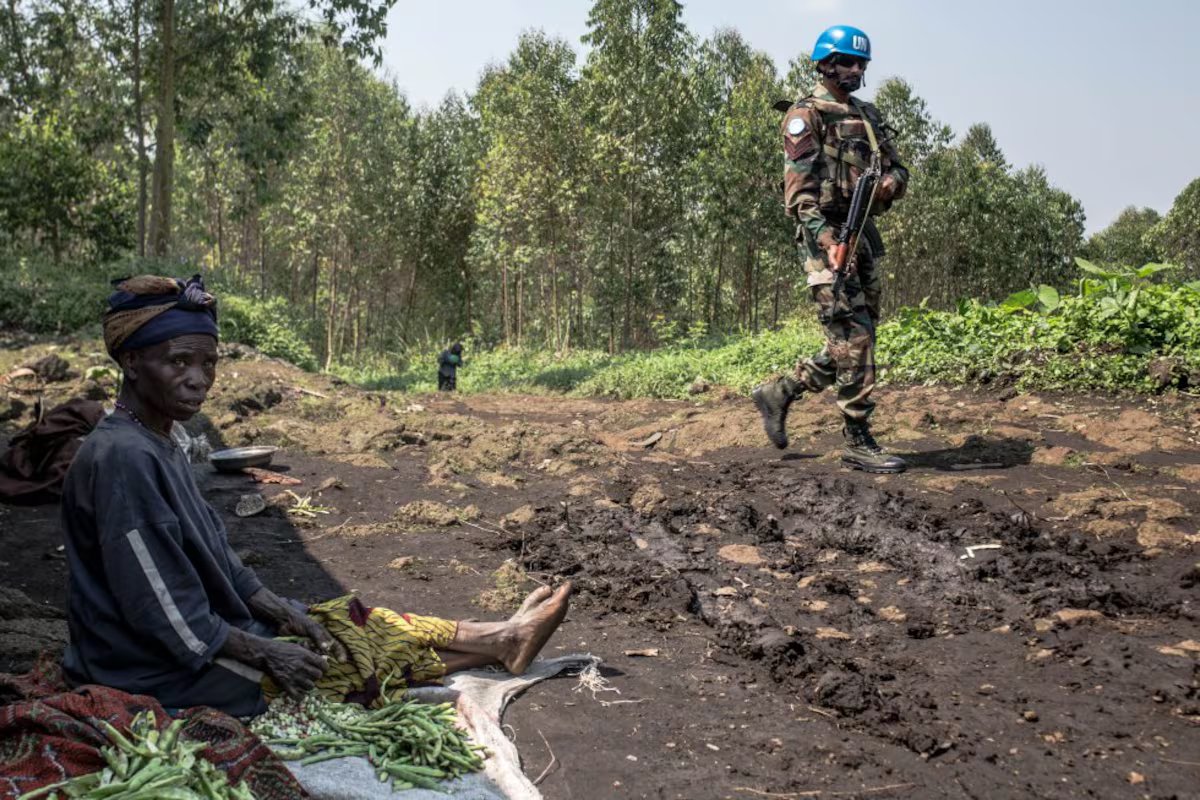
Priyanka Chowdhury has spent seven years working in South Sudan. The security situation in the African country — the youngest in the world — is difficult: violence between supporters of Salva Kiir and Riek Machar, bitter enemies, threatens to reignite the civil conflict that ravaged one of the poorest lands on the planet last decade. Neighboring Sudan to the north is pressing at the border in a brutal war between the army and paramilitaries. Still, Chowdhury resists conceding that this is the worst moment since she became spokesperson for the United Nations peacekeeping mission in South Sudan (UNMISS).
“We have not hit rock bottom,” she says by phone from the capital, Juba. She does reiterate that the challenge is “extreme” given cuts to funding for the just over 12,000 U.N. personnel deployed there. That number may seem high, but it follows the repatriation in recent months of more than 4,300 troops. The first elections since independence in 2011 are scheduled for December. And political violence continues to rise.
Peace costs money, and there is less of it. South Sudan is only one alarming example of the hole in the United Nations’ peacekeeping coffers. The budget to contain war is falling in step with confidence in multilateral missions, whether they carry the U.N. imprimatur or not. The Stockholm International Peace Research Institute (SIPRI) published a report in May calculating 78,633 military, police and civilian personnel in peace operations — 58 missions in 34 countries or territories — a 17% drop from a year earlier.
Looking back, the fall is sharper: the number of personnel in these missions is now 49% lower than a decade ago, mainly due to liquidity problems. The United Nations’ most recent peacekeeping budget was €4.7 billion ($5.4 billion), the lowest in 10 years. In 2016 it was around €7 billion ($8 billion).
The mission in South Sudan is a major concern. Violence is growing between supporters of President Kiir and those of Machar, the former vice president who is currently in prison, accused of murder, treason and crimes against humanity. As Chowdhury recounts, the situation in this young nation is fragile.
“We had to close our field offices in Aweil and Torit, while in Rumbek and Kuajok the presence is exclusively military,” the UNMISS spokesperson continues. As a result, civilian protection, a cornerstone of peace operations, is suffering. “South Sudan is a country that was born 15 years ago with great potential,” she adds, “it is real people who deserve our attention.”
One quarter fewer staff
The SIPRI report noted that the accounts of the U.N.’s Department of Peace Operations were carrying a shortfall of about €1.75 billion ($2 billion). After that report was published in May, EL PAÍS contacted the U.N. department: almost €1.9 billion ($2.2 billion) is outstanding (a figure that would correspond to nearly 40% of the current budget). Contributors are not meeting their commitments, including the United States, the largest of them all.
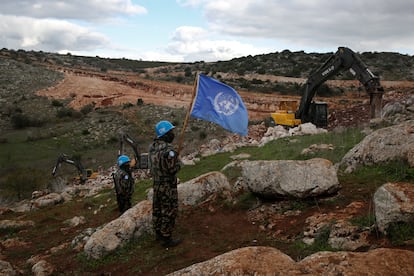
This failure of duty toward peace is not evenly distributed. Each mission has its own budget, which states must fund. Some operations are more high-profile or of greater interest to major powers, such as the one in Lebanon (UNIFIL), whose mandate ends at year’s end despite the conflict between Hezbollah and Israel, while others, like those in Africa, attract less financial and public attention.
Because of the growing hole in U.N. finances, in October — months after the approval of the latest accounts — the organization launched a savings plan equivalent to 15% of its total expenditures. Personnel numbers were to be reduced further: by 25%. Hence the closure of regional offices and bases and the repatriation of soldiers and civilian staff.
The sweeping cuts have led to a loss of presence in areas vital to peacekeeping operations. Some missions were already overstretched, like the one in South Sudan. “Cuts have been made in missions that were already very tight,” a U.N. peace operations official told EL PAÍS in a video call. Still, the source adds, the contingency plan had been completed by January and teams repatriated. The official admits some elements will not return, while others have been reorganized to keep functioning should funding resume. That is a complex prospect given that the accounts for the 2026–2027 period, currently under negotiation, are likely to face further cuts.
In a statement sent to the press in early June, Jean-Pierre Lacroix, the U.N.’s under-secretary-general for peace operations, cited examples of the consequences of that loss of capacity due to budget cuts. In the Democratic Republic of Congo — the mission is scheduled to close at the end of the year — patrol activities have fallen by 30%, limiting access to remote, high-risk areas.
In Western Sahara, cuts have reduced the mission’s ability to monitor multiple areas simultaneously, increasing the risk that some violations go “undetected.” And in the Central African Republic, MINUSCA — the U.N. mission with the largest staff (17,885 military, civilian and volunteer personnel) — the reduction in flights has constrained surveillance and monitoring efforts in remote areas.
New intervention models
The cocktail is toxic for peacekeeping under the multilateral umbrella. As SIPRI noted, it is not just the U.N., with 18 active missions, that has tightened its belt. African Union missions have also been squeezed by declining European funding, and the Organization for Security and Co-operation in Europe (OSCE) recently approved a budget cut of about 10%.
The liquidity crunch also undermines a model that has been questioned for decades and is now subject to a renewed surge in international polarization. A clear example was the closure two years ago of the mission in Mali, governed by a military junta backed by Russia, or the imminent closure of UNIFIL, despite the validity of its mandate.
In this context, new bilateral models of intervention in conflicts are emerging — deployments of Rwandan forces in the Central African Republic or Mozambique, of the United Arab Emirates in Somalia, or of Uganda in Congo — as well as original ad hoc alliances like the Global Security Force (GSF) to eliminate gangs in Haiti, authorized by the United Nations and supported by a motley group of countries led by the United States (Canada, Jamaica, the Bahamas, El Salvador, Kenya, Sri Lanka…).
“If things continue this way, we could witness a drastic weakening of multilateral conflict management and the near-total sidelining of institutions like the United Nations,” says Jair van der Lijn of SIPRI. Indeed, it is hard to imagine the U.N. playing any role in postwar management of conflicts as difficult as Gaza or Ukraine. “This will likely lead to an increase in conflicts, with even more severe consequences for civilians, as states abandon established norms,” Van der Lijn continues. South Sudan, Haiti and Lebanon will, unfortunately, be the next testing grounds.
Sign up for our weekly newsletter to get more English-language news coverage from EL PAÍS USA Edition
