
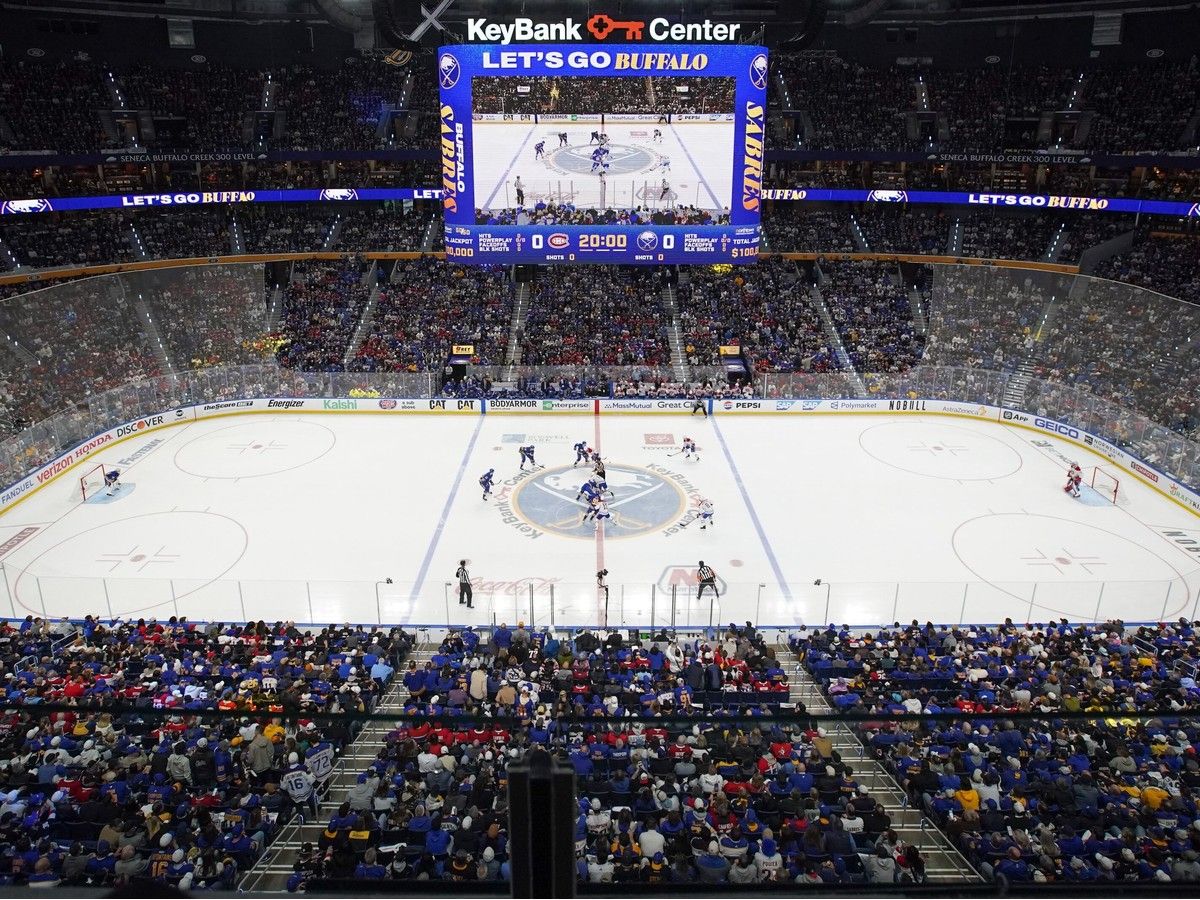
There may not have been a huge contingent of visiting Montreal Canadiens fans at the opening games of the team’s second-round playoff series against the Buffalo Sabres last week, but there were definitely more Canadians in the stands than meets the eye — and many of them bleed blue and gold.
It’s well known that ever since its founding in 1970, the Sabres have enjoyed a wellspring of ardent supporters from Southern Ontario. And when the NHL club is playing at home, scores of residents from the border town of Fort Erie, neighbouring Niagara Falls and St. Catharines, and elsewhere in the region — including a healthy contingent of Torontonians — have traditionally streamed across the Peace Bridge to cheer them on.
There’s no precise number, but at times it’s been estimated that a considerable cohort of season ticket holders at the 19,000-seat Key Bank Arena are Canadians. It’s also routine for fans of the nearby Toronto Maple Leafs, Montreal Canadiens and Ottawa Senators to make the trip from their burroughs.

Among those season ticket holders at one point was Dean Payer of Toronto, a diehard fan since the early days when the French Connection of Gilbert Perrault, Rick Martin and Rene Robert led the team, who figures he has only missed watching or listening to maybe 10 games over the decades and has visited Buffalo “hundreds of times over the years” to see the Sabres play live.
“Even when they were bad these last 14 years, I still watched every single game, I still went to games,” he told National Post.
The first of those trips came at 16 when he and some friends told their parents they were going to watch a game, but neglected to divulge that it was in Buffalo. After the game (2-2 tie), they missed the first bus home and didn’t get back to Toronto until 3 a.m. With no transit available at that hour, one of the teenagers had to call their parents for a ride.
“It wasn’t me,” he said.
In return for the in-person patronage, Payer and others like him have been greeted by a welcoming, working-class city and a team that honours the unique relationship by singing O Canada ahead of every home game, even when the visiting team isn’t one of Canada’s seven. That’s a tradition many Canadians learned about for the first time in a goosebump-raising moment from the first round of this year’s postseason when the Sabres faithful picked up the anthem after the singer’s mic abruptly cut out.
During Game 6 in Boston, representatives from Molson — owner of the Canadiens — went to Buffalo and visited local bars where they bought rounds of beer for Sabres fans.
Here in the true north strong and free, the anthem moment was a little reminder of the cross-border neighbourly goodwill that’s been overshadowed by U.S. President Donald Trump’s trade tactics and threats against Canada’s sovereignty, actions that have resulted in significantly fewer west-to-east visits across the Niagara River.
According to Visit Buffalo CEO and president Patrick Kaler, inbound travel was down roughly 18 per cent in 2025 year-over-year from 2024 and down a further eight per cent in the first quarter of 2026.
“We’re not seeing any traction going the other way,” he told National Post, noting that their own website traffic fell between 65 to 75 per cent each month last year compared 2024.

Attendance at many popular attractions in the city was down between 25 and 35 per cent, he said, adding that one cultural institution board on which he sits “had to make some financial decisions last year because of Canadians not coming across the border.”
Toronto’s Art Rubin, whose fandom developed in the same early Sabres era as Payer’s, is one of those Canadians, and while he initially stopped attending games after the COVID-19 pandemic, the Trump administration’s attitude towards Canada has only reinforced that choice.
“I like seeing the statistics in the press where it says their tourism from Canada into the U.S. dropped by like 30 per cent,” said Rubin, who is trying to drum up members for his Buffalo Sabres Fans in Toronto Area Facebook group .
But with the Sabres in the playoffs for the first time since 2011 and in the second round for the first time in 19 years, Rubin said he may put his principle aside should they advance deeper in the postseason.
“I don’t think I’ll be going to a game, but I might go take in the atmosphere, or maybe I’ll go to St. Catharines with my son to a bar,” he said.

Rubin won’t attend in person because Sabres tickets, normally among the cheapest regular season options in the league at between $160 and $60 each depending on bowl location, have shot up significantly for the playoffs.
Tickets for the first home game against the Boston Bruins in Round 1 were the highest-priced in the league, with the lowest-cost option at US$464 (CAD$634) and the most expensive seat selling for more than $7,000 (CAD$9,500), as reported by The Desert News in Utah.
As of Sunday night, the cheapest seats for Game 5 on Thursday were $344 on Ticketmaster, the league’s official ticket retailer and reseller, with seats asking an average of $1,500 and a few well over $2,000 and at least one exceeding $2,500.
“After 14 years of no playoffs, I think the fans are willing to pay almost anything,” suggested Payer. “They were starving for success, so I guess it’s not really that shocking.”
The team considered restricting playoff tickets to American fans in certain ZIP codes, but ultimately opted “not to ‘geofence’ ticket sales to avoid boxing out the team’s fans across the border,” according to Buffalo News.
Payer expects regular-season ticket prices to climb ahead this fall following this spring’s success.
The subject of affordability was an element of fandom examined in the 2019 master’s thesis of a Brock University sport management student exploring Sabres and Toronto Maple Leafs Fans in Fort Erie.
Author Adnan Sidani said the Sabres fans he interviewed identified the economic value as an important factor in choosing the team over the Toronto Maple Leafs.
“A family of four could go to a game and have all amenities — the popcorn, the pop, get the jersey for the kid, you know, whatever you had to do,” 29-year-old Luke told him.
Even some of the Leafs supporters he spoke with acknowledged the draw of significantly cheaper tickets.
“So, when the Leafs come into Buffalo, there’s more Leaf fans than there are Sabre fans because of the mere fact that even if you had to pay double the face-value, you were still better off buying a Sabres ticket than trying to get to a Leaf game,” Sandy, 56, remarked.
Sidani also found that many of the Sabres fans identified themselves as “blue-collar” workers and felt their favourite team embodied many of those same characteristics.
“The characteristics differed from interview to interview, however it was interesting to note that while most of the Buffalo Sabres fans agreed their team represented Fort Erie well, the Toronto Maple Leafs fans rejected the idea of their team being a good representation of their community,” Sidani wrote. “In fact, some Maple Leafs fans went as far as to say that the Buffalo Sabres were a better representation of Fort Erie when considering the economic state of the city and town.”
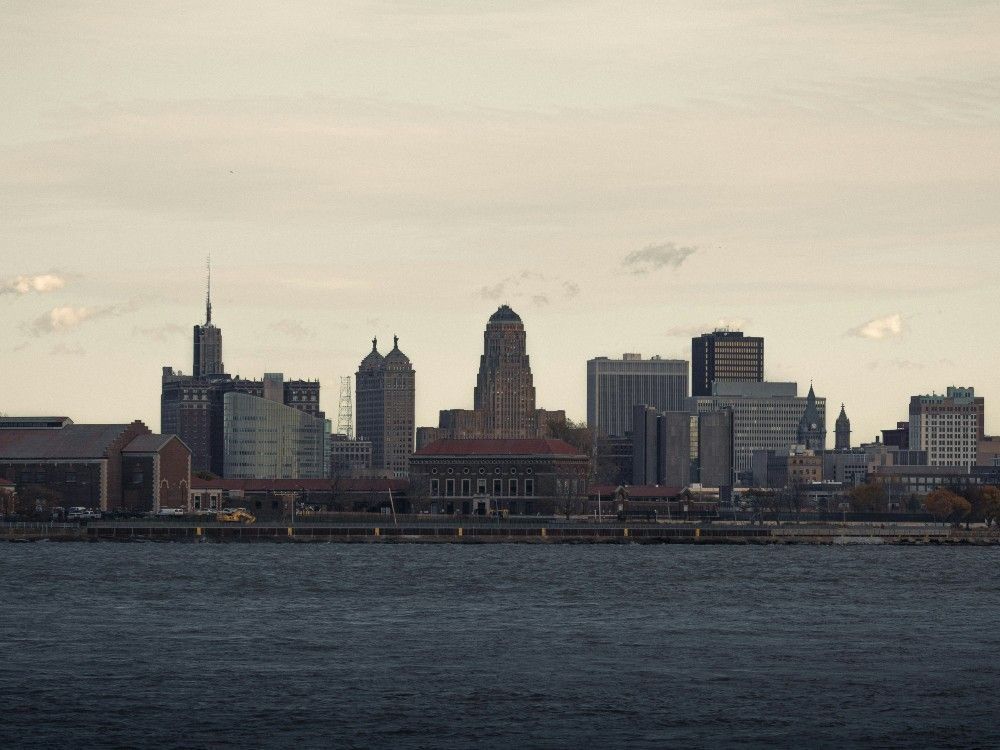
In 2011, then managing partner Larry Quinn told the New York Times, “there’s no question” that Buffalo itself has a Canadian feel and that part of their marketing strategy in Southern Ontario “is to pretend there isn’t a border.”
The organization has consistently made efforts to stay connected to its dedicated Canadian fanbase over its 56 years, starting with founding brothers Seymour and Nortrup Knox, who elected to use the Canadian spelling of Sabre (not Saber) when Toronto filmmaker Harry Cole won a 1969 naming contest for the expansion club.
In 2013, the Sabres signed a broadcasting deal with Bell to make 50 games per season available to viewers in Southern Ontario at no extra cost.
“Many people don’t think of the Southern Ontario region as being ‘Sabres Territory’ because it’s in a different country,” then team president Ted Black said. “But, in reality, some of our most passionate fans come from right over the Peace Bridge. They’ve been crossing the border to come to games at the arena for years, and now they’ll be able to watch a majority of Sabres games from the comfort of their homes.”
That fall, according to Niagara This Week reported, the team conducted a two-day “Invade Canada” campaign by visiting four locations to generate buzz for the 2013 campaign.
In 2023, long after the deal with Bell had expired following the 2015-16 season, the team inked another deal with streaming service Fubo for more than 40 games.
Visit Buffalo, too, has tried to stay connected with Canadians amidst the tensions with the Trump administration. Kaler said the organization “doesn’t subscribe to what’s coming out of D.C.”
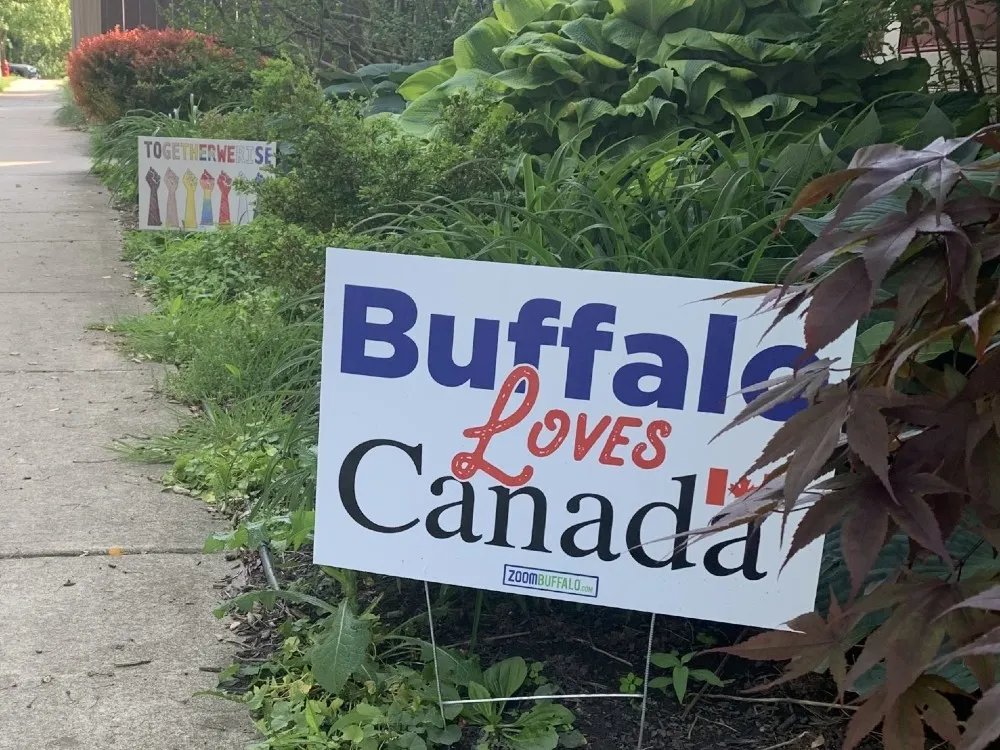
Last February, around the time the president was routinely trolling about Canada as the 51st state, the organization relaunched an existing “Buffalo Loves Canada” marketing campaign and paid for two prominent billboards in Toronto. They ended it early due to negative feedback and have dialled back efforts to connect since, Kaler explained.
“We’ve wanted to be respectful because we know that whenever we’ve done something with our messaging, Canadians will come at us and say, ‘We love you, Buffalo, but we’re not going to come until the president is out of office.’”
“We, as the tourism organization for Buffalo, completely validate and appreciate Canadians’ feelings towards that.”
But, he said, the viral anthem moment provided an ideal opportunity to “extend that olive branch” and remind Canadians what they mean to Buffalo. Last week, Visit Buffalo launched a new campaign with three billboards — one at the terminus of the Queen Elizabeth Way near the Peace Bridge and two more on either side of the Gardiner Expressway — that read “O Canada, We Meant Every Word.”
Kaler emphasized that the campaign and its predecessor aren’t meant to be transactional but a reminder that Buffalo is ready to welcome Canadians when they’re ready, “if it’s this summer or if it’s three summers from now.”
“We’re trying to be very respectful and not looking at this as, ‘Oh my gosh, they’re coming back — isn’t this going to be great for our economy,” he said.
“We’re just thrilled at the fact that there’s consideration about Buffalo, that Canadians are seeing us in a positive light, that they do recognize that we are their friends across the border, and that we do share so many values.
Payer and Rubin have generally nice things to say about Buffalo and Buffalonians.
“I think they love Canadian fans when we enter the border, even if we’re just going for a game or for the day, they’re very nice at the border,” Payer said.
Rubin, who attended university in Buffalo, added that he used to regularly attend a hockey tournament on the American side where any notion of nationality fell by the wayside.
It’s worth mentioning here that the Sabres aren’t the only sports draw for Canadians — the Buffalo Bills have an equally strong legion of devotees from Ontario and the Buffalo Bisons, the Toronto Blue Jays’ AAA affiliate, have a healthy number of “herd” members, too. (The team offers Canadian dollar-at-par deals at home games .)
Not to be overlooked in examining the Buffalo-Canada relationship is that Americans in Western New York, by and large, are quite fond of Canada.
While Canadians are making fewer crossings at the Peace Bridge, American traffic coming the other way hasn’t slowed the same and might be bouncing back.
West-bound passenger vehicle traffic numbered just shy of 1.8 million in 2025, down eight per cent year-over-year from 2024, according to the public bridge authority , but that number has fallen to four per cent for the first quarter of 2026 compared to the same time in 2025.

There are several reasons why, not the least of which is the strength of their dollar. As of Monday morning, US$1 was worth CAD$1.37.
They’re also coming for the many services and amenities available in Toronto and the surrounding area, the closest major hub to Buffalo. The IKEA in St. Catharines, for instance, is the closest to New York State’s Erie County and its population of around a million.
It’s also been said that many choose to fly out of Toronto Pearson International Airport because it offers more flight options than Buffalo area airports. The Jays and the Toronto Raptors are also the closest teams from their respective professional leagues, while other big draws include provincial parks, amusement parks, museums, nightlife and all the big-name musical acts that regularly visit Toronto.
Even Americans will admit that the Canadian side of Niagara Falls is immeasurably grander.
Then you have to consider the less savoury draws — a lower drinking age, stronger (arguably better) beer and strip clubs a little more liberal than American counterparts.
In fact, the only complaints that continually arise in discussions across social media are traffic and bad drivers.
The Canadiens defeated the Sabres 6-2 in Game 3 on Sunday to claim a 2-1 lead in the best-of-seven series, which continues with Game 4 on Tuesday night at the Bell Centre in Montreal. Without a Sabres victory there, the team faces elimination when the series returns to Buffalo for Game 5 on Thursday night.
Our website is the place for the latest breaking news, exclusive scoops, longreads and provocative commentary. Please bookmark nationalpost.com and sign up for our daily newsletter, Posted, here.
