
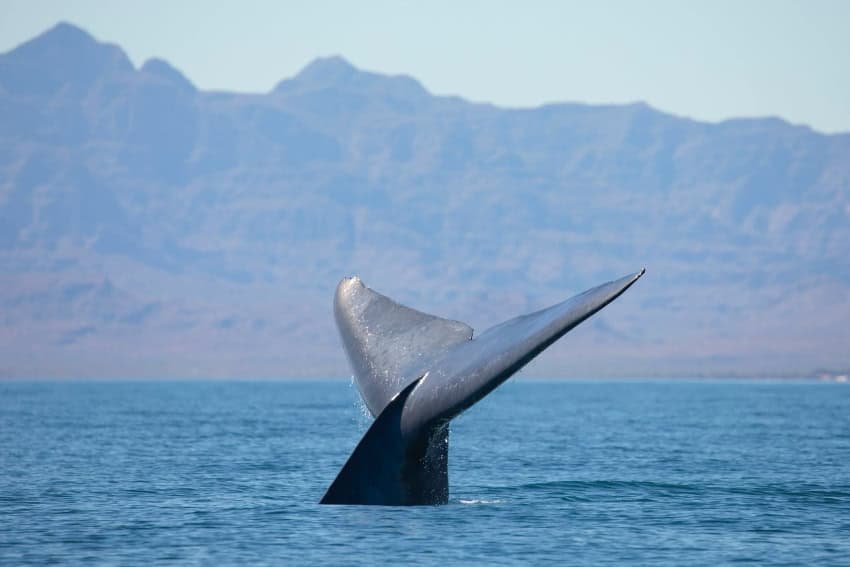
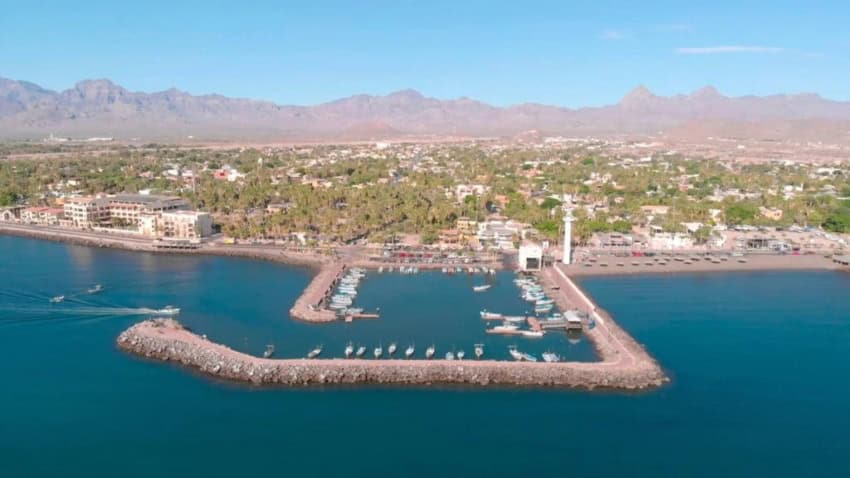
On April 10, a federal decree was issued, officially reclassifying Loreto in Baja California Sur as a deep-sea cabotage port, thereby opening it to large-scale maritime traffic, including more and larger cruise ships. This decree, however, was not well-received. In fact, not only have residents and activists called for President Claudia Sheinbaum to revoke the decree, but a petition on Change.org seeking the same outcome already has over 47,000 signatures.
Why the decree is so unpopular
It’s not difficult to understand the pushback. Loreto and its offshore islands are a National Park and have been designated an Important Marina Mammal Area — the area is a prime seasonal habitat for endangered blue whales, the largest creature ever to have lived, and a sanctuary for many other creatures — as well as a UNESCO World Heritage Site, a Ramsar Wetland of International Importantce and a PACE Priority Site, under the Mexican government’s official framework for endangered species protection. Loreto itself, settled since 1697 and the capital of Baja California until 1829, is also a Pueblo Mágico.
In other words, this is one of the most beautiful and ecologically diverse places on the planet.
“We are not opposing development,” notes a recent release from the Nakawe Project, which works to conserve the Baja California peninsula’s environment and species. “We are demanding legality, science-based decision-making and responsibility toward our environment and our people. Loreto is not a deep-sea industrial port. It is a living ecosystem, a globally significant sanctuary, and a critical habitat within a transboundary ocean system. Protecting it is not optional — it is a legal, ecological and moral obligation.”
Potential recourses
The community of Loreto has until May 8 to file an amparo challenging the decree on constitutional grounds, with a ruling to follow in the coming months.
It’s a sure bet the filers mention legal precedent, since when the 206,580-hectare national park — much of it marine-based — was created in 1996, its goal was to preserve “ecological equilibrium,” a mandate since formalized through zoning by the National Commission of Protected Natural Areas (CONANP) and the Ministry of Environment and Natural Resources (SEMARNAT).
Who actually pushed for the decree to happen?
The key promoter appears to have been the Administración Portuaria Integral de Baja California Sur (API-BCS), whose director general, Narciso Agúndez Gómez, has stated that the decree is a “strategic step to strengthen the maritime and tourism development of Baja California Sur.”
Agúndez knows the state’s tourism well. His father, Narciso Agúndez Montaño, was the state’s former governor, and his uncle and brother — José Antonio Agúndez Montaño and Christian Agúndez Gómez, respectively — have both served as president of the municipality of Los Cabos.
However, there was no broad consensus for the decree to occur, as evidenced by the fact that the state’s current governor, Víctor Castro Cosío, has already had at least three meetings with upset residents in Loreto, and more are scheduled.
“Although the decree reclassifying the port of Loreto as a deep-sea and coastal port has already been published,” added Loreto Mayor Paz del Alma Ochoa Amador, “it could be repealed if the community does not agree.”
It certainly appears as if they don’t.
How to bid on a luxurious Cabo villa
Have you ever dreamed of owning a villa in Los Cabos? Now’s your chance, although you’ll need to have some pretty deep pockets.
Between May 19-27, Concierge Auctions will be accepting bids on the 6,247-square-foot Villa 7 at the Four Seasons Resort and Residences at Costa Palmas in La Ribera, on the East Cape of Los Cabos, with live bidding taking place on May 27 at The Connaught in London’s upscale Mayfair district. The villa is listed at US $19.95 million and opening bids are expected to be in the range of US $7 to $12 million.
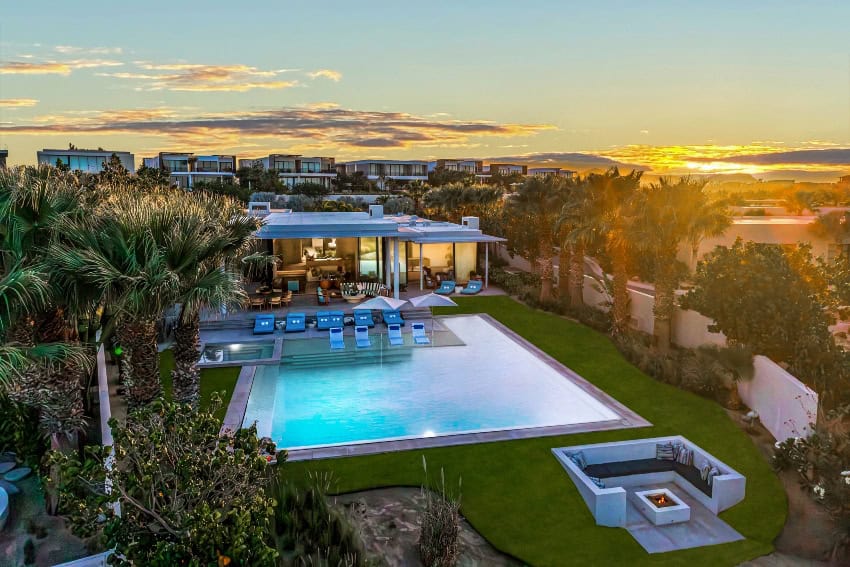
If that seems a little steep, it bears noting that ownership also includes membership in the Costa Palmas Beach and Yacht Club, as well as access to the Robert Trent Jones-designed Costa Palmas Golf Club.
“Our London Global Sale has become both a consistent and powerful platform for connecting engaged buyers with premier properties like this stunning Four Seasons residence within desirable Costas Palmas,” said Chad Roffers, CEO and co-founder of Concierge Auctions. “After selling branded residences for well over a decade, we know that the international appeal of these luxury properties isn’t just about location, but the promise of a world-class lifestyle, which we make possible in a matter of weeks.”
A Los Cabos golf course update
As Querencia’s Campo Alto moves closer to its opening date later this year, another Los Cabos golf course development is also inching towards completion. That would be Oleada Golf Links, the Ernie Els-designed course that will serve as a centerpiece of the 860-acre resort and residential community (also called Oleada) on the Pacific Coast north of Cabo San Lucas.
The course, Els’ first in Mexico, will have its grand opening in November, it was recently announced, with preview play starting in July. The early access allows for feedback and final adjustments ahead of the formal opening.
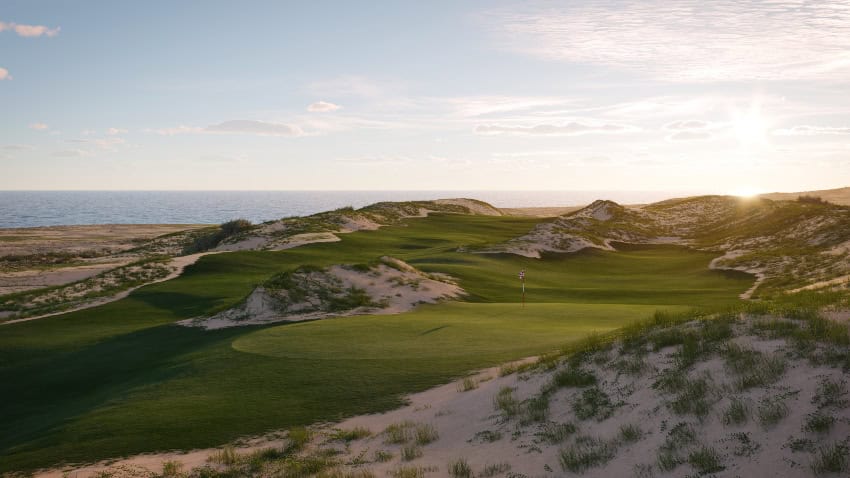
Fifteen of 18 holes at the 7,336-yard Oleada Golf Links are built around beachfront dunes and all the holes will feature Pacific Ocean views.
Oleada Golf Links
“Because the native contours and dune formations are so good, very little earthmoving was required to build the course,” Els told Sports Illustrated. “Shaping was minimalistic. Man cannot improve on what Mother Nature has created over the eons. The golf course that we’ve created at Oleada will be here long after I’m gone. That means something and it makes me feel very proud.”
As for the rest of Oleada, it’s coming along, too. The 300-room Grand Hyatt Los Cabos at Oleada is also scheduled to open by the end of 2026, with the 175-key Conrad Los Cabos at Oleada to follow in 2027.
Chris Sands is a writer and editor for Mexico News Daily, and the former Cabo San Lucas local expert for the USA Today travel website 10 Best and writer of Fodor’s Los Cabos travel guidebook. He has also contributed to numerous other websites and publications, including The San Diego Union-Tribune, Marriott Bonvoy Traveler, Forbes Travel Guide, Porthole Cruise and Travel, and Cabo Living.
