
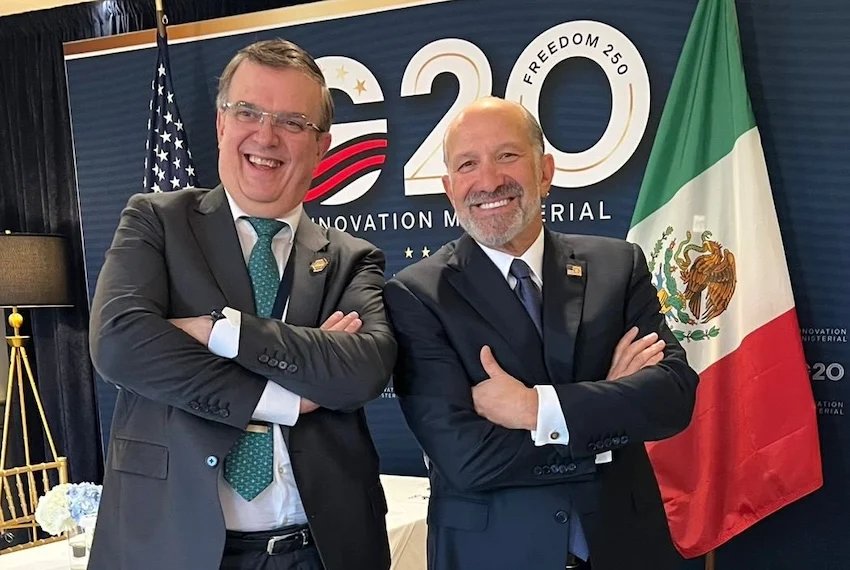
Mexico Economy Minister Marcelo Ebrard and U.S. Commerce Secretary Howard Lutnick met Wednesday on the sidelines of a G-20 gathering in North Carolina, where they discussed the troubled negotiations on the U.S.-Mexico-Canada (USMCA) trade agreement.
Ebrard is pushing back on U.S. tariffs on cars, steel, and aluminum, which have been a sticking point in the negotiations. Mexico says the tariffs on these sectors are unjustified and at odds with the spirit of North America’s closely integrated manufacturing supply chains.
The United States is hosting the two-day G-20 “Innovation Ministerial,” led by Lutnick and White House Office of Science and Technology Policy Director Michael Kratsios, with representatives from Mexico, China, Brazil, Canada, Germany, and other G-20 nations in attendance.
The summit focuses on innovation policies and the deployment of technologies to boost the economic prosperity of member countries. These topics were also discussed by Ebrard and Lutnick as they apply at the regional level.
Artificial intelligence (AI) has been one of the central topics of G-20 discussion, alongside industrial innovation in supply chains and the development of a skilled workforce to meet growing global technological demands.
Several business leaders are attending the event, including Nvidia CEO Jensen Huang, Anthropic co-founder Tom Brown, OpenAI CEO Sam Altman, Meta CEO Mark Zuckerberg and Tesla/SpaceX CEO Elon Musk.
The US goes its own way on Artificial Intelligence
While Mexico has yet to forge an official national AI plan, the clash of views between the United States and the European Union on AI regulation has been apparent at the G20 Innovation Ministerial.

U.S. representatives voiced opposition to technology-specific AI regulations found in the EU’s AI Act. Trump’s tech adviser, Michael Kratsios, encouraged countries to embrace the so-called Carolina Principles instead, which advocate regulations that do not single out specific technologies.
Meanwhile, the European Commission confirmed this week it had sent requests to over 30 AI companies worldwide to better understand whether they are complying with the EU’s AI Act.
The Act has been billed as the world’s first comprehensive effort to regulate AI and would prohibit any AI activities deemed to pose an “unacceptable risk.” It also imposed transparency standards that took effect in August.
With reports from Reuters, La Jornada, CNBC and Al Jazeera
