
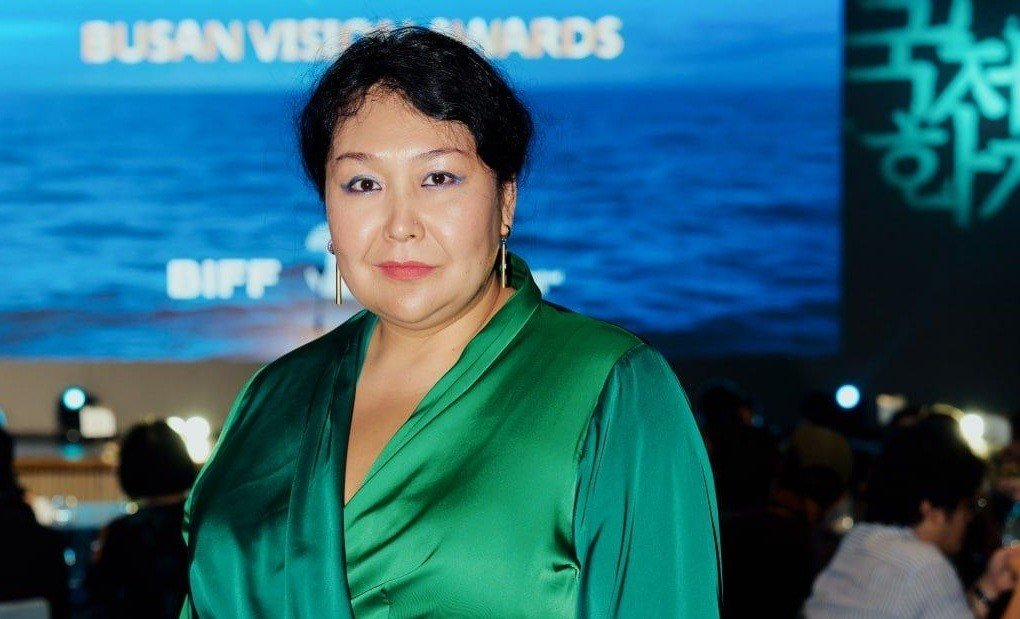
– We sat down with the multihyphenate to talk about the state of Kyrgyz cinema, international co-production and what the industry is still in need of
Few figures in Central Asian cinema combine as many roles as Erke Dzhumakmatova. An actress, screenwriter, director, producer and industry advocate, she has been a driving force in Kyrgyz cinema for nearly three decades. Her latest film as producer and co-director, Kurak, premiered at the Busan International Film Festival in 2024, winning multiple awards, including the GC Award in the Envision Asia section, and has since collected seven prizes across 15 festivals.
Cineuropa: Could you introduce yourself and tell us about your career?
Erke Dzhumakmatova: I have been working in the film industry – locally and regionally – since I was 20, so that is already 28 years. In 2011, I founded my own company, Toimo Studio, and gradually moved into producing, writing and directing. My first feature was a kind of film almanac – an anthology of shorts, documentaries and fiction pieces – which screened at national and some international festivals. In 2020, I produced Lake, which I also co-wrote: it was nominated for the Asian New Talent Awards in Shanghai and was submitted as Kyrgyzstan’s official entry for the Golden Globe long list. Then, in 2025, we completed Kurak, which had its world premiere at Busan.
You are also deeply involved in industry structures. Can you tell us about those roles?
Since 2021, I have been chair of the board of the Kyrgyz Association of Film Producers. We now have 70 members, which is a significant number for our country. I am also vice-chair of the Union of Filmmakers of Kyrgyzstan. These roles matter because the industry needs collective advocacy – it is not enough to make films; you also have to build the infrastructure around them.
How would you describe the support system for cinema in Kyrgyzstan today?
Before 2023, government funding was very limited. The whole system – the National Kyrgyz Film Studio, the Department of Cinematography and the small network of roughly 20 local movie theatres – ran on a modest annual allocation. With that, Kyrgyzstan produced perhaps one, two or, at most, three auteur films per year with full state support, plus one or two co-productions every couple of years. In 2023, however, a presidential decree on supporting the film industry changed things considerably. Funding has been increasing every year: last year, it reached around one billion soms, which is roughly €10 million. The money is being invested in equipment, in rebuilding the National Kyrgyz Film Studio and in constructing a new production pavilion. Last year, the state supported 13 or 14 features – the budgets are not large, but it is a real step forward. The focus has shifted somewhat towards commercial projects, although three or four of those supported films are still auteur cinema.
Kurak was your first international co-production. How did that process unfold?
It started in 2021, when the project was selected for the Asian Project Market. Through that, I connected with a Swiss co-producer – a Central Asian-born filmmaker based in Switzerland – and we secured around €40,000 from a regional fund in Lucerne. It was, I believe, the first time a Kyrgyz film was officially supported by a foreign fund: we were listed in the Swiss film catalogue as an official co-production. That was the first building block. Then I applied to Kyrgyzstan’s own Department of Cinematography and received state funding. After that, a Serbian producer, Miloš Jukerić, of Red Production, came on board and contributed equipment. I then found two French co-producers, Ekaterina Tarboignat and Johan Chapelman, who invested in the form of shares and consulting – we applied to the CNC but did not get through. Finally, a Dutch producer covered the post-production. During that phase, Italian involvement also came in: we got the film’s composer and score from Italy. So, the final film had partners from Switzerland, Serbia, France, the Netherlands and Italy – it was all assembled step by step, with each partner opening the door to the next.
Kyrgyz mainstream cinema is booming at the domestic box office. How do you read those numbers?
The numbers are genuinely remarkable. In any given year, around 400 films are released in Kyrgyz cinemas, the majority being Hollywood titles. Kyrgyz domestic productions represent only 10%-15% of that total – 40 or 50 films – yet they capture around 50% of the total box office. This year, we have already released about 70 local films. These are low-budget, fast-turnaround productions made entirely for the local market, in the Kyrgyz language, and they clearly speak directly to their audience. It is a phenomenon that deserves serious analysis, and I think it also entails a paradox: the same industry that has this commercial vitality struggles to build the skills and infrastructure needed to go international.
What does Kyrgyz cinema need most urgently right now?
Three things. First, education: many professionals know only the local system and fall into what I call a “local trap” – they produce for domestic release and have no framework for thinking internationally. Second, a stable and transparent system: clearer rules for how state funds are allocated, and how national and international producers interact. And third, formal co-production treaties. We need bilateral agreements with other countries – not just goodwill, but legal frameworks that protect both sides. A cash-rebate mechanism would also make an enormous difference for attracting foreign shoots. These are structural tools that other small film nations have used effectively, and we need to build them, too.
The film you produced, Kurak, was removed from the festival’s programme following an intervention by the censorship authorities. What can you tell us about it?
It’s a very difficult moment for our entire team. There is a bitter irony in this: Kurak tells the story of the suppression of the truth, of attempts to silence voices, and of structures that are afraid of women’s voices. And now, since we have been denied a distribution licence, reality has replicated exactly what we portrayed in our film. By trying to ban the movie, they have only confirmed its main message: what happens in the film is exactly what is happening in real life right now.
For me, this is especially painful because this screening was supposed to be a homecoming. We wanted to honour the memory of my co-director, Emil Atageldiev, who poured all of his final energy into this feature. But this ban only goes to show how important it is for this movie to be seen right here in Kyrgyzstan. We are not going to back down.
