
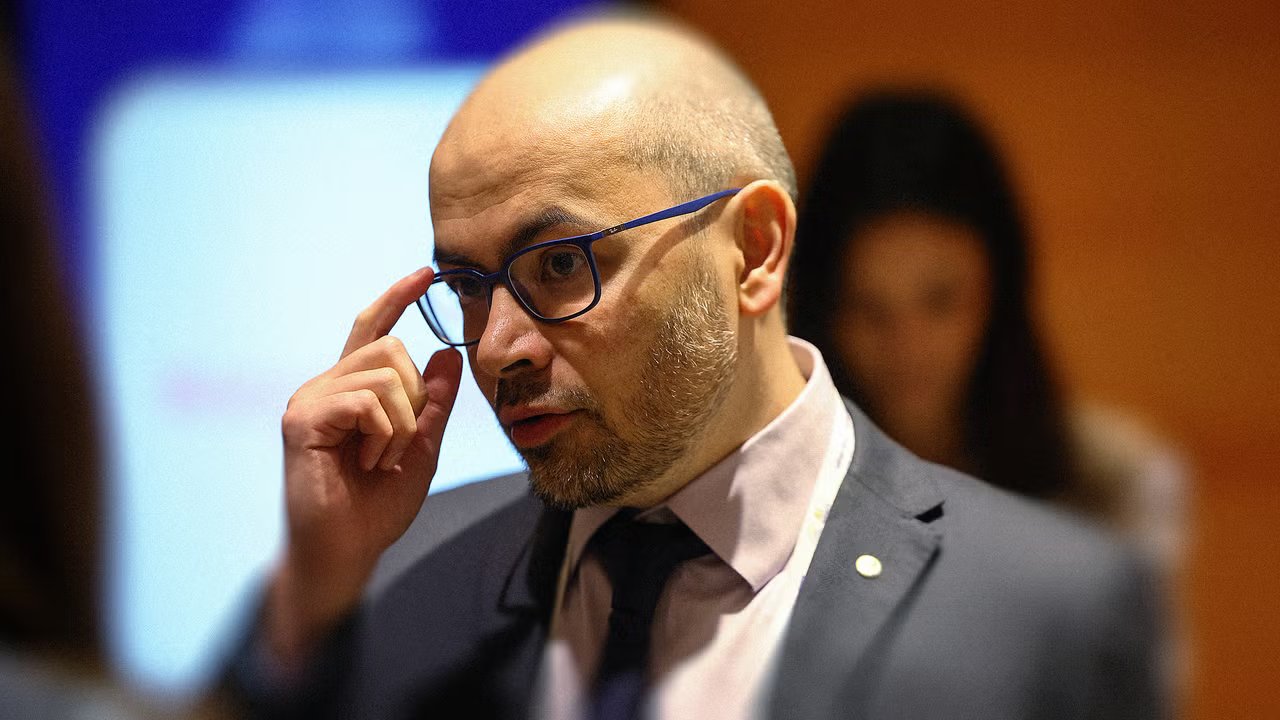
Google DeepMind CEO Demis Hassabis has been vocal about his belief that artificial general intelligence (AGI), a theoretical type of AI that can perform tasks matching human cognition, is just a few years away from being achieved.
During a recent interview at Stanford Graduate School of Business, Hassabis reaffirmed his prediction.
“I believe that we’re only a few years away from that, maybe 2030, plus or minus a year, which is astounding to think, really,” Hassabis said.
“I think that will be such an enormous transformative technology,” he added. “It’s gonna effectively be a new human era.”
Ten years from now, Hassabis said he thinks “we’ll realize that we were standing in the foothills of the singularity,” referring to the point at which AI surpasses human intelligence and continually improves itself, beyond human control.
There’s no consensus on when AGI will be reached, even among leaders in the AI space.
Last year, Sam Altman wrote in a blog post that “humanity is close to building digital superintelligence,” referring to the hypothetical future stage after AGI, where AI’s intelligence level surpasses the smartest human minds. “We (the whole industry, not just OpenAI) are building a brain for the world,” Altman wrote in the post.
In an essay published in 2024, Anthropic CEO Dario Amodei predicted that powerful AI could be achieved as soon as late 2026. “In 2027, AI systems could be capable of tasks that take a person weeks,” wrote Anthropic’s cofounder Jack Clark and The Anthropic Institute’s lead Marina Favaro in a coauthored piece published last month.”
Yann LeCun, Meta’s former VP & chief AI scientist, and a pioneer of convolutional neural networks—the visual processing technology behind facial recognition and autonomous vehicles—said the “concept of general intelligence is complete BS.” LeCun also believes that the current transformer-based large language models are not likely to achieve general or human-level intelligence that will produce high-value work.
Hassabis’ Google DeepMind counterpart and chief AGI scientist, Shane Legg, predicts a 50% chance that “minimal AGI”—AI that can complete some of the cognitive tasks that humans do—will be reached in 2028.
“I still think there’s a lot more work, and it’s just the beginning,” Hassabis said, later adding: “I think society needs to hear that, because we don’t have long to prepare for what that means, and it’s going to be enormously profound.”
From automating daily work tasks to coding, AI has already changed how humans work and given rise to fears around job loss. Because AGI would have the ability to solve problems, make its own decisions and learn from and adapt to changes, it could become more involved in high-level tasks in the workplace.
In an interview last month, Hassabis said that there are some human qualities that will set people apart from machines.
In the next five years, he said that those with “taste, design sensibility, original thinking” and the ability “to synthesize different subjects together” will “be in an amazing position.”
“I think amazing new things are going to be created,” Hassabis said. “I’ve got a lot of faith in human ingenuity, where we’re sort of instantly adaptable.”
“We’re general intelligences ourselves, don’t forget,” he added. “Look at what we built around us—it’s incredible—with our hunter-gatherer brains. Why would we stop here?”
