
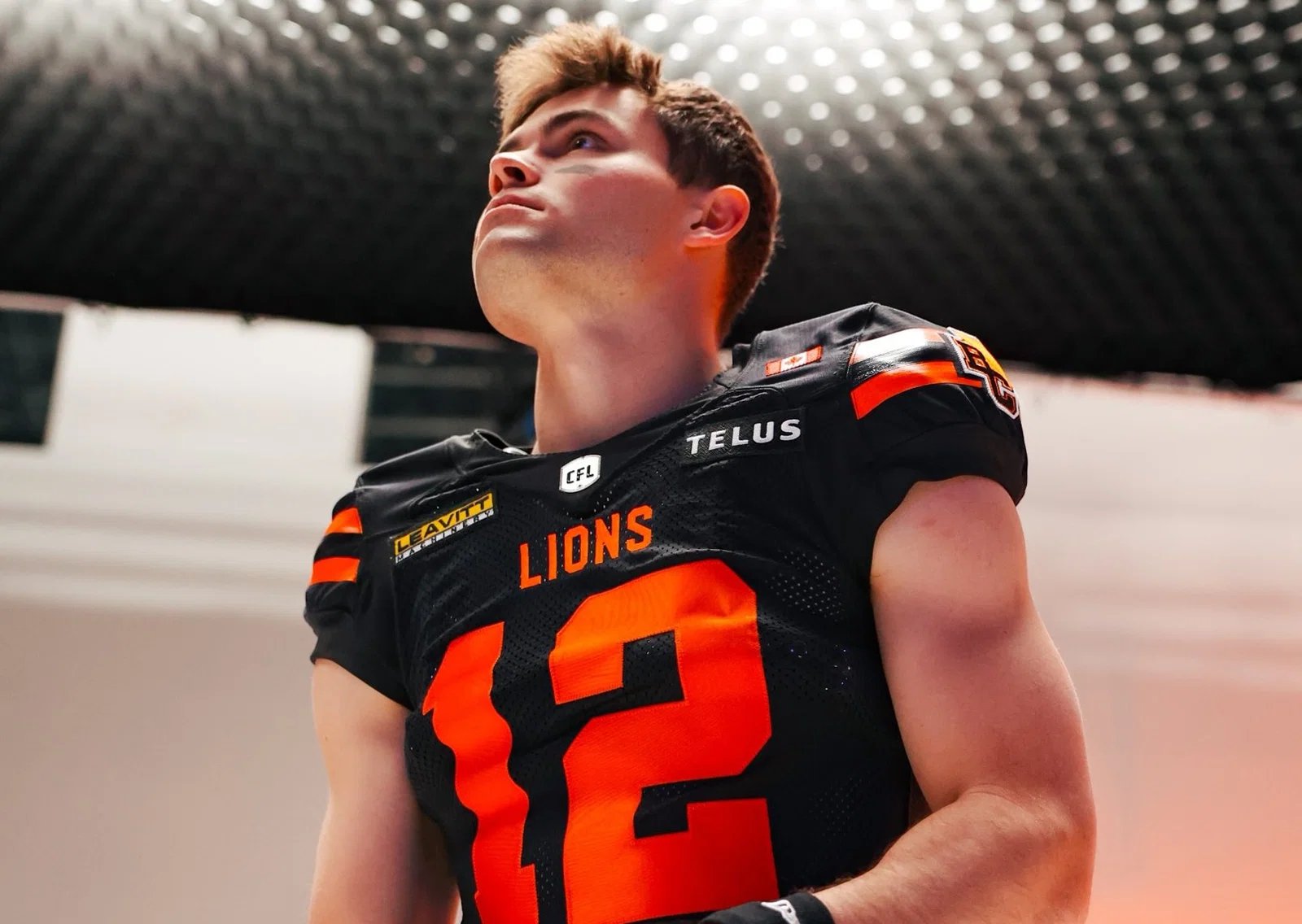
Photo courtesy: B.C. Lions.
3DownNation has put in the work — down to the dollars and cents — for our publication’s annual show-me-the-money series.
Our site will unveil the Canadian Football League’s highest-paid players from each position group. It starts with the most important position in football: quarterback. Check back over the coming days for the league’s top-earning running backs, receivers, offensive linemen, defensive linemen, linebackers and defensive backs.
“Hard money” is a CFL term that refers to any portion of a contract that is paid even if a player is hurt. That can includes base salary, signing bonuses, roster bonuses, housing allowances, travel allowances, and training allowances. Marketing money, which is officially called “non-football-related services,” isn’t always guaranteed, though we’ve decided to include it in hard money for our series.
Any additional components — often referred to as “playtime” or “performance incentives” — are outlined in part or in full in the paragraph accompanying each player. These bonuses are often tied to how much a player sees the field, produces yardage, scores a touchdown, makes tackles, or whether or not they’re named an all-star.
Please note “N” denotes national players and “A” denotes American players.
1) Nathan Rourke, B.C. Lions (N)
Hard money: $684,700
Maximum value: $684,700
The Victoria, B.C. native was the highest-paid player in the CFL last year, earning $624,200.
Rourke’s 2026 compensation comes from a $275,000 base salary, $210,000 February 5 active roster bonus, $160,000 in marketing money, $14,700 in housing, and a $10,000 training allowance. His hard money will increase in 2027 and 2028.
2) Chad Kelly, Toronto Argonauts (A)
Hard money: $625,000
Maximum value: $625,000
Kelly’s 2026 compensation comes from a $210,480 base salary, $160,000 February 1 active roster bonus, $125,000 in marketing money, $65,000 signing bonus, $25,000 report and pass bonus, $20,000 training allowance, $15,420 in housing, and a $4,100 training allowance.
3) Zach Collaros, Winnipeg Blue Bombers (A)
Hard money: $550,000
Maximum value: $550,000
Collaros’ 2026 total comes from a $300,000 base salary, two separate $100,000 offseason bonuses on January 1 and January 15, plus a $50,000 signing bonus for taking a $50,000 pay cut.
4) Vernon Adams Jr., Calgary Stampeders (A)
Hard money: $500,000
Maximum value: $500,000
Adams Jr.’s 2026 compensation comes from a $225,000 signing bonus, $210,000 base salary, $20,000 travel allowance, $15,000 training allowance, $15,000 in marketing money, and $15,000 housing.
5) Bo Levi Mitchell, Hamilton Tiger-Cats (A)
Hard money: $485,300
Maximum value: $515,300
Mitchell’s 2026 compensation comes from a $210,000 signing bonus, $210,000 base salary, $40,000 in marketing money, $15,300 for housing and a $10,000 travel allowance. He has an additional $30,000 available in incentives, which can be unlocked if he makes the active roster and plays one snap in 16 games.
6) Trevor Harris, Saskatchewan Roughriders (A)
Hard money: $455,300
Maximum value: $509,300
Harris’ 2026 compensation comes from a $220,000 base salary, $190,000 signing bonus, $25,000 in marketing money, $15,300 in housing, a $5,000 travel allowance for $455,300 in hard money. He has an additional $54,000 available in playtime money — $3,000 per game for playing 51 percent of the offensive snaps.
7) Davis Alexander, Montreal Alouettes (A)
Hard money: $404,000
Maximum value: $446,000
Alexander’s 2026 compensation comes from a $180,000 signing bonus, $141,080 base salary, $50,000 in marketing, $15,420 in housing, $12,500 in travel, and $5,000 in training. He has an additional $36,000 available in playtime, plus $6,000 in all-star and award incentives.
8) Cody Fajardo, Edmonton Elks (A)
Hard money: $395,500
Maximum value: $447,500
Fajardo’s 2026 compensation comes from a $190,000 signing bonus, $135,080 base salary, $35,000 in marketing money, a $20,000 travel allowance, and $15,420 in housing. He has an additional $52,000 available in active roster, statistical and award incentives.
9) Dru Brown, Ottawa Redblacks (A)
Hard money: $321,00
Maximum value: $387,000
Browns’s 2026 compensation comes from a $150,000 signing bonus, $131,000 base salary, $15,000 in marketing money, $15,000 in housing, and a $10,000 travel allowance. He has an additional $66,000 available in playtime, statistical, all-star and award incentives.
10) Jake Maier, Ottawa Redblacks (A)
Hard money: $200,000
Maximum value: $263,000
Maier’s 2026 compensation comes from a $94,600 base salary, $75,000 signing bonus, $15,400 in housing, $7,500 travel allowance, and $7,5000 in marketing money. He has an additional $63,000 available in playtime, statistical and award incentives.
11) Taylor Powell, Edmonton Elks (A)
Hard money: $145,000
Maximum value: $220,500
After earning $89,500 with Hamilton in 2025, Powell garnered a $55,500 hard-money raise from Edmonton to sign in the Alberta capital.
12) Dustin Crum, Montreal Alouettes (A)
Hard money: $140,000
Maximum value: $202,000
After earning $105,000 in hard money plus at least an additional $18,000 in playtime cash with Ottawa in 2025, Crum received a $35,000 hard-money raise from Montreal to go to La Belle Province and back-up Davis Alexander.
13) Nick Arbuckle, Toronto Argonauts (A)
Hard money: $135,000
Maximum value: $195,000
Arbuckle earned $130,000 in hard-money plus an additional $50,000 in playtime cash last season with the Argos.
14) Tre Ford, Hamilton Tiger-Cats (N)
Hard money: $130,000
Maximum value: $262,000
After earning $257,000 in hard money plus at least an additional $18,750 in playtime cash with Edmonton in 2025, Ford took a pay cut going from a projected starter to Bo Levi Mitchell’s backup.


