
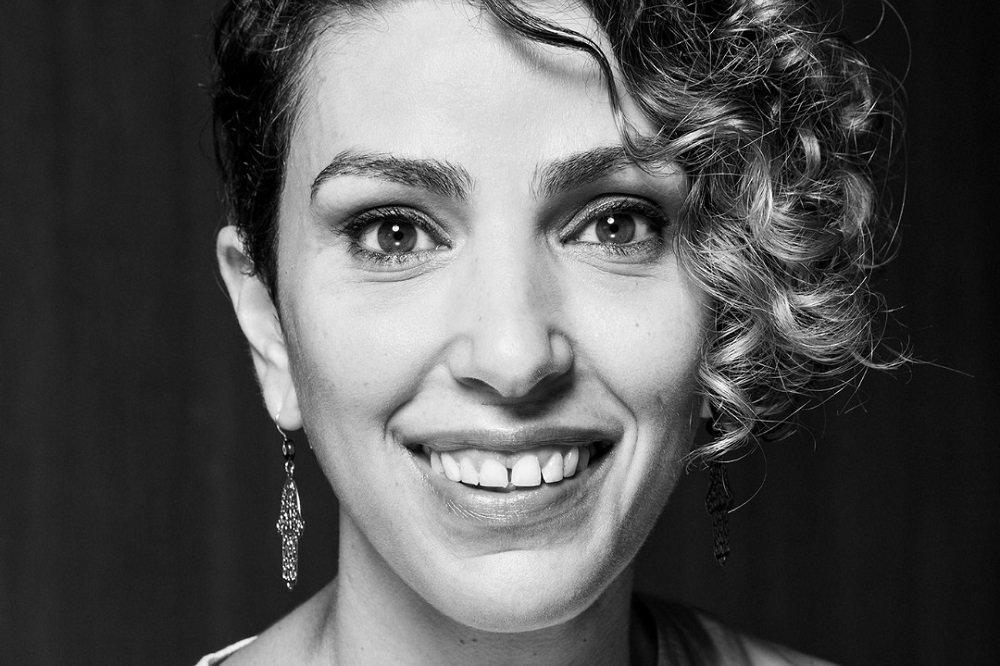
“I look abroad because I think it adds value to Swedish film, not because there’s a lack of it”
– The Swedish producer discusses building an international slate, protecting the theatrical experience and working across cultures, identities and languages
(© Frank Schoepgens)
Having entered producing after initially dreaming of acting, writing and directing, Sweden’s participant in European Film Promotion’s Producers on the Move Linda Mutawi has built her practice around stories rooted in cultural intersections and political urgency. Through her company Fikra, she is developing a slate spanning feature films and television, with projects involving Swedish, Danish, Palestinian and Jordanian partners.
Cineuropa: What drew you to producing in the first place, and what kept you in it?
Linda Mutawi: I started out wanting to be an actress, then a writer-director. I’ve always been a very creative person, and those dreams are still there, somewhere. I fell into producing because I thought it was the best way to learn about filmmaking — you see the whole 360-degree view of the process — and I was right. Then I realised I loved it, and that I was good at it, so I just continued. Opportunities kept appearing, and I kept saying yes. But underneath it all, I always knew I wanted to make films. That passion never wavered. I am in this field because I am passionate about telling stories that say something about the world. I always say you have to have a little bit of craziness in you to do this job, so I guess there is a screw loose somewhere.
What are you currently working on, and which projects are you bringing to Cannes?
I am building a slate I am genuinely excited about, all rooted in Fikra’s ethos. The Replaceable (Utbytbara) is a feature by writer-director Abbe Hassan, which follows a young man who infiltrates a trafficking network to avenge his missing brother, only to realise he might still be alive inside the system he is trying to destroy. It is currently a Swedish-Danish co-production with Nordisk Film, and we are looking for more co-producers.
Then there is Dear Tarkovsky, a feature film with Palestinian director Firas Khoury. It is a Palestine-Sweden-Jordan co-production about a Palestinian filmmaker obsessed with Tarkovsky, who stages a fake rescue to con a wealthy man’s daughter into funding his debut feature — only to fall in love with her, triggering a tragicomic chain of love, betrayal, imprisonment and a final act of defiance.
I am also working on Zein, a TV drama in early development. It centres on a senior prosecutor at Sweden’s Economic Crime Authority investigating financial crimes that threaten society from within, torn between what he knows is true and what the system will let him prove — while the cost puts his family’s safety at risk. Across all three projects, I am at Cannes looking for European co-production partners, financing, sales agents and creative collaborators whose work matches their ambition.
Are you going to Cannes with a clear plan, or is it more about seeing where conversations lead?
Honestly, it’s a mix. I have clear goals for each project on the slate, and I know what I’d like to come away from the week with. But I also love that Cannes opens up space for me to expand my network, strengthen existing relationships and form new ones. I never approach a relationship transactionally — I personally don’t like operating that way — so I really value the chance to meet people and get to know them before expecting anything to blossom into a working collaboration.
Sweden has a strong funding system. Does it still work well for you, or do you find yourself looking more and more abroad?
Sweden has a strong tradition of public support for film, and I do not see that changing. But the global industry has been shifting for a long time. Technology, financing, access to stories, streaming and the changing distribution landscape — all of this means that filmmaking now depends on broader collaborations. I am also an international person. I thrive at the intersection of cultures, identities and languages, and I am naturally drawn to those kinds of stories. I think it genuinely enriches the films we make and authentically reflects the diversity of voices within our societies. So I look abroad because I think it adds value to Swedish cinema, not because there is a lack of it.
Have streamers changed the way you think about developing and packaging projects?
Yes. They have widened the net, especially for television, and reshaped the way audiences consume content. Whether that is a good thing or a bad thing, it is the reality. That said, I am very passionate about protecting the theatrical experience. Going to the cinema is both a privilege and a communal way of experiencing art, and we have to cherish and protect it. Audiences have not returned to cinemas in the way they once did, and producers and distributors share the responsibility of bringing them back — that is part of a much broader conversation. At the same time, not every film needs a theatrical release, and that is where streaming platforms play an important role: bringing a wider range of films to audiences who might otherwise never see them, and extending a film’s life beyond the theatrical window.
Do you feel Swedish cinema is still perceived internationally in the same way as before, or is that perception beginning to shift?
I have the advantage of seeing Swedish cinema from both an insider’s and an outsider’s perspective. From where I stand, it is still going strong. Tarik Saleh — with whom I have worked closely — Ruben Östlund, Levan Akin, Nathalie Álvarez Mesén, Ali Abbasi and others are reaching international audiences and winning major awards. I cannot speak for every market’s perception, but the work itself is travelling, and that is what matters.
Are you more drawn to auteur-driven projects, or are you actively exploring more commercial or hybrid formats?
Honestly, I am drawn to what a project is and how it resonates with me and my philosophy. For me, it is about the story and the vision more than the label. I do not want to box myself into either auteur-driven or commercial cinema — I love both, especially projects that have the potential to cross over. I also think it is exciting to challenge yourself as a producer and try different things. Right now, I am involved in an anime-inspired young-adult film, which is completely new territory for me. It has been both great fun and a steep learning curve entering the world of animation. But regardless of the project, what I really care about is audiences seeing the films and enjoying them — making something that entertains and resonates.
As a woman working in film, what have been the main challenges you have faced along the way?
I could not possibly fit the answer into a short paragraph. As a woman, an Arab, a Palestinian, a Muslim, a person of colour, and someone who has worked in five different countries — always as the “outsider” — to say that I have faced prejudice and challenges would be an understatement. At the same time — and I do not say this to sound cliché — I am also a very privileged person, and I remind myself of that every day. I have access, opportunity and mobility, and I live in safety. I get to do what I love, and that is far more than most people in the world have. So the challenges have only driven me further and pushed me closer towards my dreams, rather than becoming something I dwell on.
