
Jumping on countless happy memories of hours spent in front of the arcade machine or game console, video game series adaptations have proven to be an idea gold mine for studios, with classics such as Silent Hill, Resident Evil, Tomb Raider, Sonic the Hedgehog, Mario and Minecraft being remoulded from the consoles to the big screen in hopes of appeasing video game fanatics by featuring their beloved characters and lore in the film world.
One game franchise caught up in film re-tellings is Mortal Kombat, a martial arts-based fantasy game series created by Ed Boon and John Tobias. The series centres on a collection of worldly realms created by Elder Gods, in which teams of warriors fight one another to maintain control of their distinct ones. An initial film adaptation came in 1995 with Paul W.S. Anderson’s film, followed by a 1997 sequel, Mortal Kombat: Annihilation, by John R. Leonetti.
However, the lingering rate of a revamp never strays far from re-worked source material. Coming in as a collaboration between director Simon McQuoid and writer Jeremy Slater, Mortal Kombat II is the sequel to the original 2021 reboot of the film versions of Boon and Tobias’s games, also by McQuoid, who worked from a script penned by Greg Russo and Dave Callaham.
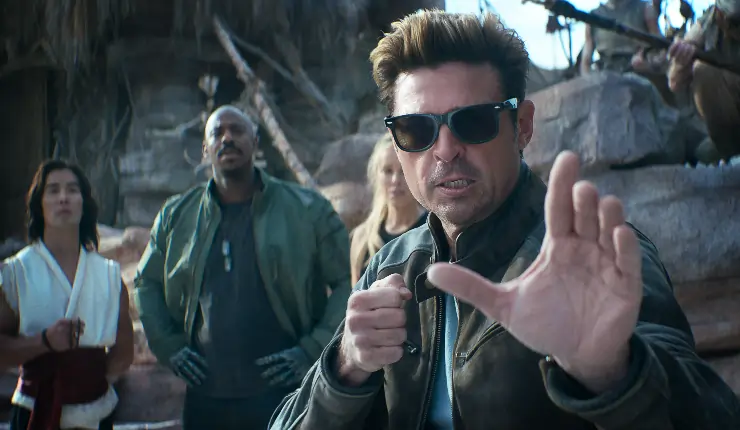
Mortal Kombat II takes off from the events of the first film, with the Earthrealm champions seeking the help of martial arts actor Johnny Cage to help them win a series of tournaments to fight off the oppressive rule of Shao Kahn, involving hand-to-hand combat. Kahn seeks the upper hand by seeking a powerful amulet which will grant him God-like powers, prompting the Earthrealm champions to take on the hunt for the amulet alongside the tournament and training Cage.
The sequel features a return of cast members Jessica McNamee, Josh Lawson, Ludi Lin, Mehcad Brooks, Lewis Tan, Damon Herriman, who dons a new role, Chin Han, Tadanobu Asano, Joe Taslim, and Hiroyuki Sanada. Newcomers to the sequel include Karl Urban, Adeline Rudolph, and Tati Gabrielle.
One immediate obstacle, or at least a response, to a wholly immersive enjoyment and acceptance of viewing such media in today’s landscape is that engaging with contemporary film versions of the original games is that there is an instant fixation on late ’90s to early 2000s nostalgia and sensations. The imagery, dialogue and story events as a whole just feel locked in a time capsule from when the games and first adaptations were created and enjoyed, feeling out of place in today’s cinematic world.
A specific example comes in some of the early lines establishing the film events, and Cage’s responses, which come across as loaded with a nauseating corn and cheese combo, with Cage as a whole battling an ambience of being an original character and a carbon copy of countless sarcastic, slacking, unlikely male heroes we’ve seen before.
Even McNamee’s performance as fighter Sonya Blade, whilst being a highlight of the film with some great capturing of the character and looking incredible in rest and fight mode, oozes that kickass yet sexy early 2000s heroine chic seen in Angelina Jolie’s Lara Croft (Tomb Raider), Milla Jovovich’s Alice (Resident Evil) and Uma Thurman as The Bride (Kill Bill).
Additionally, the pacing and story introduction come across as somewhat rushed and awkward, as though Slater’s writing just wishes to rush straight into the action and the meat of the story. However, once we’re in and watching the tournaments, bursting with the terrific stylised fight sequences and stunts brilliantly rigged by Lee Adamson, everything picks up and rolls swiftly. The fights are, of course, an integral component of McQuoid’s work, and they more than pull it off, with the detailed camera movement, curated by cinematographer Stephen F. Windon, and editing, handled by editor Stuart Levy, allowing for every punch and kick to feel amplified.
There’s also some interesting and clever self-referential material embedded, such as Cage’s retro-style introduction, making for a callback to the 90s, which feels more celebratory than outdated. As mentioned, with McNamee in the role of Sonya, Mortal Kombat II achieves solid characterisation as a film adaptation of a video game, featuring a stellar and colourful array of beloved characters. The cast committed to each character intensely, with Asano’s Lord Raiden, Sandana’s Hanzo/Scorpion, Lin’s Liu Kang and Brooks’s Jax serving as shining highlights alongside McNammee.
Additionally, Rudolph is given a chance to shine as fan favourite Kitana, who runs the course alongside Urban’s Cage as the film’s focal points of character development and influence. Rudolph balances the layers of Kitana’s character, given her circumstances in the film, steadily and provides the emotional breakthroughs to balance out the overall action-packed, aggressive tone.
Overall, Mortal Kombat II eventually triumphs over some pacing and tonal complications to wholly deliver on the central action and vibrant characterisation, sprinkling in some great punches of comedy. Fans of the games are handed highlights and downsides, such as visual settings feeling choppy, yet the overarching action shines fiercely, with the overall feature expanding solidly from the original.
★★★
In cinemas on May 8th / Karl Urban, Jessica McNamee, Josh Lawson, Ludi Lin, Mehcad Brooks, Lewis Tan, Damon Herriman, Chin Han, Tadanobu Asano, Joe Taslim, Hiroyuki Sanada, Adeline Rudolph, Tati Gabrielle/ Dir: Simon McQuoid/ Warner Bros Pictures, New Line Cinema / 18
Discover more from
Subscribe to get the latest posts sent to your email.
