
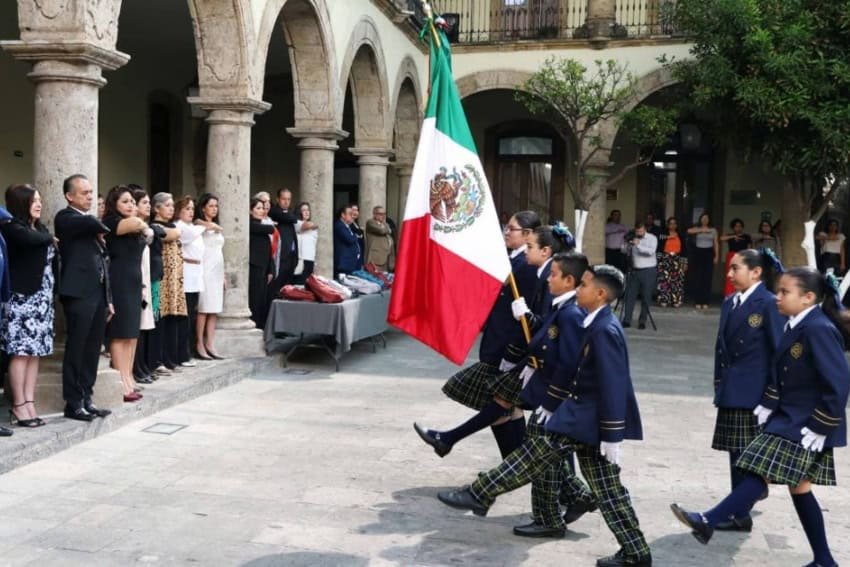
Yesterday, I went to the final Honores a la bandera — flag ceremony — at my daughter’s elementary school. She’s “graduating” next week, so it’s the last one she’ll have participated in at that school.
This one was extra special because the 6th grade “escolta” (escorts?) passed the flag on to the 5th grade ones as a symbolic gesture. Now they’ll be the school “elders” that keep it going! To add to the ceremony of it, a state police band came with trumpets and drums, the leader directing with a spinning trumpet.
In schools, every flag ceremony is basically the same. First, the escolta marches forward, directed by one extra responsible kid in military fashion. Parents of whichever group are performing the ceremony are invited to attend, and all are instructed on what to do by another kid: stand at attention, salute and put ourselves at ease.
We say the pledge of allegiance and we sing the national anthem. At my kid’s school, the kids not in the escolta read “fun facts,” some in garbled English. The flag is ceremoniously walked back. The ceremony ends, and then we can all take pictures with our kids before they go back to class.
It’s all very official.
Getting emotional over the flag ceremony
Here’s a video of it. This isn’t my kid’s school … just one of many I found online. This one has a drum line!
It’s hard to describe what a flag ceremony here does to me, even when — especially when? — it’s performed by kids. I cry literally every time.

Granted, I’m a crier. Any kind of ceremony where lots of people are doing the same thing just makes me bawl my eyes out. Ceremonies, concerts, parades — I can’t wear mascara to a single one of them. Lots of people being very serious about something all at once just gets to me.
It’s also just amazing to me that for a culture that is so incredibly bromista (prone to joking) in so many ways, this is something they take deadly seriously. Even among small children, there is no horsing around. Being chosen to be in the escolta is an honor, something kids brag about to their parents when they get home.
Pledging allegiance
It’s also just so touching, in a time when so many things are changing so quickly, to feel what the late Congressman John Lewis called “the spirit of history.” The ideals we pledge during these ceremonies are the same ones that have been pledged for decades. The ceremony is the same one now as it was in the 1980s.
Another thing I find interesting about these ceremonies is that they’re, to use the parlance of the day, “left-coded.” The parents who take off work and show up enthusiastically to these ceremonies are usually the most liberal ones. This makes sense, because Mexico has had “left-wing” governments for most of its modern history, save the years that the PAN was in control.
But it’s interesting to me because in the United States, where I’m from, it’s the opposite. Republicans are the ones who are perceived to “own” patriotism (the same way they “own” Christianity).
Here, everyone gets to “own” it, and they do. The officialness of it surprises me every time.
So let’s examine some of the elements here of the Honores a la bandera. First, there’s their pledge of allegiance (called the Juramento a la bandera), which is pretty dang beautiful. Here it is, in Spanish and English:
English version
Flag of Mexico!
Legacy of our heroes,
Symbol of the unity of our parents and our siblings.
We promise to always be faithful
To the principles of liberty and of justice
Which make our homeland an independent, humane, and generous nation.
To which we give our existence.
How to salute properly
While you recite this, by the way, you hold your right arm out toward the flag, palm down. When I suggested to my partner that this felt weird because it resembled the Nazi salute, he immediately took offense. “But that’s not what it is at all!”
Mexicans: Their official honorific gestures are not up for debate. Nor is the national anthem: you’re not allowed to make fun of it or sing a parody, or change any words. And if you’re a TV or radio station, you have to play it when coming on air or signing off (most stations are 24-hour, of course, so do it at midnight).
The national anthem, I’ll admit, I’ve never completely learned. To be fair, it’s got 10 stanzas, all right? Okay, fine. It’s now only four. But four is still a lot! Still, I should make more of an effort than I’ve made before, at least to learn the one stanza with the chorus that’s typically sung in school ceremonies.
Alas, the lyrics that I do know often make this lifelong pacifist clutch her pearls. One line that always stands out to me: un soldado en cada hijo te dio — “a soldier in every son was given to you.” And technically, that’s true: all Mexican males are required to complete military service once they turn 18 (with a few exceptions).
Singing the national anthem
The version sung for flag ceremonies is short, and I’ll put the lyrics, translation and a video with lyrics here in case you’d like to learn it. It’s certainly time for me to do so!
Here’s a “sing-along” video in Spanish, and below I’ll include an English translation. (Ojo: you can’t sing it in English. Like, legally you can’t.)
English version:
(Chorus) Mexicans, at the cry of war
make ready the steel and the bridle,
and let the earth tremble at its center
at the resounding roar of the cannon. (repeat last two lines)
(1st verse) Oh Fatherland! May the divine archangel of peace
wreathe your brow in olive,
for your eternal destiny in Heaven
was written by the finger of God.
But should a foreign enemy dare
to profane your soil with his step,
think, oh beloved Fatherland! that Heaven
has given you a soldier in every son.
(repeat chorus)
And even though my daughter is graduating from elementary school, these will be taking place in middle school as well. I’ve got three more years to sing along properly! … if I can stop myself from choking up.
Sarah DeVries is a writer and translator based in Xalapa, Veracruz. She can be reached through her website, sarahedevries.substack.com.
