
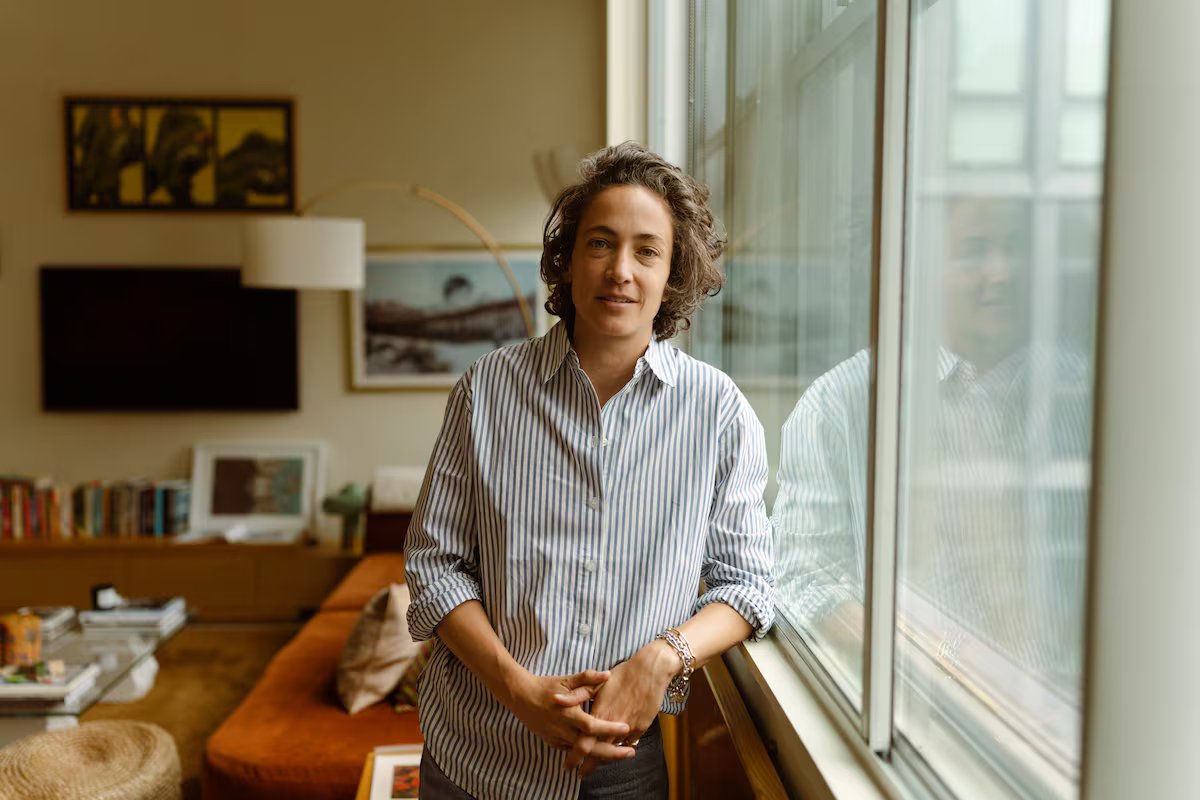
Paola Ramos (Miami, 39) has a lot of questions and few answers. Far from being bothered by this, she finds it exciting. The journalist and writer is perhaps one of the few people who find motivation in the uncertainty that has gripped Donald Trump’s United States. It is the chaos and anguish caused by the Republican that Ramos wants to delve into. She wants to be among the communities affected by the president’s mass raids and deportations — which are also her own communities, Latinos and Hispanics — to understand the country’s broken spirit and determine whether it can be mended.
That possibility seems particularly remote when Ramos welcomes EL PAÍS to her apartment in Williamsburg, New York. It has been only 72 hours since an agent from U.S. Immigration and Customs Enforcement (ICE, as it is known by its dreaded acronym) shot and killed a young Colombian man in the state of Maine. His name was Johan Sebastián Durán Guerrero. Days earlier, Lorenzo Salgado Araujo, a Mexican national, died in the same way in Texas. Both add to a record number of deaths caused by Trump’s immigration crackdown. A reality that, according to Ramos, raises the question: “Are we a country of immigrants or not?” “Maybe not,” she answers herself. “We’ve always had that struggle of ‘Who are we?’ and I don’t think we know,” she says during an interview conducted in Spanish, letting a phrase slip out naturally in English — the language that, throughout her career, has allowed her to share the reality of the Latino and Hispanic communities with an entire country.
Ramos, the daughter of journalist Jorge Ramos — with whom she launched a podcast last year in English — will participate on Wednesday, July 22, on the panel “Our Journalism Under Attack,” organized by EL PAÍS as part of the annual National Association of Hispanic Journalists (NAHJ) conference. The Emmy Award winner and former political strategist for the Democratic Party speaks to EL PAÍS at a critical moment for Spanish-language journalism in the United States.
Question. In the last two weeks alone, three migrants have died in encounters with ICE. Has Trump taken his immigration policy to a point of no return?
Answer. Trump is doing exactly what he wants to do. What I fear is that we’re only seeing the beginning. For them, this anti-immigrant campaign has little to do with politics. I don’t think they’re looking at the polls. Strategically, they don’t care what happens in November, because for them this struggle is an ideological battle, not a political one. It’s about how this White House can bring an end to this country’s natural demographic progress. They understand that by 2050, minorities will be the majority. That prospect is an existential battle. So, whatever the cost, they’re going to keep doing it. This is a defining moment in the history of the United States — a country that must ask itself what kind of nation it is — and we have very little time to answer that question.
Q. If this is just the beginning, can it be stopped? Can we recover as a country?
A. The moral burden doesn’t lie with Trump. The moral burden lies with the American people. These are the same people who, in 2018, wept when they heard the cries of those children being separated at the border — and who twice chose to vote for Trump. Immigration has become not a Latino problem, but an American crisis. Now that people living in Maine or Minnesota — who for decades have been able to maintain a certain distance from the border and an emotional distance from these immigrant stories — are experiencing it firsthand, what now? How we answer that question defines the next historical phase of the United States.
Q. Don’t you think the American people have already begun to answer that question by electing Trump twice?
A. The American people, including Latinos, are not immune to these anti-immigrant sentiments. To understand the Latino voter is to understand that we ourselves carry a very complex history and that we, too, can see something powerful in Trump’s vision. However, the difference between 2016 and 2018 is that now, in almost every state in this country — whether Democratic or Republican, whether you’re in a rural or urban area — everyone is exposed to raids. Immigration is no longer a theoretical issue. Perhaps that is what will lead to a change of heart, so that suddenly people truly humanize something that is very difficult to humanize.
Q. In this relentless news cycle, in which tragedies like the one in Maine keep happening, what is the importance of the media’s work?
A. It’s about returning to journalism’s original mission: telling the truth in a country and an environment where those at the highest levels are trying to distort it. They’re normalizing fake news and misinformation. Right now, as journalists, as Latinos, as Hispanics, we have not only a professional but also a moral responsibility to guide readers and audiences to understand what is at stake in this country.
Q. And to help humanize something that too often is reduced to mere headlines and statistics…
A. We in the media have also helped fuel this situation. If you don’t call Johan Sebastián Durán Guerrero by his name and don’t mention that he’s a father with a three-year-old daughter and a wife — and instead just refer to him as an immigrant — we’re not doing our job. We not only have a duty to humanize, but also to try to break away from language that has already become part of the fabric of the United States, where many media outlets lack even the vocabulary to respect these people and see them as human beings. Furthermore, we face a difficult challenge: people are very afraid to speak out and have a great deal of distrust toward the media. How do we ensure they continue to trust us? We cannot do our job without them. We must nurture that trust.
Q. We’re approaching the November elections, which — like those in 2018 — will be crucial for the future of American democracy. What lessons do you think the Democratic Party should keep in mind in light of the 2024 results?
A. What’s interesting about the midterm elections we’re about to see is that they aren’t a referendum against Trump. They’re going to be a referendum against the Democratic Party. Trump is a product of widespread disillusionment among many Democratic voters — such as young people, Latinos, and African Americans. They’ve felt deeply let down by a party they believe hasn’t stood up for them. For me, that’s what will be interesting: understanding what voters are saying against the Democratic Party — a party that even today lacks a collective identity and a unified message. Morally, it’s still trying to define itself. The Democratic Party needs to be very clear about what it means to defend human rights and what it means to defend immigrants.
Q. Do you think Latinos regret their decisions in November 2024?
A. I always bring up the numbers because I find it quite remarkable that someone like Trump, promising mass deportations, won nearly 50% of the Latino vote. And not only that, but he won a very high percentage of naturalized citizens. Many of them believed him when he said he was only going to go after criminals. Now they’re realizing that Trump is talking about them — that, in the Trumpist worldview, being Latino also means potentially threatening that white vision they hold. I’ve met quite a few Latino voters — even here in the Bronx, in Miami, and in the Rio Grande Valley — who regret their choice, though in a very subtle way that doesn’t necessarily translate into a vote for the Democrats. What I think we’re experiencing — at least among Latinos — is really an identity crisis. Who loves me? Where do I feel at home?

Q. Questions to which the Democrats aren’t offering sufficient answers.
A. No, because today’s Democrats are responding to Trumpism. What’s interesting about the conversations taking place among Democratic voters is that, suddenly, ideas that were once considered radical — such as wanting to abolish ICE — are becoming normalized. Now, for example, according to YouGov polls, approximately 50% of Americans support that measure. Six months ago, that was a radical idea.
Q. Amid the deluge of news, what are you most passionate about working on right now?
A. I love trying to understand the complexity and the contradictions that define us as a community. I want to delve into the margins of the stories we see every day and understand a moment when people are trying to answer very simple questions. What does it mean to be Latino, and what does solidarity mean? It’s a moment when we don’t have many answers as journalists, and that’s the best part.
Sign up for our weekly newsletter to get more English-language news coverage from EL PAÍS USA Edition
