
– Yuliia Hontaruk’s emotionally direct, 12-year portrait of three Ukrainian fighters reveals how war endures not only in the trenches, but in homes, families, language and memory
Yuliia Hontaruk‘s To Die to Live, which world-premiered in the Special Screenings section at the 60th Karlovy Vary International Film Festival, is the kind of documentary whose long gestation is not simply a production detail, but the very source of its power. Filmed over 12 years, the Ukrainian-Latvian-Slovak co-production follows three Ukrainian men – Shakhta, Dancer and Potter – who volunteered to fight in 2014, returned to civilian life after the first phase of the war, and were later pulled back into history by Russia’s full-scale invasion in 2022.

The film begins, inevitably, with war: Hontaruk’s camera takes us into trenches, ruined spaces and military positions where danger is never abstract. Yet what makes To Die to Live stand out is not the combat footage itself, but the time it spends with its protagonists away from the front. Its most revealing scenes are often those in which the men are back home, trying to rebuild some version of ordinary life while knowing that normality has become unavailable to them. The war does not end when they leave the battlefield – it lingers in their relationships, their silences, their bodies, their sense of time.
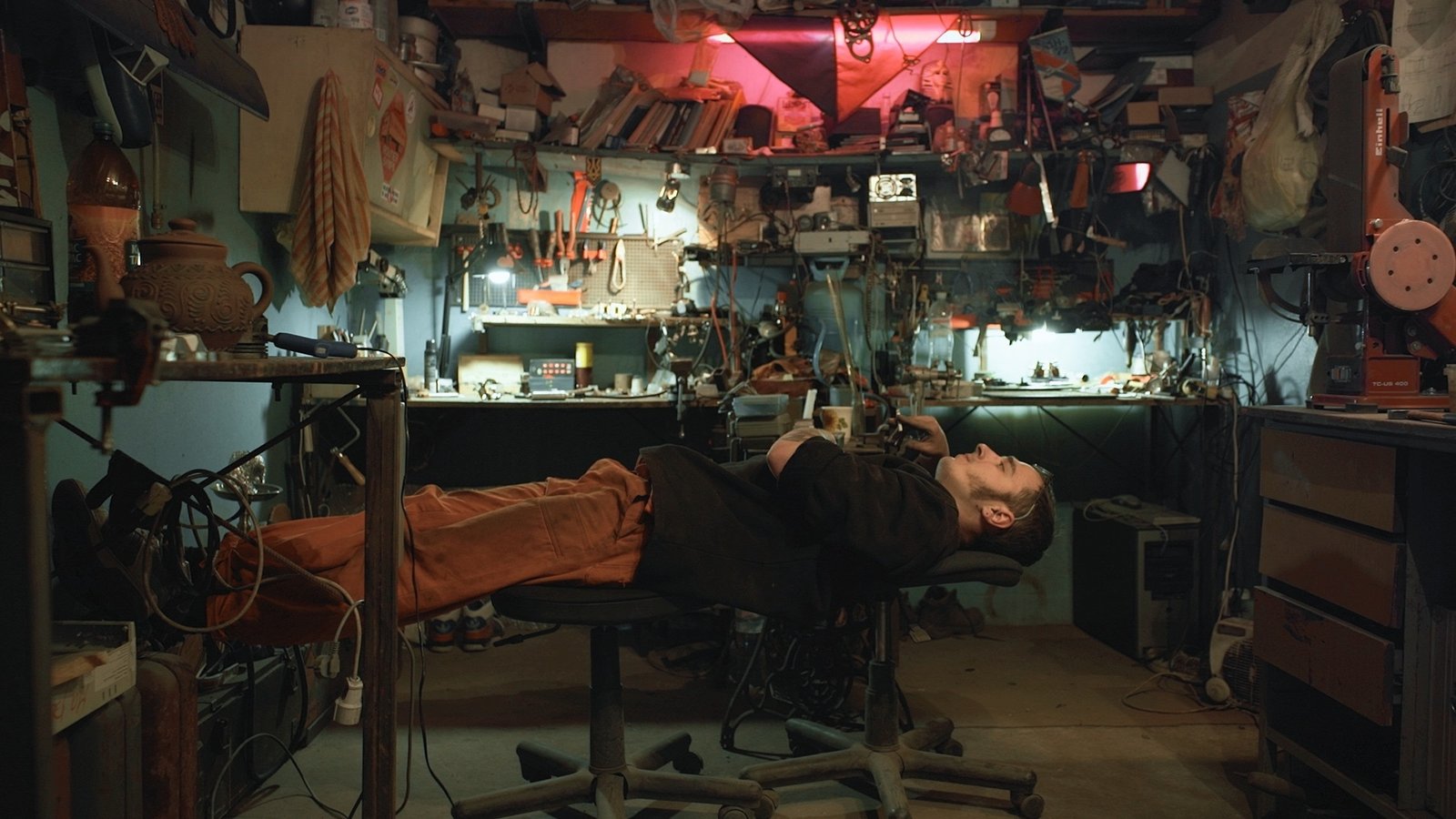
Hontaruk is helped by the fact that her three protagonists are extremely compelling and sharply distinct. Shakhta is the film’s most overtly reflective presence – wounded, articulate and increasingly haunted by the fear that the conflict will not end with his generation, but be passed on to Ukraine’s children. Dancer carries a different energy, tied to movement, discipline and the fragile possibility of grace. Potter is the quirkiest of the three, and the source of several of the film’s rare flashes of humour and lightness, which are all the more precious for never feeling imposed. Each man has his own rhythm, passion and motivation, but all three are bound by the same terrible knowledge: once death has become a daily companion, life can no longer be resumed as if nothing had happened.
One of the film’s strongest achievements is that it never needs to overstate how omnipresent the war has become. It is everywhere: in school lessons, in public spaces, on billboards, in private conversations and in the fight against Russian propaganda. Hontaruk also commendably underlines the importance of language in this struggle, especially for those Ukrainians who grew up speaking Russian as their native tongue. When Shakhta tells a classroom that their biggest weapon is their language, the line lands not as rhetoric, but as a hard-earned political and existential conclusion.
There is, admittedly, a simplicity to the documentary’s moral framing. Its emphasis falls on what one character describes as a “bipolar world”: on one side, a force that wants to conquer and subjugate; on the other, people who want simple freedom. In another context, this might sound too schematic. Here, it feels honest, because this is not an abstract geopolitical thesis, but the world as understood by men who have had to fight, lose friends, return home, leave again and keep living through uncertainty.
Formally, To Die to Live is direct and largely unadorned. Despite the large team of cinematographers and editors involved, the film maintains a surprisingly coherent audiovisual language, one suited to a documentary that needs no flourishes, only to go straight to the point. Its structure deepens as time passes: the longer we stay with these men, the more their reflections open up, and the more painful the gap becomes between resilience and exhaustion.
What remains is a highly emotional viewing experience, and a sobering awareness that, over these years, little has fundamentally changed except the scale of uncertainty. Yet Hontaruk does not reduce her protagonists to victims. She shows civilians forced to abandon their lives, soldiers grappling with PTSD, families getting by day after day, and a country displaying extraordinary strength against all odds. To Die to Live, then, is not only a film about the devastation of war, but about the stubborn, almost irrational insistence on life after one has already learned how close death can be.
To Die to Live was produced by Babylon’13 Production (Ukraine) and Directory Films (Ukraine) and co-produced by VFS Films (Latvia) and Silverart (Slovakia).
