
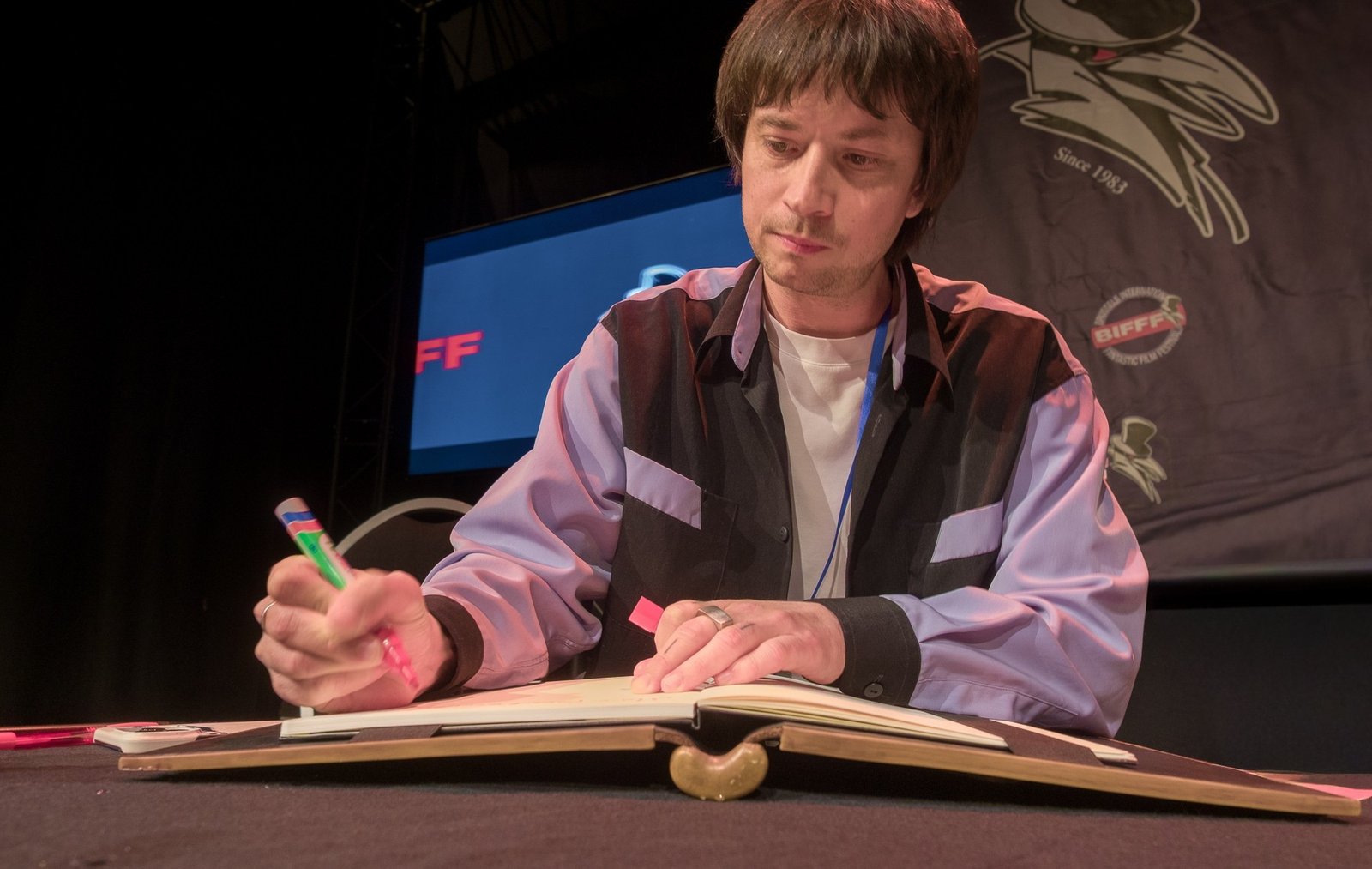
“Kyma is my answer to US movies: it’s about a mysterious being that doesn’t arrive in Manhattan or in Los Angeles, but in my region in France”
– The French director breaks down his story about three teenagers trying to save a mysterious, sound-based entity from secret agents who intend to weaponise it
(© BIFFF/Michel van Reysen)
Kyma celebrated its international premiere in the Méliès competition of the 44th Brussels International Fantastic Film Festival (BIFFF), which took place from 3-18 April. Of all of the films in this section, Kyma was the only one aimed at a teenage audience. The story centres on three adolescents who are trying to save a mysterious, sound-based entity from secret agents who intend to weaponise it.
In our interview, director Romain Daudet-Jahan talks about how he came up with the idea, how he managed to combine his love of science with his love of cinema, and the similarities between hypnosis and filmmaking.
Cineuropa: How did you come up with the idea for Kyma?
Roman Daudet-Jahan: First of all, I’ve been passionate about science since I was a kid. At secondary school, I met the astrophysicist André Brahic, who had an almost romantic relationship with science. What’s more, science fiction is a very popular genre in French literature, as you can see from books such as Planet of the Apes.
As I got older, I took an interest in cinema. With Kyma, I wanted to tell a story that I would have loved to see as a child: one about aliens landing in my region in France, rather than in Manhattan or Los Angeles. At one point, however, I decided to create an alien being made entirely of sound – a creature unlike anything we have ever seen or heard before. From a scientific point of view, however, a being composed solely of sound waves could not survive in outer space. It would have to live in a very dense environment – inside the Earth, for example. Thus, Kyma [or “wave” in Greek] became an “intraterrestrial” being.
I read that you’re a trained hypnotist. In what ways are filmmaking and hypnosis similar, and in what ways do they differ?
That’s an absolutely fascinating question! But it’s also so complex that I could never provide a complete answer. Hypnosis involves paying close attention to others; it is the gentleness and tenderness we show others by synchronising with them, listening to them and deciphering their way of thinking. Beyond being an art form through which we express ourselves, cinema is also an art we create for others. I love immersive cinema that takes the viewer on an adventure, that grabs them and lifts them off the ground. Hypnosis is another way of achieving this on an individual level, through suggestion. In this sense, cinema is a sort of amplified form of hypnosis, and the two are closely linked.
You work with several animals in the film – horses, cats and a snake. What were the challenges involved in this?
There are lots of animals in my film because I love them. I think they’re beautiful. To me, they represent a special connection to the supernatural. Besides, working with animals is fun, but tricky. For our shoot, we worked with specialised cat trainers. But shooting with cats always is difficult – they have a mind of their own. You need to set up the camera and be patient. Give the cat space to come to you in its own time.
With the horses, it was different. They weren’t originally part of the film; initially, Ousmane’s character was supposed to work with chickens. Then, we found a farm with horses and decided to include them in the movie. Fortunately, one of the crew members had experience with horses and was able to help us; otherwise, since we didn’t have a horse trainer, including the horses would not have been possible. It was one of those moments where everything magically fell into place.
The sound design in Kyma is very sophisticated, but it can also be unsettling. As a viewer, it feels as though one is an animal exposed to noise pollution. What was your intention with the sound?
The idea wasn’t to make the audience feel uncomfortable; rather, it was to create an all-encompassing sound that would get under their skin. Kyma is like a caged tiger, whose scream is terrifying and makes your insides quiver. I also hope that viewers will begin to empathise with Kyma as the film unfolds, guided by the different sounds it makes and by the way Kyma is depicted through Chladni figures.
However, I did intend to make the audience feel uncomfortable in the scene in which the children are in the soundproof room, and everything goes silent and the children panic. In this scene, Zoé [played by Lucie Loste Berset] is able to use her hearing impairment to her advantage; she is the only one who remains calm and becomes an asset to the others.
