
Steven J. Mihaljevich’s spellbinding exploration of guile and resolve is survival horror at its visceral and gruelling best.
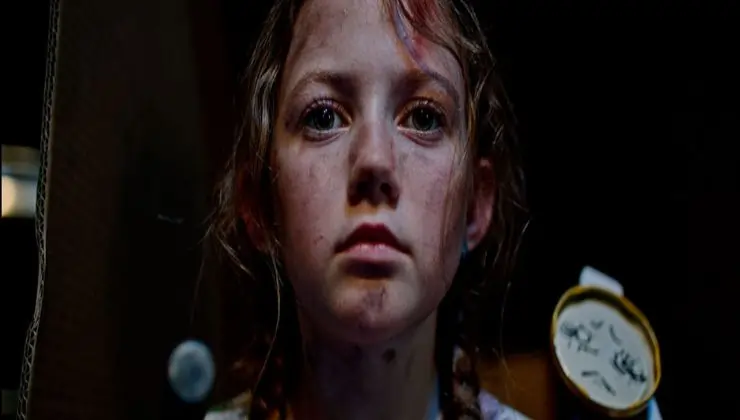
Mia is a 10-year-old girl trapped in a work shed on Christmas Eve, just as a deranged killer butchers her entire family. Alone and terrified, she must escape before she dies of dehydration or hunger while avoiding the grim clutches of the wheezing madman festering in her living room. Shot in just two weeks on a micro-budget, Shed is a hyper-focused manifesto on the popular theory that children are deceptively more resilient than their fragility suggests. Unremittingly bleak, the film places alienation and vulnerability on the altar of hope as we witness a young girl’s will to live, clarified by terror into pure instinct.
After Mia discovers she has lost everything she loves to the random violence of a psychopathic loner, there is no time to process the horrors. Grief must be shelved, and self-pity deferred if she is to outwit the immediate threat of a killer who is addled by alcoholism and riddled with illness but unchecked by solitude and devoid of mercy. At first, resilience and imagination are regulating factors, but as her predicament spirals, Mia becomes a puppet for luck and fate until opportunism offers a sliver of salvation. It’s a gripping ride as the filmmakers encircle us with immersive camerawork and skilful sound design, creating surges of tension entrenched in the earthy realism.
The title is multi-layered, echoing the meticulous texture and cultured inventiveness of the film. The first three letters of Shed are coloured blood red during the opening credits to riff on gender, and bloodshed is exactly what happens. As Mia’s world disintegrates, a deeper reading of the title surfaces as she is compelled to shed the innocence and unconditional protection of childhood and confront a harsh new reality of arbitrary peril and autonomous self-preservation.
Shed is mostly played down for gore, which enriches its non-exploitative credentials, but bloodthirsty viewers will revel in a couple of exceptionally well-staged and unexpected set pieces and a stomach-churning refrigerator reveal. There’s also a brief but bonkers cameo from Wolf Creek‘s John Jarratt, eager to please genre fans with some trademark brutality.
Mani Shanks is utterly committed as Mia. Her grounded depiction of a youngster in dire peril is one of empathetic propagation. She has very little dialogue to work with, relying on wide-eyed emoting and a physical manifestation of dogged determination to carry much of the movie. There is a palpable sense within Shed that the dynamic between actress and filmmakers was fluid in expectations and limits, soliciting a game of artistic ‘chicken’. This greatly enhances its magnetic rawness and constitutes a rare unmasking of the symbiosis between role dedication and narrative realisation.
Rugged and callous, this is feral filmmaking from the grubby underskirts of independent Aussie cinema. A fucked up suburban nightmare that supplants stale horror tropes with chilling existentialism and the intuitive beacon of enforced stoicism.
★★★★
Awaiting Distribution / Mani Shanks, Jason Robert Lester, John Jarratt / Dir: Steven J. Mihaljevich / Cert. TBC
<
Discover more from
Subscribe to get the latest posts sent to your email.
