
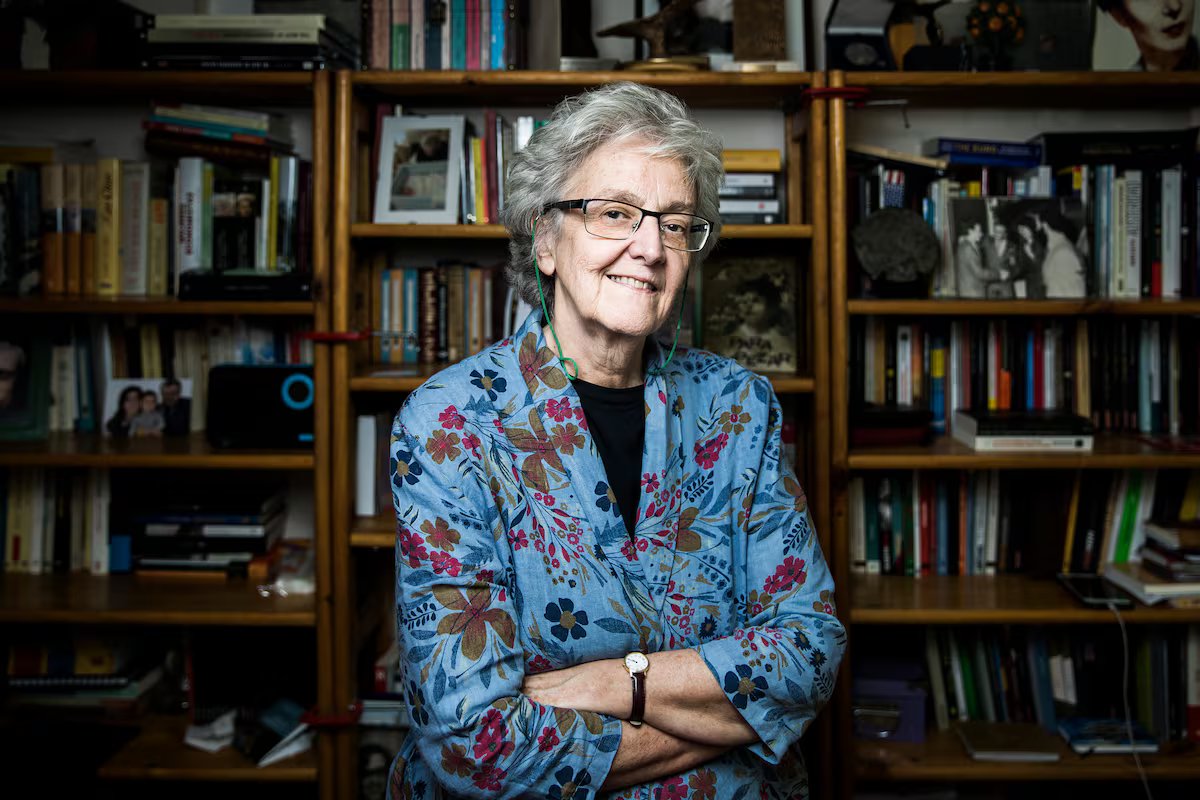
Soledad Gallego-Díaz, who died this Tuesday in Madrid at the age of 75, achieved the major journalistic scoop of Spain’s democratic transition at just 26 years old: the publication in the magazine Cuadernos para el Diálogo of the draft of the Spanish Constitution of 1978, which, for reasons that now seem incomprehensible, was kept under strict secrecy. From then on, Sol, as she was known, was a force to be reckoned with in Spanish journalism: the first female editor-in-chief of EL PAÍS from June 8, 2018, to June 15, 2020; deputy editor under three different editors (Juan Luis Cebrián, Joaquín Estefanía, and Jesús Ceberio); correspondent in Brussels, London, Paris, New York, and Buenos Aires; special envoy to numerous international events, such as the end of the dissolution of the Soviet Union; political reporter; bureau chief in Seville; readers’ advocate; editorial writer; and professor at the newspaper.
In recent years, she published a weekly column in the Ideas supplement under the heading Punto de observación, as well as contributing to Cadena SER. These were texts in which reporting prevailed over opinion, often with surprising titles, written in a direct and effective style, with which many readers began their Sunday newspaper. They were always guided by a principle that defined her entire career: she never told anyone what to think, nor did she try to impose her views amid a deluge of words and adjectives. On the contrary, she made us think — sometimes against ourselves — through arguments and facts.
Above all, Sol was one of the ethical and professional pillars for several generations of journalists, within and beyond EL PAÍS, who found in this woman — warm yet tough at once — a guiding figure in the confusing and exhilarating times the profession has experienced in recent decades. She received every imaginable award, yet no recognition or newsroom position ever distanced her in the slightest from the reporter she always was: a courageous journalist who believed in free information, in the search for truth, and in the importance of journalism in improving society.
Sol was a newsroom journalist — one of the reasons she rejected Juan Luis Cebrián’s first offer to become editor-in-chief of EL PAÍS in 1988 was to avoid distancing herself from what she considered the vital center of journalism — who knew how to work as part of a team and was always willing to share her vast knowledge. The speech she gave in 2018 upon receiving the Ortega y Gasset Award for her lifetime achievement, shortly before being appointed editor, summed up her professional principles: “It is newsrooms that make media organizations great. What is most rare and remarkable about newsrooms is that they do everything better because they do it together, because they respect the same professional procedures, because we learn from one another and collaborate with one another. Because, thanks to that shared culture, we know how to distinguish good journalism from bad.”
The last public event she took part in was the presentation, in April, of the Aurelio Martín Award for Journalistic Ethics, granted for the first time by the Federation of Associations of Journalists of Spain. The jury’s decision was unanimous. She was surrounded by journalists from many generations. She was already seriously ill, but she took the stage to deliver a speech in which she expressed an idea that had been fundamental throughout her life and career: the inalienable capacity to say no. She argued that for a journalist, doing what one wants is very difficult because one is subject to the (almost military) discipline of a newsroom, but one can always refuse to act against the fundamental principles of the profession. In fact, one of Sol’s trademark phrases when she opposed something was: “Well, no.”
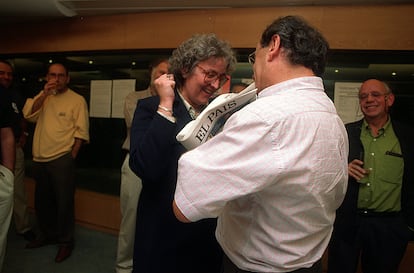
The first time Gallego-Díaz got into serious professional trouble was, in fact, for saying no. She was working at the Pyresa news agency, which was part of the Movement’s Press, a state-controlled network of media outlets, and she was dismissed in May 1975 for going on strike alongside Bonifacio de la Cuadra, one of her great companions in life and in the profession. She was one of the few women in that newsroom, and her dismissal also had that dimension: standing her ground in a profession and in a country that barely made space for them. That agency was her first job, when she was still studying journalism.
Her political commitment came from her family. She was born in Madrid on April 21, 1951; her mother, Cuban, met her father on a trip to Spain. Her father was José Gallego-Díaz Moreno, a mathematician, communist, and persecuted republican. He had to give private lessons at home, attended by a young engineering student named Juan Benet. In Otoño en Madrid hacia 1950 (Fall in Madrid towards 1950), the novelist wrote about Sol’s father: “An hour of mathematics with him provided work for 12 or 15 hours of study during the seven days of the week.”
However, as the scoop that defined her career would show, that commitment never interfered with her work as a reporter: she always followed the facts wherever they led and firmly believed in the need for citizens to be informed, without any kind of tutelage from those in power over what they should or should not know. Nor did Sol accept any kind of paternalism for being a woman — quite the opposite. And it was by no means easy to be a journalist in Spain during the early years of the democratic transition. “Being a woman and young awakened paternal instincts that were professionally disastrous, because you didn’t need a father — you needed to be left to work in peace,” she said in a podcast. Her feminism always bore that mark: it was less a banner than a way of practicing the profession. She did not ask for permission, protection, or to be reminded that she was the first or the only — she asked to be allowed to work, and from there, she opened the way.
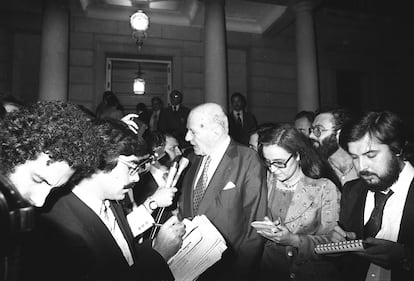
The exclusive that defined her career also sums up her lifelong conception of the profession. I must confess I am not unrelated to that story: when it was published, my father, Pedro Altares, was the editor of Cuadernos para el Diálogo, one of the magazines that brought together the opposition to Francoism, and he felt immense professional pride in the civic courage shown by the protagonists of that story. As Soledad Gallego-Díaz explained in the documentary series En primicia dedicated to her figure, the draft of the Spanish Constitution of 1978 was circulating through Spain’s centers of power but remained secret. The unions had it, the Episcopal Conference, the political parties, the Crown… but not the citizens, who were the ones who would live under that new law.
Three journalists from that newsroom on Jarama Street in Madrid — Gallego-Díaz, José Luis Martínez, another of Sol’s life and professional companions, and the late Federico Abascal — were convinced that there was no reason to keep the text in the dark, and they set out to find it until they did and published it in November 1977. They were accused of irresponsibility and of endangering the constitutional process. But nothing happened — in fact, the opposite: their publication improved the text and opened a public debate on key aspects of the draft.
The three reporters published a delightful account of that scoop the following week, showing it was not a stroke of luck but painstaking and exhausting work. That text also reflects another trait of Sol: she had a great sense of humor, a frank and genuine laugh — although when she got angry, it was better to be several kilometers away. The authors of the leak also explained something that was true then and has only worsened: “The Spanish political class of all stripes has a very particular devotion to secrecy and is remarkably efficient at covering even its most innocent activities under seven veils.” And they confessed that while waiting for their source — whose name has never been revealed — they went through two bottles of a “delicious” red wine. Wine was one of the pleasures that accompanied Sol throughout her life, along with reading, conversation, friendship, and travel.
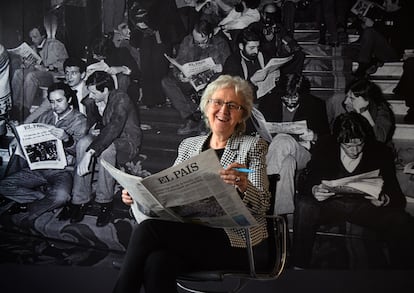
Reviewing the hundreds of articles she signed over nearly five decades is a feast of the very best journalism. The title of one of her columns as the newspaper’s readers’ advocate sums up her credo quite well: “Is there anything worse than a boring lead?” Soledad Gallego-Díaz’s correspondences were important not only for the major stories but also for the small ones. It is moving to read the chronicles she wrote about the sadness and loneliness of the great Hispanist Gerald Brenan in a nursing home in England and his desire to return to the town of Alhaurín el Grande.
Xavier Vidal-Folch, who shared the deputy editor role with Sol and many other adventures, recalled when she received the Aurelio Martín Award, another of the traits that defined her long career: her instinct. “She was always the first to know what was being cooked up and where things were heading,” he said.
She turned down the first offer from Juan Luis Cebrián to lead the newspaper, although the person who eventually became editor-in-chief was another of her closest friends, a companion since the days of Cuadernos para el Diálogo, Joaquín Estefanía. Many years later, in 2018, at a delicate moment in the history of EL PAÍS, she accepted the editorship and left partial retirement to lead the newspaper. She was the first woman to head EL PAÍS in its more than 40-year history, but Sol did not want to turn it into an event. She did not give speeches about glass ceilings or make her appointment a personal cause; she took it on with the same naturalness with which she had entered every newsroom since Pyresa, as someone accepting a job that simply had to be done well. Her feminism was always like that: it was not declared but practiced. And in practicing it, she opened doors that had previously been closed.
She immediately appointed Joaquín deputy editor, a position of great trust. Supported by a highly skilled team that brought together journalists from several generations, with the enthusiasm of the newsroom and the wisdom of Joaquín, Sol earned the trust and complicity of readers.
She also led one of the most difficult coverage operations in the newspaper’s history: the pandemic, with all journalists working from home. She always believed that technology was a tool that helped journalism without changing its essence, and she demonstrated it through that feat, which relied on the drive of the entire newsroom — whom she described as “formidable and powerful” when she stepped down two years later.
Under her leadership, in May 2020, the paywall system was also introduced to ensure the newspaper’s survival. It was a major milestone in the history of EL PAÍS, which Gallego-Díaz decided to delay by three months because of the pandemic, so as not to deprive readers of essential information.
During the two years she was at the helm of the newspaper, she demonstrated an extraordinary capacity for work. She undertook an intense newsroom reform, and the shift to a paywall also required changes in many internal dynamics. Shortly after arriving, she made another defining decision of her tenure: to launch an investigation into sexual abuse in the Catholic Church in Spain, later expanded to the Americas — a massive journalistic project that is still ongoing and that has led to profound changes and compensation for victims. This project reflects two other of Sol’s professional beliefs: that journalism has the power to influence reality far more through information than opinion and that it has a duty to give voice to those who do not have one. In June 2020, with a sense of mission accomplished, she stepped down as editor to return to writing, and reading.
“If I have to be remembered for something, let it be for the honesty and independence of my work. I believe in my profession,” she said in an interview. All of us who had the luck to know and love Sol can say of her what she wrote upon the death of Javier Pradera, the great editorial writer of EL PAÍS whom she deeply admired: “He was an ironic and affectionate friend, ready to lift your spirits in the worst moments and not let them get too high in the best ones.”
The best tribute we can pay her — besides drinking a glass of good wine — is to follow her advice and never give in to what is intolerable. “We cannot prevent what happens, but we must not accept it,” was another of her great phrases. And we should remember that we always have the right and the duty to say “well, no” when someone tries to impose something against the principles she passed on to us.
