
Along with its predecessor, The Iliad, Homer’s Odyssey is one of the earliest landmarks of Western literature. First uttered around 2,800 years ago, the Greek poem has seen many iterations, translations, and attempts to decipher its tale of homecoming since then fully. The core of the book follows the king of Ithaca, Odysseus, as he tries to find his way home after the ten-year-long Trojan War, encountering unimaginable perils along the way. In his absence, a group of suitors have laid waste to his home, leaving his wife Penelope and son Telemachus to try to contend with their savagery.
Most adaptations of the poem attempt a loose translation, often leaving out portions of its incident-filled, island-hopping journey or simply adapting specific segments into something more drawn out, like Uberto Pasolini’s 2024 film The Return, starring Ralph Fiennes, which solely draws from the last portions of Homer’s tale, rather than anything whole. Then there are films like Joel Coen’s 2000 O Brother, Where Art Thou?, which swaps the Mediterranean for the deep American South during the 1930s, as George Clooney takes on the Latin form of Odysseus, Ulysses. In 1995, Greek auteur Theo Angelopoulos made Ulysses’ Gaze. This one follows Harvey Keitel as an exiled filmmaker who finally returns home to his country, where past mysteries come back to haunt him. My point is that Homer’s work has influenced boundless films, but these are the ones that make the fact that they are adaptations of it.
Wolfgang Petersen’s adaptation of The Iliad, in the form of the Brad Pitt-starring Troy, is the most Hollywood Homer has ever been. Whilst that film does actually look like it’s a nearly $200 million budget, something you can’t really say for nowadays blockbusters, it is full of half-arsed stereotypes, dragging it across the ground. And in 2026, Hollywood has given us Christopher Nolan’s blank-check adaptation, titled The Odyssey, which is probably the closest thing we’ve ever gotten to a one-to-one adaptation of the epic poem. Well, in terms of its inclusion of all the book’s incidents at least, less in a complete sense of its predecessors’ themes.
There is one adaptation of the Odyssey, however, that has flown under the mainstream radar for 37 years. Nostos: The Return is an Italian film written and directed by Franco Piavoli that was released, in a very limited capacity, mind you, in 1989. The film reassembles the overall idea of Odysseus (Luigi Mezzanotte) returning home after war, instead of just being lost in a geographical sense, wandering from island to island; the film sees Odysseus lost in time. There is a wondrousness to this film’s temporal sense, because we never get a literal manifestation of its time frames; its freedom is a marvellous and compelling quality. Many adaptations of The Odyssey confine themselves to time, but Piavoli does the opposite. Whilst the film appears linear, it presents Homer’s story as a story within a story.
Despite only having a few lines of dialogue, the film is intentionally subtitle-less. Its limited words are spoken in an imaginary Mediterranean language, inspired by ancient Greek, Sanskrit and Latin. Very few films that do this actually pull this off, and virtually nothing has ever achieved it to this effect. Piavoli puts his images in total control here, sailing the ship of cinematic form, as he tries to avoid the self-serious boundaries of literalism and let the nature of its landscapes and distant echoes reign over you. Nostos: The Return features none of the poem’s fantastical elements that exist in the form of its many monsters, and yet, its impressions are purely that of illusion.
It is a film that shoots our Earth with unimaginable beauty, and yet its landscapes resemble those of a distant, extraterrestrial planet, completely alien to our own. Its sense of fantasy and magic is ingrained into the blue tint of its frames and its equal parts bountiful and desolate murals. Despite actually taking place on another planet, the only work I could compare it to in that sense is Andrzej Żuławski’s unfinished masterpiece, On the Silver Globe, both of which are swept up in rocky landscapes drowned in moments of formal cold.
Similar to Nolan, Piavoli paints a godless vision of the Odyssey in line with his lack of material fantasy. But Nolan’s obsession with that material realism is what drove him down that route, ultimately leading to a film that fails in its humanism, stuck in an awkward limbo of literal and fantastical. Beyond that, it comes down to a shift in technology: Piavoli’s landscapes breathe expansive life into the looseness of his frames, where his focus always lets these backdrops sit and linger past a single subject, so it doesn’t matter that his film is godless, because its awe contains multitudes. Nolan’s obsession with the austere and irrationally confining IMAX 70mm film limits his sense of scope to medium closeups and shallow focus that totally drown out his landscapes, leaving him with little advantage of removing the gods from his source material.
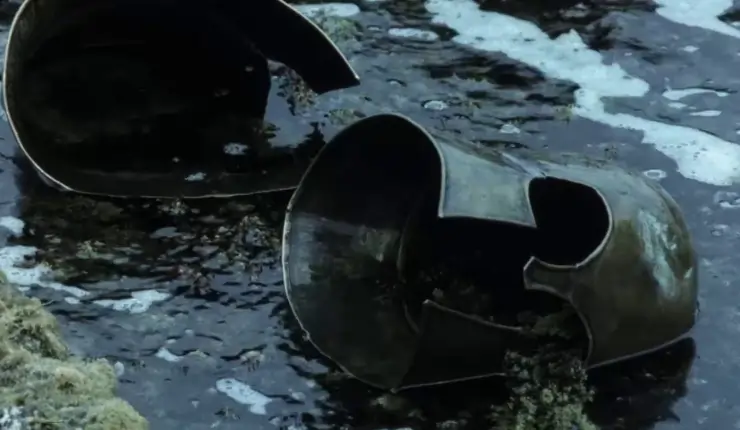
Beyond this, the otherworldliness of Piavoli’s film lies in its dedication to heightening the elemental specifics of Homer’s work into something that is completely engulfed by it. Sequences of armour sinking into pools of water, the ripples of water in caves echoing through our characters’ minds like the guilt of war, endless rolls of hills, clouds framed within the frame of ruined structures, and the setting sun baking the waves. Piavoli doesn’t just picture them in brief; he holds onto them, comes back to them, even after they are gone- the noises of waterfalls, the omens of birds in the sky audibly hang onto the images that don’t resemble them, as time slips away.
We used to live in a haptic world of cinema of tangible senses and images you could reach out and touch; now that only exists in limited numbers. Odysseus wanders through empty halls, in dream and in reality, encountering little human life beyond the unspecified woman of Calypso. This film, at times, holds an odd comfort, a warmth in its intimate soundscape, derived from something so close to a primal form of Earth yet so far.
No one else has ever quite captured Odysseus’ ambiguous doubt about returning home, as Piavoli does here. He clings to the past only through an image of a metal hoop rolling across the hills of his youth, never appearing to topple. Yet as Jonas Mekas once titled a book of his, “There is no Ithaca”. Here, the pining for Ithaca and Penelope are all but a distant mumbling under the breath of Odysseus; he yearns for them in quite desperation, fueled by its uncertainty of physical clarity.
If you classified Nostos: The Return as science fiction, I wouldn’t bat an eyelid; there is nothing else like it; it is fantasy without fantasy, and poignant without any word. Poetry in motion, as the sights and sounds of Homer’s epic wrap around its formalities and never loosen.
SUPPORT INDEPENDENT JOURNALISM! If you enjoy our reviews, interviews and film news, you can help The People’s Movies continue bringing you independent coverage.
Discover more from
Subscribe to get the latest posts sent to your email.
