

The Tower of Babel described in Genesis may have been built not in Babylon, as the biblical account states, but in New Guinea. In the western part of the island, Papua New Guinea, located north of Australia, about 840 languages are spoken despite a population of barely 12 million. By comparison, Europeans — 745 million people — speak a quarter of that number of languages. Such linguistic diversity is exceptional in today’s world, but it wasn’t in the past: a study published in Science shows how the Tower of Babel rose over the last 12,000 years, peaking a few millennia ago and then beginning to crumble.
Today, humans speak or write roughly 7,500 languages. More than half have so few speakers or face so many threats that they are heading toward extinction. Sixty percent of the world’s population communicates in one of the 10 most widely spoken languages. One final figure to complete the picture: each year the last speaker of four languages dies, and with each extinction a portion of knowledge disappears. That is why researchers are so interested in understanding how linguistic diversity evolved in the past, so it can be preserved in the future.
“In the highlands of New Guinea, it’s a kind of Garden of Eden. There is an abundance of available resources. These people have access to incredibly fertile land and the potential for an extremely wide dietary niche,” says Damián Blasi, a researcher at the Catalan Institution for Research and Advanced Studies (ICREA) and the study’s lead author. In reality there is not one Eden but many isolated edens, “with an environment so rich and generous that it reduces the need to wage war or trade with other communities,” Blasi adds; he is also a scientist in the Department of Human Evolutionary Biology at Harvard University (United States). And that isolation fuels linguistic divergence.
What Blasi and his colleagues did was build a model of past linguistic diversity using available data. They used as a basis 171 traditional hunter-gatherer communities, like those in Papua New Guinea. Drawing also on evidence from anthropology, archaeology, paleontology, demography, and other fields, they modeled the evolution in the number of languages from the end of the Paleocene through the current geological epoch, the Holocene.
“The [scientific] literature tells us that 12,000 years ago there were between four million and 10 million people on the planet. So what we asked was: how do we divide that number by the average population size of hunter-gatherer communities?” Blasi says. The dynamics of these groups are limited by available resources and group size. Under normal conditions, beyond a certain threshold, populations split in search of new territories. “So we divide, and that gives you an approximation of the total number of languages,” the Argentine researcher adds. His calculations suggest that at the end of the last glaciation, as the Pleistocene ended, between 4,500 and 6,200 languages were spoken on Earth. However, with the Holocene everything changed.
Improved climatic conditions, aided by innovations characteristic of the Neolithic (the spread of agriculture and sedentarization in different parts of the globe at different times), triggered a huge human population expansion. At the same time, societies grew larger, which meant that more and more people could share the same language.
To capture these opposing processes, the researchers modeled thousands of possible trajectories connecting estimates from the start of the Holocene to the present. Although the precise trajectory remains uncertain, the models produced a general pattern: linguistic diversity increased for most of the Holocene, peaking between 1,000 and 3,000 years ago, with a number of languages roughly 10 times greater than at the end of the Pleistocene.
“The most unexpected result is how recent the linguistic boom appears to have been,” Claire Bowern, a researcher at Yale University (United States) and co-author of the study, says in a statement. “The period of greatest linguistic diversity may not have occurred in the distant Paleolithic [the archaeological equivalent of the geological Pleistocene], but during the era of state expansion and the first empires,” she adds. In other words, it was in the times of the emergence of writing and the rise of great Mesopotamian, Anatolian, and Egyptian civilizations, and beyond them those of the Indus valley and eastern Asia, that the biblical Tower of Babel was tallest.
But it is also with the expansion of the first empires that the decline in linguistic diversity begins. The model also captures later impacts. Perhaps the best known is that of the Roman Empire. When Rome was still a dream, Latin was spoken only in Latium (the present-day Lazio region) on an Italian peninsula where some 400 other languages were spoken. A millennium later, it was the language of half the known world.
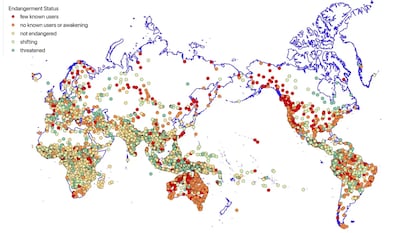
Until now, many theorists and those outside the field blamed European colonialism from the 16th century onward for the extinction of many languages. “This work demystifies the idea that language loss is due solely to western expansion,” says Antonio Benítez, a professor at the University of Seville. “The study’s authors are leading experts and used a multitude of data, from demographic to epidemic records, to carry it out.”
For Benítez, the study highlights what he considers dramatic: “The loss of linguistic diversity implies other losses, because language stores everything that is culturally relevant.” The professor points out the two main predictors of language extinction, both processes inherent to globalization. “The most relevant predictor is the number of miles of road in a given territory.” The second is “the number of years we spend in school,” he adds. Both destroy isolation. Blasi, the study’s lead author, points to a new worry to which he is now devoting his efforts: the impact of artificial intelligence on the languages that remain on Earth.
Sign up for our weekly newsletter to get more English-language news coverage from EL PAÍS USA Edition
