
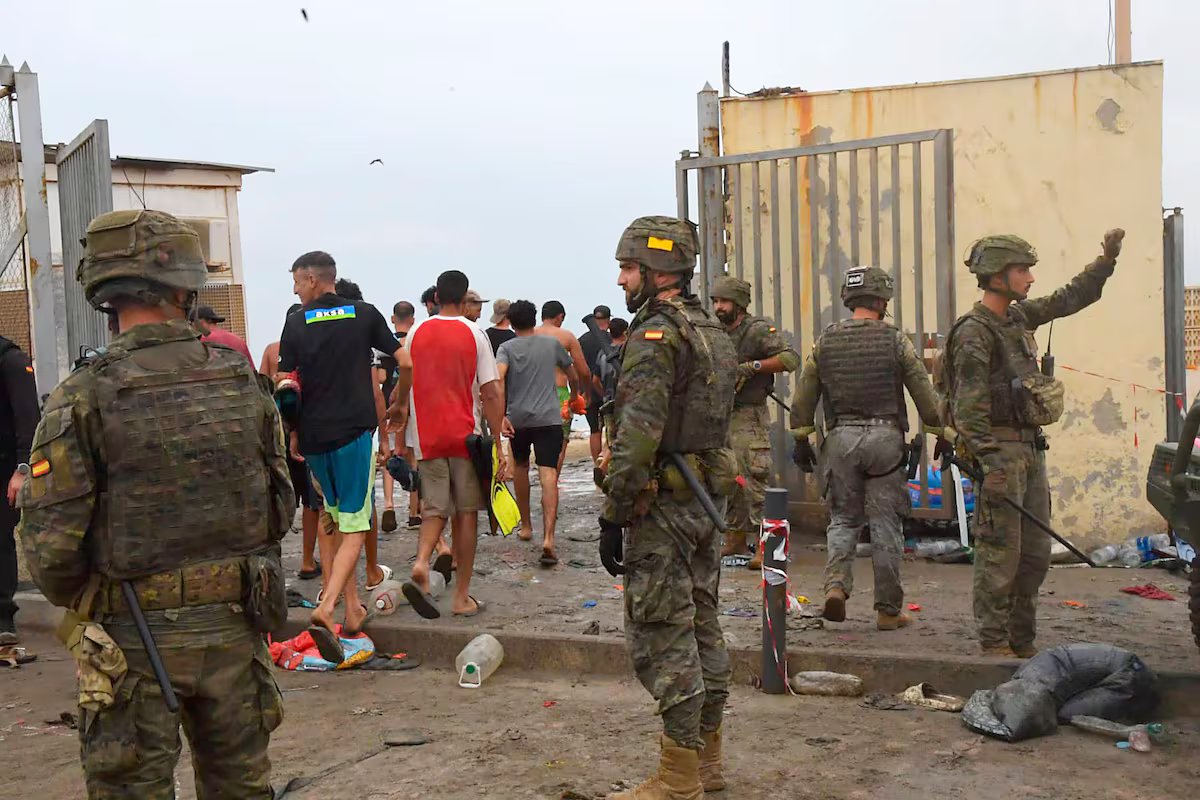
Thousands of migrants who had irregularly entered Ceuta over the past 24 hours began returning to Morocco on Friday, either by the land border or by swimming around the breakwater that separates the Spanish exclave city from the North African country. Spain’s Interior Ministry on Friday placed the arrivals figure at 50,000, and said that of these, 48,300 have already returned home voluntarily.
Some of the returnees said they are going back home because there are too many people in the city, they cannot find places to sleep, shops and bars are refusing to serve them, and they cannot find food. Some have reported mistreatment by residents of certain neighborhoods who have thrown stones at them and threatened them with guns.
Following the concern expressed by some EU members, Spain’s Foreign Minister José Manuel Albares assured on Friday that the integrity of the Schengen area is “absolutely guaranteed,” after Italy said it would introduce border controls at seaports and airports for travelers arriving from Spain. France, for its part, said it would multiply by five the number of agents stationed at its border with Spain. Brussels has denied any movements of people from Ceuta to mainland Spain or elsewhere in Europe.
Had a phone call with Minister Albares. He informed me that, after the sustained efforts, practically all those who had entered Ceuta have returned. Not a single person has crossed to mainland EU. We will remain in close contact and are in touch with ministers across Europe. https://t.co/FBgpOO3Ch7
— Magnus Brunner (@magnusbrunner) July 31, 2026
A two-way journey
The breakwater that marks the border between Spain and Morocco in Ceuta has become a crossing used both by those entering and those leaving — in other words, by people arriving in Spain and by those returning to Morocco. Down in the water early Friday, some people were still attempting to swim to the exclave with flotation devices.
A 21-year-old Moroccan nurse, Salma Zoubiri, said she was turning back, that things are going badly with the police, and that she came this far because she has family in Ceuta. She said she didn’t mind going back out to sea with her float — she likes to swim. At the border, which is open to people crossing legally — both entering and leaving — about 30 military vehicles were stationed.
Ceuta awoke on Friday to thousands of young people huddled on the damp grass in parks, sleeping with little clothing, children at the entrances to public parking lots, and youths shivering on top of statue pedestals. The city had turned into an improvised dormitory.
The promenades along the beach were full of young people wandering aimlessly carrying plastic bags. High-mobility Spanish army tactical vehicles moved slowly along the road. The climb up to the Príncipe neighborhood was packed with shirtless young people and litter scattered across the street like the aftermath of a summer festival. The army deployment gave the city a wartime appearance.
Around 50,000 people entered the city in the last 24 hours, according to Spanish authorities. Thousands arrived in the early hours of Friday. Over 50 people have died, according to provisional figures, while trying to swim around the breakwater that separates the two countries. This toll far exceeds that recorded in the previous migration crisis in the autonomous city, in May 2021, when it was estimated that over 10,000 migrants breached border controls.
Sign up for our weekly newsletter to get more English-language news coverage from EL PAÍS USA Edition
