
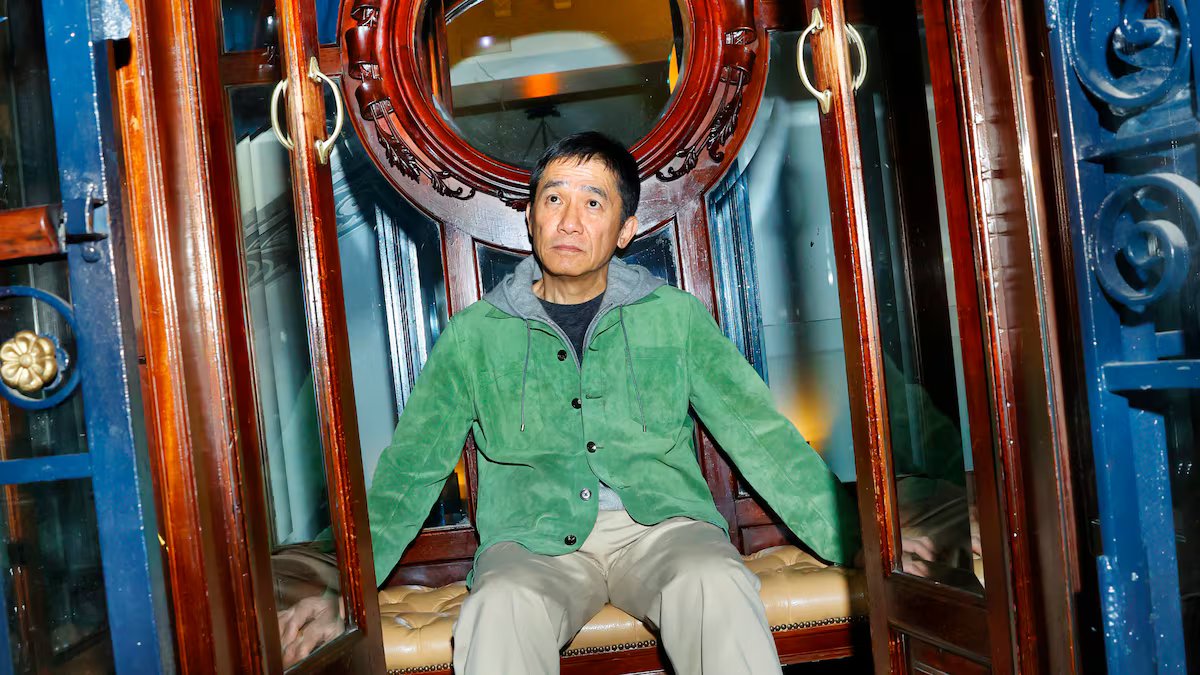
Tony Leung (Hong Kong, 63) enters the lobby of a Madrid hotel and brings with him an absolute sense of calm. The pace slows; you even get the impression the temperature has dropped slightly. Leung’s image in the film collective was sealed by his role in In the Mood for Love, Wong Kar-wai’s masterpiece that earned Leung the best actor award at the 2000 Cannes Film Festival. A man anchored in melancholy, unable to confront his unfaithful wife or to declare his love to his neighbor. That introspection turned Leung into one of the coolest men on the planet.
In 2026 his aura remains. His English has improved in recent years and he can now give an interview in that language, in his calm style — the same manner with which he plays a kindly neurologist confined during the pandemic at a German university in his latest film, Silent Friend. A zen spirit that, in Leung’s case, was born from two paternal abandonments.
The first he experienced himself. “I was five or six when my father left home. Honestly, I was a very lively kid. Suddenly shadows fell over my family. I couldn’t tell my classmates I no longer had a father. I felt a lot of shame. I swallowed my feelings; I didn’t express my emotions. That’s how my character was formed. My sister and my mother respected my secrets.” Would his life have been different without that abandonment? “I haven’t thought much about it, although I probably would have been happier.”
The second abandonment was suffered by Wong Kar-wai. That Errol Flynn air inherited by the male lead in In the Mood for Love and that version of Quizas, Quizas, Quizas by Nat King Cole that plays in the film — in short, all that melancholy atmosphere — came from the filmmaker’s childhood nights with his mother at the fairs that punctuated Hong Kong’s evenings in the late 1960s, while his father ran a night club. The director always recounts that Flynn was his mother’s favorite actor, and that his solitude in Hong Kong (his two older brothers had stayed in China while the rest of the family fled to the then-British colony) drove him to introspection and to watching a lot of movies.
Now it seems impossible, even to Leung himself, that Wong Kar-wai might have done anything else. In Madrid the actor displays the magnetism that partly springs from a natural elegance.
Question. Between films and series, you’ve racked up close to 100 roles. Do you still feel passionate about what you do?
Answer. I work because I love my craft; it fills me with joy and right now I enjoy it even more. I am moved by passion. Things will happen if they have to, and if not, they won’t. I’m in no rush to achieve anything. When I’m filming, I’m just an actor. I forget what people think of me and I don’t consciously try to please the audience.
Q. Whom do you try to please?
A. For me, the most important thing in life has never been to answer to someone else, but to assume responsibility for our actions. The only person to whom we must answer is ourselves, because we live for ourselves. In the end, we will be the only ones to judge us.
Q. Are you aware that, for the West, you are the man of Wong Kar-wai’s cinema?
A. I made more films with him before and after In the Mood for Love [they’ve shot together on five occasions], but in the Western imagination I have been marked.
Q. Is that why, and because of your disposition, you have played so many roles that aren’t exactly cheerful?
A. Yes, probably [smiles].
Q. You must get asked about In the Mood for Love on a daily basis.
A. Yes, and I’m very grateful to that film. I feel very proud and happy to have taken part in a work that means so much. It is passing from generation to generation.
The truth is Leung’s career began in a different register. His mother’s financial situation forced him to leave school, and as a teenager he worked as a grocery delivery boy, and as a door-to-door seller of small appliances, until he met comedian Stephen Chow, who pushed him toward acting. Tony Leung Chiu-wai, his full name, enrolled in an acting course at TVB, the television network, graduating in 1982. That is why he began on the small screen with comedy roles. Two years later he was the lead in the series Police Cadet ‘84 and achieved popularity. There he met Maggie Cheung, his co-star in In the Mood for Love, with whom he has worked on six other films and countless series. “We have chemistry, although she once said we would never be a couple in real life because of our differing characters.” A small laugh escapes Leung.

The rest of the world discovered him in 1989 in A City of Sadness, by Taiwanese director Hou Hsiao-hsien, winner of the Golden Lion in Venice. The following year he conquered another territory — the video-rental shelves, specifically the action section — with John Woo’s Bullet in the Head. That same year, 1990, he first crossed paths with Wong Kar-wai in Days of Being Wild, and in 1992 he starred in another action classic, Hard Boiled, also by Woo, this time alongside Chow Yun-Fat. “On television I had learned to dance. Even to sing — I did it on several occasions and recorded albums. It goes back to dance. It helped me compose my movements in action sequences. It’s curious: just before Days of Being Wild I considered quitting because I had doubts; I was on the verge of an existential boredom, but working with Wong Kar-wai transformed me.”
For a time he combined action and auteur cinema. To the point that in 2002 he co-starred with Andy Lau in a crime masterpiece, Infernal Affairs, directed by Andrew Lau (they share a surname though they’re not related, and Lau is the director and the actor he has worked with most).
Four years later, The Departed, the U.S. version of Internal Affairs, directed by Martin Scorsese, won four Academy Awards, including best picture and director. “It will be the time I came closest to a project that linked me to Scorsese, a director I would love to work with. He deserved his Oscar long before. In short, I’ve been very lucky to coincide with an impressive generation of Hong Kong and Chinese filmmakers. Like Ang Lee, because Lust, Caution is a very important film for me.” A question to which Leung replies evasively is the mutation his hometown underwent, from British colony to special administrative region of China. He only contends that there is “a Hong Kong spirit” that runs through times and political changes. Does he feel it? “Everything I’ve lived through makes me who I am today. It doesn’t matter if it’s good or bad. I absorb it, it changes me, and thus I never repeat myself in film.”
Q. Can we go back to your early career with Hou Hsiao-hsien? He changed your life and forced you to learn Mandarin.
A. He mixed professionals with amateur actors. And I noticed how spontaneous and natural their performances were. I came from series where everything was forced. I began to look for a balance between acting and authenticity. Hong Kong cinema originated in Canton and is rooted in Cantonese opera, where theatricality had great emphasis onstage. I inherited that on television, because the small screen forces you to enlarge your gestures. However, on a dark cinema screen, the kind of acting I was used to seemed completely exaggerated.
Q. And amid those doubts, Wong Kar-wai showed up and took you to another place.
A. From the first day I met him, when I was going through a period of frustration, I knew we would make special films, that he would elevate me to another level. He pressed my acting button again. Our ideas are very similar and, in general, we tune in the same way. We’ve never needed to talk much. Intuitively he understood what he expected of me as an actor. This connection between us is also why we could collaborate for so long.
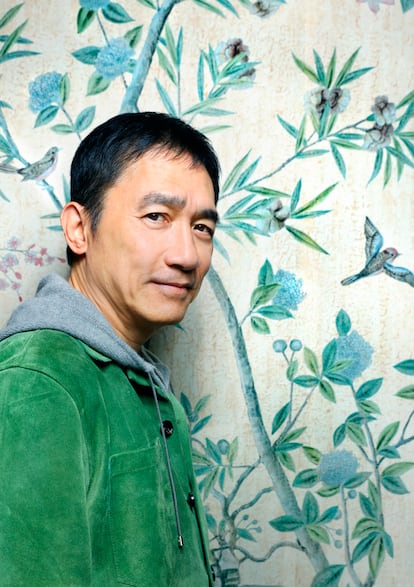
Q. You shot Happy Together in Buenos Aires. What do you remember about Argentina?
A. Its capital reminded me, in its human bustle, of Hong Kong. I learned far too little Spanish, only enough to catch a cab and ask for the check.
Q. Have you ever thought about directing?
A. I don’t have the talent. I’ve worked with so many directors that I know I can’t do it. I’m not the communicative type. My wife is — she’s a social being. She knows how to relate to people. I don’t. At a party you’d find me hiding in a corner. That’s why my characters communicate more with their eyes than with words… and why I can’t direct.
Q. You’ve acted in three Golden Lion–winning films, you won the best actor prize at Cannes, and in Asia your record is unmatched. What’s the point of awards?
A. Winning an award has never seemed to me like something that could change my life. I don’t like looking at trophies because then I stop progressing; I don’t need someone to tell me I’m doing well; instead, I remind myself what I need to improve. I’m not seeking a professional peak.
At the start of his television career, Leung never turned anything down. When the Hong Kong film industry exploded with an infinity of productions, he kept working, taking one shoot after another. More than controlling his career, he feels it “has flowed,” and acting allowed him to channel emotions left over from childhood. His work helped him find a certain inner balance and later to broaden his knowledge. Leung is married to actress Carina Lau — a relationship that has lasted almost three decades, although at first it was intermittent — and they have no children. “I need my own space and time alone. I really enjoy reading and playing sports. And we’re both passionate about our work,” he explains.
Q. Willem Dafoe describes himself as paint in a painter’s hands — the director’s. What are you like as an actor?
A. I serve so others can express their emotions. In any case, I always add things of my own; I like to contribute. I tell them: “I’ll do it your way, but with my details.” I immerse myself, sometimes too much, in my character; I dedicate time to them. I think that at the beginning I felt I had found a job where I could release all my repressed emotions. I found acting cathartic for my life. Later, I gradually fell in love with acting because it benefited me in many ways and allowed me to greatly expand my horizons. I’m more cultured for what I’ve learned preparing my roles.
The interview takes place during the European promotion of Silent Friend, by Hungarian director Ildikó Enyedi, which is now being released in Spain. The film tells the story of a ginkgo tree in Marburg, Germany, across three chapters set in 1908, 1972, and 2020. Leung appears in the last chapter as a neonatology specialist who is confined to the university by the Covid pandemic. There he begins to take an interest in plants, their possible neuronal activity, and specifically the ginkgo. “Ildikó provided me with a tremendous amount of information. Trees possess intelligence in a form different from ours. Perhaps even feelings. After studying them, my perspective on plants has changed,” he explains. “It was a wonderful shoot that has opened my appetite for more European productions, which until now I had also been reluctant to do. Right now my greatest desire is to work with directors from different countries.” In addition to reading book after book, Leung moved to Cambridge (UK) to refine his English accent. “I thought that scientist would have studied at a university like that.”
Q. Where were you when the lockdown hit?
A. First in Sydney, then I was able to travel to my home in Tokyo. It was incredible to experience silence in two such tumultuous cities.
Q. Do you live in Japan?
A. Actually, I have three homes: in Hong Kong, in Tokyo, and in Hokkaido. I love practicing sports, especially those that interact with nature. In Hokkaido, where there is always snow, I go snowboarding.
Q. That doesn’t seem like acting.
A. On the contrary. It’s a bit like acting when you have to adapt to situations you can’t control.
Sign up for our weekly newsletter to get more English-language news coverage from EL PAÍS USA Edition
