
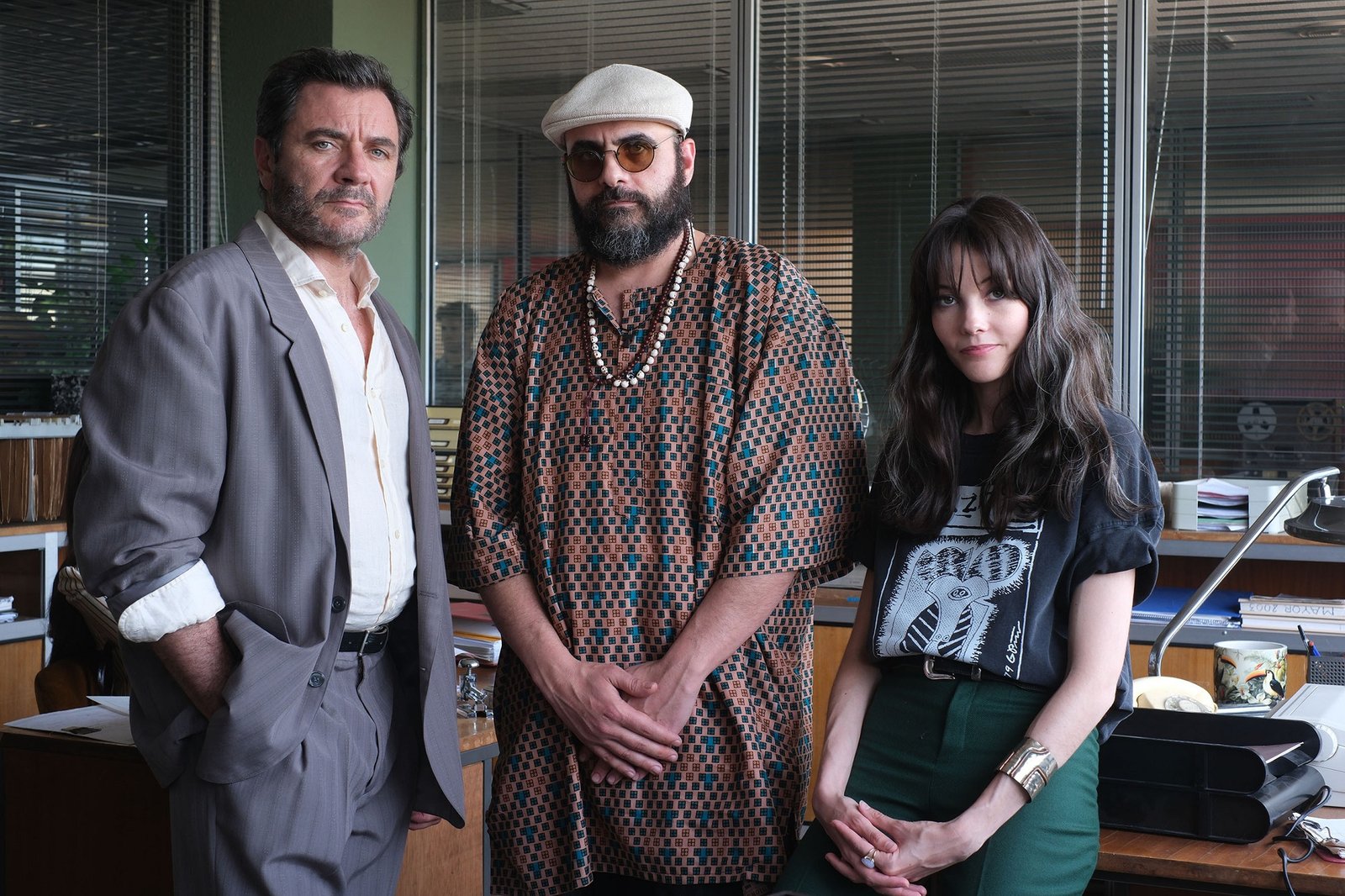
– Àlex Brendemühl, Mireia Oriol and Ariadna Gil topline the Spanish director’s film, which makes use of practical effects, and gothic and retrofuturist iconography
Actor Àlex Brendemühl, director Velasco Broca and actress Mireia Oriol (© Oscar Fernández Orengo)
The shoot for The Next Testament, the feature debut by Velasco Broca, kicked off on 21 May in Madrid. The cast includes Àlex Brendemühl (who was Goya-nominated for Creatura, won an award at Karlovy Vary recently for When a River Becomes the Sea, and was also seen in Morlaix and Runner), Mireia Oriol (I Am Nevenka) and Ariadna Gil (who scooped a Goya Award for Belle Époque and was glimpsed recently in She Walks in Darkness).
The movie, shot on 35 mm with a screenplay penned by Bárbara Mingo, Hugo Castignani and Juanjo Ramírez Mascaró, begins when the chorus of a successful song mysteriously disappears from the original master copy and from all of the sold copies of the record. Its composer, Joan Baptista Ulled (played by Brendemühl), a former singer-songwriter from the 1980s, receives an invitation to go to a castle in order to get it back. What initially seems like an absurd practical joke opens up a rift in reality: a journey through time and space, from transition-era Spain to an alternate-reality Italy and a colonised Mars, where the artist will have to confront forces that are rewriting his memory, his identity and the entire universe.
The director explains that the movie “is born of a very specific absence. A song chorus might seem like something small, but it can contain a whole life: an era, an identity, a love, a way to be remembered. Here, fantasy doesn’t serve as a form of embellishment, but rather as a way of reaching emotional terrain that a conventional narrative would not be able to reach in the same way.”
The Rioja-born filmmaker, whose full name is César Velasco Broca, made his debut short film with the 16 mm-shot Kinky Hoodoo Voodoo (2000), in which some of the recurring themes in his work (Spanish folklore, aliens and foot fetishes) first emerged. Following Der milchshorf: La costra láctea (2001), Avant Pétalos Grillados (2006) took part in the Cannes Directors’ Fortnight, wrapping his trilogy on alien invasions known as Echos der Büchrucken. After taking a break in India, he returned with Our Friend the Moon (2016), which was premiered at Locarno and won an award at the Málaga Film Festival, constituting the first instalment in his saga on La pirámide de plata de Pseudo-Juan, to which are added Alegrías riojanas (2022) and the imminent The Next Testament. Broca also co-directed the omnibus film Ayudar al ojo humano together with Julián Génisson and Lorena Iglesias, and is the regular editor for Miguel Llansó (Crumbs, Jesus Shows You the Way to the Highway).
The Next Testament is a production led by Spanish outfit Lanzadera Films, with Piluca Baquero on board as executive producer and Cormac Regan as producer, in co-production with Iban del Campo for Limbus Filmak (Spain), Aram Garriga for Visualsuspects (Spain), Sergio Adrià for Espurna Films (Spain), Georgina Terán for EFD Studios (Spain), Katrin Kissa for Homeless Bob Production (Estonia) and Giacomo Talamini for Hive Division (Italy). Furthermore, it has secured support from EITB, La Rioja 360, the Basque government, the ICAA, the Estonian Film Institute and Filmin, which will be overseeing its Spanish distribution. It is slated for release in late 2027.
(Translated from Spanish)
