
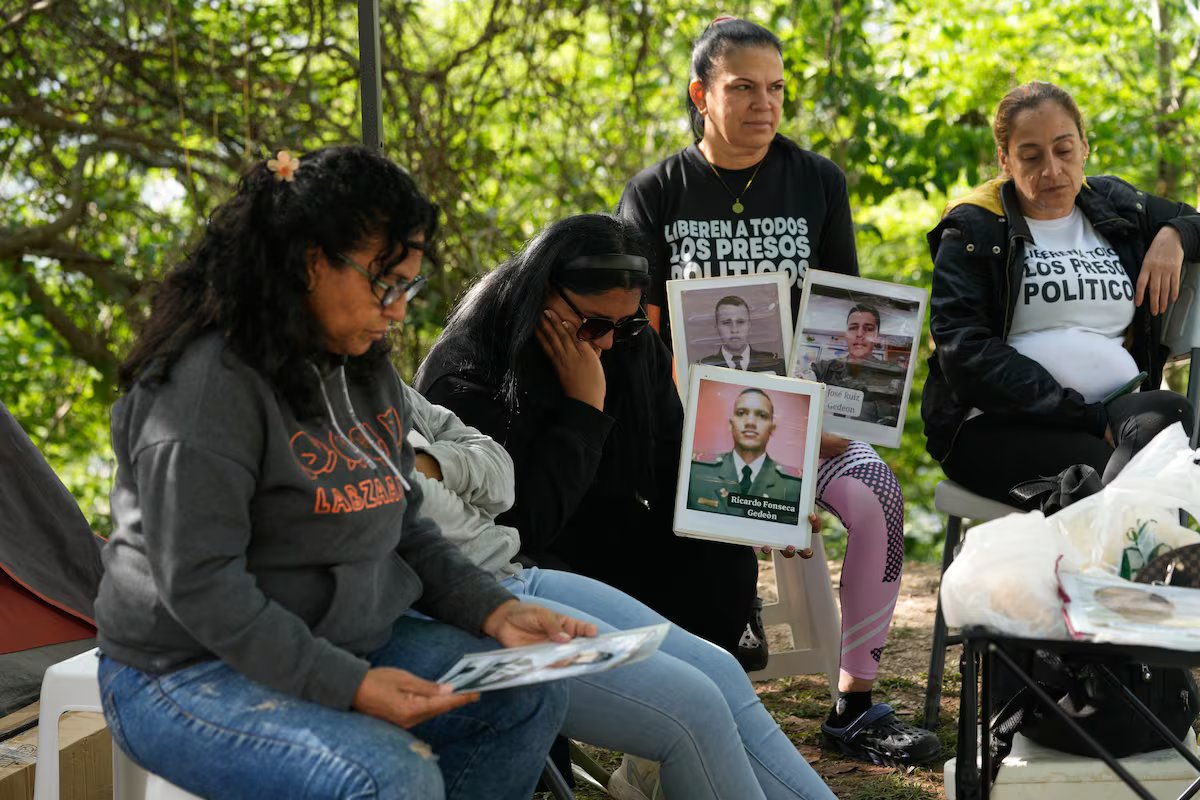
The Venezuelan government on Tuesday authorized the release of another 54 political prisoners, all military personnel, according to information confirmed by relatives of the detainees and support groups such as the Coalition for Human Rights and Democracy. Three of those released are women. According to data provided by Foro Penal official Gonzalo Himiob, most of them were part of the so‑called Operation White Armband, an alleged military conspiracy denounced by Venezuelan intelligence agencies four years ago. They had been held at Ramo Verde prison and the National Institute for Female Rehabilitation (INOF).
Among the beneficiaries of the release are Major Reinaldo Finol, detained in 2020 on accusations of espionage at the Amuay and Cardón refineries alongside U.S. citizen Matthew Heath, who was freed in 2022; Sergeant José Sánchez Chacón, jailed for sending a WhatsApp audio in which he complained about the deterioration of military units; and Lieutenant Karen Gómez, accused of ties to sabotage of the power service. It has not yet been reported whether these individuals are being released with precautionary measures or whether they have been granted full freedom.
“We demand that freedom reach all Venezuelan prisons. We especially remember the women who have been separated from their children and loved ones,” said Ana Leonor Acosta, spokesperson for the Coalition for Human Rights and Democracy.
The releases come at a sensitive moment for Delcy Rodríguez’s government in terms of human rights. In recent weeks, allegations of abuse against prisoners and harsh prison conditions under the Chavista regime have increased, affecting both political and common prisoners. This issue gained particular attention after May 7, following the national scandal over the deaths of Víctor Hugo Quero and his mother Carmen Navas, who had been searching for him for a year before learning of his death.
On May 20, Jorge Rodríguez, speaker of the National Assembly and a designated regime spokesman, announced that 300 political prisoners would be released for humanitarian reasons, including the elderly, pregnant women and nursing mothers. Before that announcement, just over a dozen people had been freed, causing anxiety among relatives and associates of the prisoners.
The Venezuelan Prison Observatory (OVP) has reported that 21 prisoners have died in state custody since March. The most recent victim was Víctor Alfonso Rivero, a common prisoner who died a few days ago from declining health at the Centro de Formación Hombre Nuevo in Carúpano, in the east. According to OVP data, 181 prisoners died in Venezuelan prisons in 2025 and 149 in 2024.
In recent days, inmates still incarcerated at El Helicoide prison in Caracas have been transferred to other penitentiary centers, generating great distress and heartbreaking scenes among relatives who fear for their lives as they are moved to other facilities. Delcy Rodríguez’s government had announced the permanent closure of this prison —“the largest torture center in Latin America,” according to opposition accusations— after the political pause created by the Amnesty Law. Relatives of detainees who had remained at El Helicoide have camped with tents near the United States embassy in Caracas to ask chargé d’affaires John Barrett to intercede with the Venezuelan government for the release of their loved ones.
Before this announcement, the NGO Foro Penal had counted 400 political prisoners in the country. Meanwhile, Justicia, Encuentro y Perdón, another civil association that has long tracked the issue, estimates there are 654.
Sign up for our weekly newsletter to get more English-language news coverage from EL PAÍS USA Edition
