
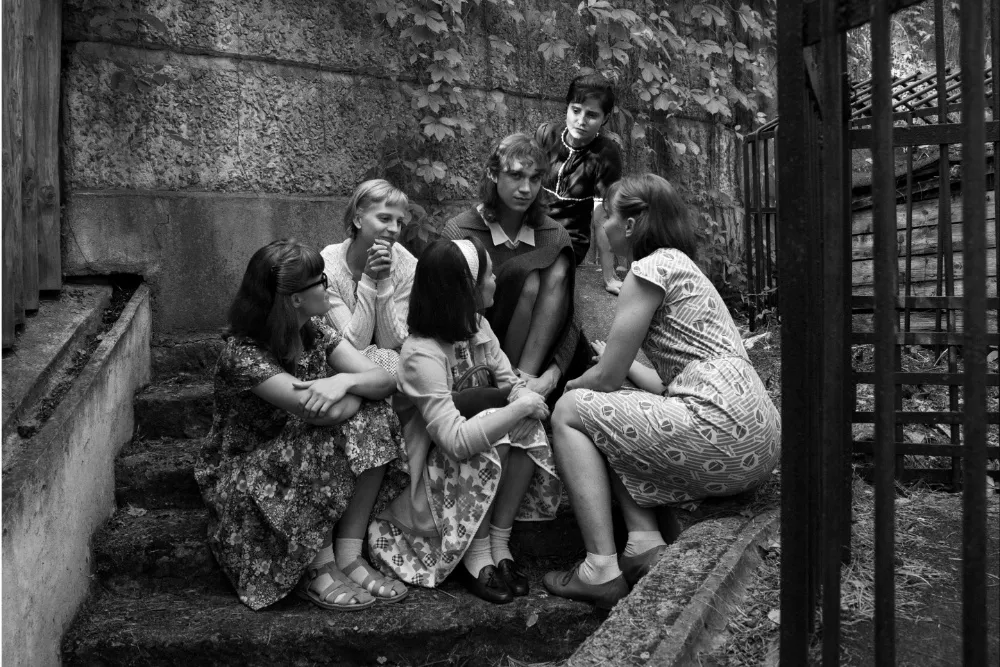
– With a major Un Certain Regard premiere and a high-profile creative team, Latvia is set to make a notable impact on the Croisette
Ulya by Viesturs Kairišs
Latvia is gearing up for a significant presence at the upcoming Cannes Film Festival (12-23 May), spearheaded by Viesturs Kairišs’ latest feature Ulya, which will world-premiere in the Un Certain Regard section. The film consolidates the Baltic country’s growing international profile, blending an ambitious creative vision with a compelling real-life story rooted in both national history and global sporting culture.

Helmed by one of Latvia’s most internationally recognised filmmakers, Ulya is Kairišs’ sixth live-action feature. Known for works such as The Chronicles of Melanie (2016), The Sign Painter (2020) and January (2022), the director has built a reputation for fusing historical subject-matter with intimate, character-driven storytelling. His latest effort continues in this vein, but shifts towards a coming-of-age narrative centred on an iconic figure.
The film tells of the life and inner journey of Ulyana Semyonova, one of the most decorated athletes in women’s basketball history. A towering presence both physically and symbolically, Semyonova was a two-time Olympic champion (1976, 1980), three-time world champion and ten-time European champion. Standing at 210 cm, she dominated the sport for decades, becoming a central figure in both the USSR national team and Latvia’s legendary TTT Riga club.
Rather than a conventional sports biopic, Ulya explores broader themes of identity, difference and self-acceptance. As lead actor and co-writer Kārlis Arnolds Avots explains, “If it were simply a film about basketball, it would be far less compelling. I think Ulya will remain my most personal role. It’s an existential one – the theme closest to who I am.”
Avots not only stars in the film, playing Semyonova herself, but also originated the project. The screenplay was co-written with Estonian collaborators Andris Feldmanis and Livia Ulman, while cinematography was handled by Polish DoP Vojtěch Staroň. Produced by Ego Media, the film is a four-country co-production, involving Pille Runk for All Film in Estonia, Magorzata Staron for Staron Film in Poland, and Ieva Norviliene at Tremora in Lithuania.
The project’s development reflects a long-term personal commitment. “The idea for Ulya came to me eight years ago and took over my life; I immediately understood that this story was my ‘to be or not to be’ moment,” Avots notes. His approach underscores the pic’s emotional core, positioning Semyonova not only as a sporting legend but as a universal figure embodying resilience and otherness.
Kairišs’ direction brings what has been described as an “operatic sense of scale” to the narrative, combining historical resonance with psychological depth. This stylistic signature, evident throughout his career across cinema, theatre and opera, is expected to elevate Ulya beyond standard biographical storytelling.
On the production side, the feature is led by veteran producer Guntis Trekteris, one of the most experienced figures in the Latvian film industry. Active since the early 1990s and founder of Ego Media, Trekteris has built an extensive international network, with co-productions spanning France, Germany, Poland, the Czech Republic, Sweden and beyond.
While detailed budget figures have not been publicly disclosed, Ulya represents a significant multi-territory collaboration typical of contemporary Baltic cinema, relying on a combination of regional funding mechanisms and cross-border partnerships. The participation of multiple countries reflects both the logistical realities and the creative ambitions of the project, situating it firmly within the European arthouse ecosystem.
Beyond its industrial framework, Ulya also carries a poignant dimension, as Semyonova passed away earlier this year. The film thus arrives at Cannes as both a tribute and a re-examination of her legacy. Avots recalls their eventual meeting after years of effort: “From that meeting onwards […] we gradually built a genuine friendship. She eventually agreed that I could portray her in the film.”
The actor further emphasises the film’s broader relevance: “Speaking about Ulya, one can address both minorities and the chosen ones in any society; she herself is a widely recognised, legendary figure in the world of sport.” This duality – between individual specificity and universal resonance – appears central to the film’s narrative strategy.
Earlier this month, the project was boarded by Paris-based sales firm B-Rated International. Financiers include the National Film Centre of Latvia, the Estonian Film Institute, the Polish Film Institute, the Lithuanian Film Centre and the Cultural Endowment of Estonia.
Latvia’s presence at Cannes this year, anchored by Ulya, highlights the Baltic country’s continued evolution as a creative and industrial player within European cinema.
