
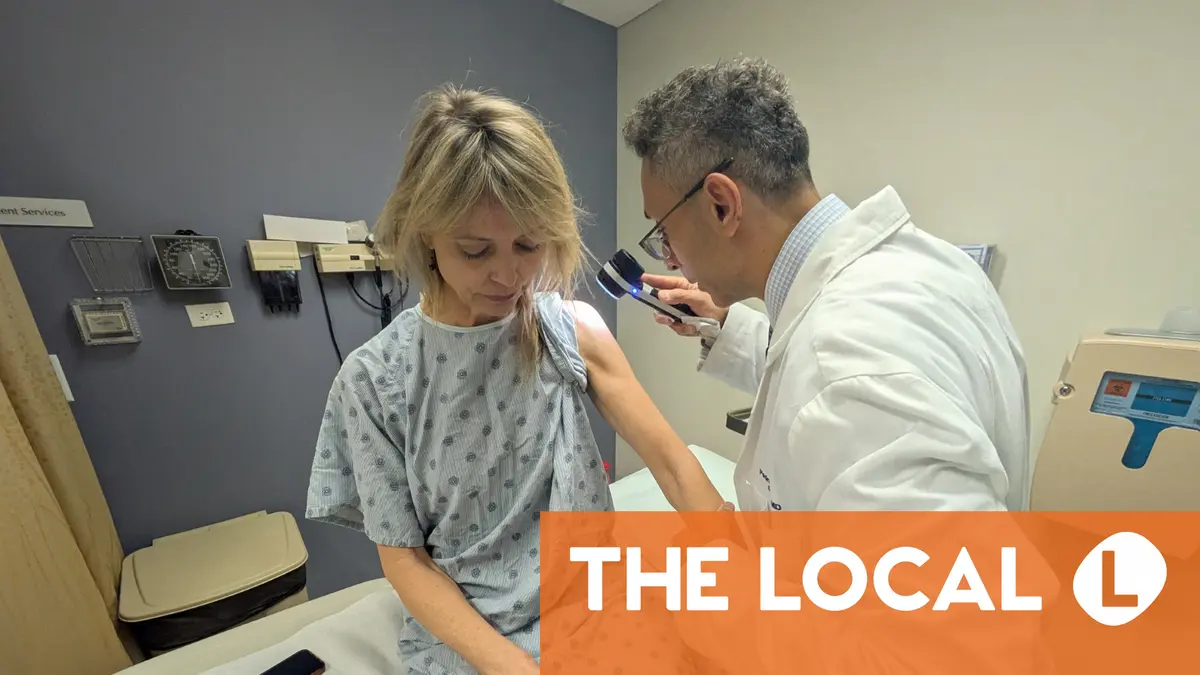
Skin cancer numbers in Spain have increased by 40 percent in the last four years. Here’s what to know about it and the difference in treatments between public and private healthcare.
Skin cancer rates have been rising in Spain over the last few years due to intense UV levels, sunny weather and outdoor lifestyles.
Estimates from the Cancer Observatory of the Spanish Association Against Cancer reveal that 20,854 new skin cancer cases were diagnosed in Spain in 2024, which represents just over seven percent of the total cancers diagnosed that year.
According to data from the Spanish Association of Dermatology and Venereology (AEDV), this incidence rate has increased by approximately 40 percent in the last four years.
READ ALSO: What breast cancer screening does Spain’s public health system offer?
Dr. Conrad Pujol, a specialist in the Dermatology Department at Quirónsalud Valencia Hospital explains that the most common types of skin cancer here are basal cell carcinoma, followed by squamous cell carcinoma, and then melanoma.
Melanoma is the most dangerous due to its ability to metastasise, but “when diagnosed in its early stages, the chances of a cure are over 90 percent,” he explained.
Risk factors for skin cancer include having fair skin, childhood sunburns, and tanning beds, as well as several others like sunbathing without any protection.
Spain doesn’t have a nationwide skin cancer screening program, which means that it’s up to you to monitor yourself and do self-checks.
Experts advise that these checks should be done monthly. It’s important to use the ABCDE rule when looking at moles for check the Asymmetry, Border, Colour, Diameter and Evolution. If you have many moles, they recommend annual skin checks.
READ ALSO: What cancer-fighting immunotherapy does Spain offer?
If you notice something out of the ordinary, the steps you take will depend on if you have public or private health insurance in Spain.
If you are with the public system, you will first have to make initial appointment with your GP. If they suspect that something is wrong, they will make a formal referral to a dermatologist to assess what’s going on.
You can typically make an appointment with your GP within a week or two, but for non-urgent dermatology appointments you could be waiting between two to six months or more, depending on the region you live in.
In Catalonia for example, the average waiting time is four months.
If, however, your GP suspects that you have a melanoma which is particularly fast-growing or a high-risk carcinoma, the waiting time will typically be a lot less as you will be given an urgent appointment and will be moved near the front of the waiting list.
If you are diagnosed, however, public hospitals in Spain provide quality oncology care and surgical procedures for urgent cases.
READ ALSO: When is it ok to go to the ER in Spain and when is it not?
If you have private health insurance in Spain, the advantage you have is that you can speed up the timeline significantly by booking an appointment directly with a dermatologist. Most of the time you won’t need a referral and the wait times are much shorter.
Private hospitals, however, aren’t necessarily any better at actual treatment plans than public hospitals.
Spain has great public hospitals which are at the forefront of cancer treatments.
Certain private hospitals can provide good treatment plans too, but it will depend on where you live as you may need to travel further for them.
If you only have public healthcare and are worried that you have a melanoma or similar and don’t want to wait a long time, you can always go private to pay for a one-off consultation.
Out-of-pocket private specialist consultations with a dermatologist cost between €80 to €150.
The main types of treatments for skin cancer used in Spain are surgical, immunotherapy and radiotherapy or a combination of them.
Surgery includes the physical removal of the tumour.
Immunotherapy helps the body’s defences attack harmful cells. These treatments are designed to target certain mutations and protein markers in the cancer. This can be combined with other types of treatments which inhibit the downregulation of the immune system and help the body’s own immunity go into overdrive to attack the cancer.
Radiotherapy uses high-energy X-rays or electron beams, to damage the DNA inside skin cancer cells and shrink the tumour when surgery is not an option.
There are other treatment options such as cryotherapy and topical creams.
The region of Madrid has also become a pioneer in Spain by using nuclear medicine therapy for treating non-melanoma skin cancers who are not ideal candidates for other types of cancer treatments.
