
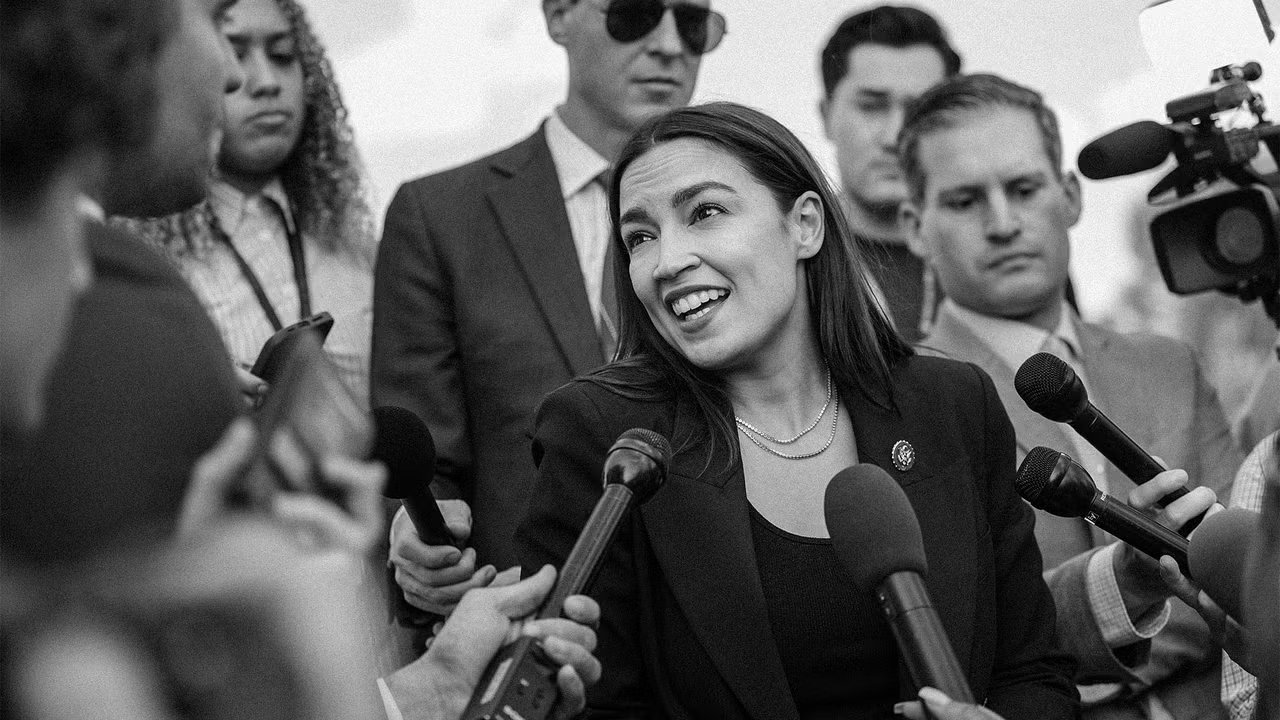
When Representative Alexandria Ocasio-Cortez said that “Woke 1.0 was crazy” on ABC News, she introduced a long-used internet term to a much wider audience.
Ocasio-Cortez was joking about how democratic socialist Francesca Hong, then still in the running to become Wisconsin’s democratic nominee for governor, had walked back some of the far-left stances she’d posted on social media in 2020—in the midst of so-called “Woke 1.0,” or the cultural moment of the early 2020s when Democratic politics were swinging left in a major way (or at least appeared to be).
Here’s what to know about the origin and history of the term.
What (and when) was Woke 1.0?
Though Ocasio-Cortez attributed the idea of Woke 1.0 to New York City Councilman Chi Ossé, it’s a far more widespread concept online. To unpack Woke 1.0, you have to start with “woke” itself and its ever-evolving meanings.
“Woke” originated as a slang term in the Black community dating back a century, meaning to be politically aware, especially about systemic discrimination. But as the term became more widespread in the 2010s, it took on more of an umbrella function: to be woke was to be a proponent of Black rights, LGBTQ+ rights, women’s rights, and more. For many, Woke 1.0 retroactively encompasses the social justice campaigns of the era, including the resurgence of Black Lives Matter in the wake of George Floyd’s murder and the continued #MeToo movement.
In recent years, “woke” has also become a pejorative for the political right, with some using the word to mock politics and cultural movements they see as too far left or performative. Efforts to improve DEI, for example, are often disparagingly labeled as “woke” by their critics.
Though Woke 1.0 has no concrete start or end date, as a concept, it’s centered on the far-left politics of the early 2020s. That’s when Ossé posted that “a cis white man should not be the next speaker of the council,” which he himself said was a “crazy” example of Woke 1.0 in action. It’s also when Hong called on America to “cancel Thanksgiving,” a comment that may have contributed to her loss in the primary. And it’s when Texas state representative James Talarico said that “God is non-binary,” among other controversially progressive stances, that have become the subject of attack ads in his current race for U.S. senate. One pessimistic poster speculated, “Woke 1.0 is gonna haunt Democrats for a generation.”
Welcome to Woke 2.0
Woke 1.0 only exists in the context of a modern Woke 2.0. It refers to our current political era, when progressive politicians are once again gaining traction across America—just not with stances as extreme as they may have held five years ago.
New York City Mayor Zohran Mamdani is emblematic of the moment for many: His election in 2025 came with cries that “woke is back” across social media, and the other progressive candidates he ushered into office behind him prove that the political pendulum may indeed be swinging far to the left once again.
Ossé spoke to the difference between Woke 1.0 and Woke 2.0 on NPR’s Code Switch podcast earlier this summer, saying he hopes Woke 2.0 will “be more productive,” moving away from what some call virtue signaling (like Senate Democrats’ infamous Kente cloth photo op).
“I want to secure more wins for Black people, for trans people, for any person who’s dealing with oppression, for any working-class person,” Ossé said. “I found that in Woke 1, there was a lot of ‘culture war’ stuff, like McDonald’s doing a Black Lives Matter thing, and then reverting back to being a right-leaning company . . . I think we need to be a bit more focused and honed in on what will actually uplift and serve us.”
An internet buzzword, for better or worse
With AOC’s viral comment, Woke 1.0 and Woke 2.0 have officially entered the sphere of political legitimacy. But they’ve been used online since at least 2024 as markers of two cultural movements, which can be seen in online discourse.
Some recent viral posts show how “Woke 1.0” is thrown around in practice. One user’s comedic post explained how the shift from Woke 1.0 to Woke 2.0 got in the way of their flirting strategy: “Thought this girl was Woke 1.0 (kill all men) so I tried ‘you’re always right’ gimmick, but she was actually Woke 2.0 (anti-bioessentialism) and I gave her the ick,” they lamented. That post has 4.5 million views.
In another viral post, a user complained that a class in their graduate program was “so Woke 1.0 in the worst way,” with it asserting that “indigenous people are never homeless on stolen land.”
“Yes they are if they sleep on the street!” the user wrote. “Can we focus on the actual issue and not platitudes?”
But others see the concepts of a Woke 1.0 and Woke 2.0 as reductive and dismissive of the political work done in the early 2020s, which continues into the modern day. Journalist Andree Gee wrote in The Guardian that the terms are “off-putting because it’s dismissive of the work that abolition advocates and social justice organizations have been doing before and after 2020.”
“What happened at the start of the decade wasn’t momentary advocacy; it’s in lockstep with what freedom fighters have been seeking since the inception of this country,” he continued. “The truest advocates are still on the frontlines, even if the masses have decided it’s no longer trendy.”
Another social user responded to Ocasio-Cortez’s viral news clip, calling that framing of 2020’s social justice movements “pretty distasteful.”
“We watched George Floyd get murdered on video, as he screamed and cried for his mother,” they posted. “The politics that came in response to that was an honest way of trying to combat the institutions that produced that outcome.”
