
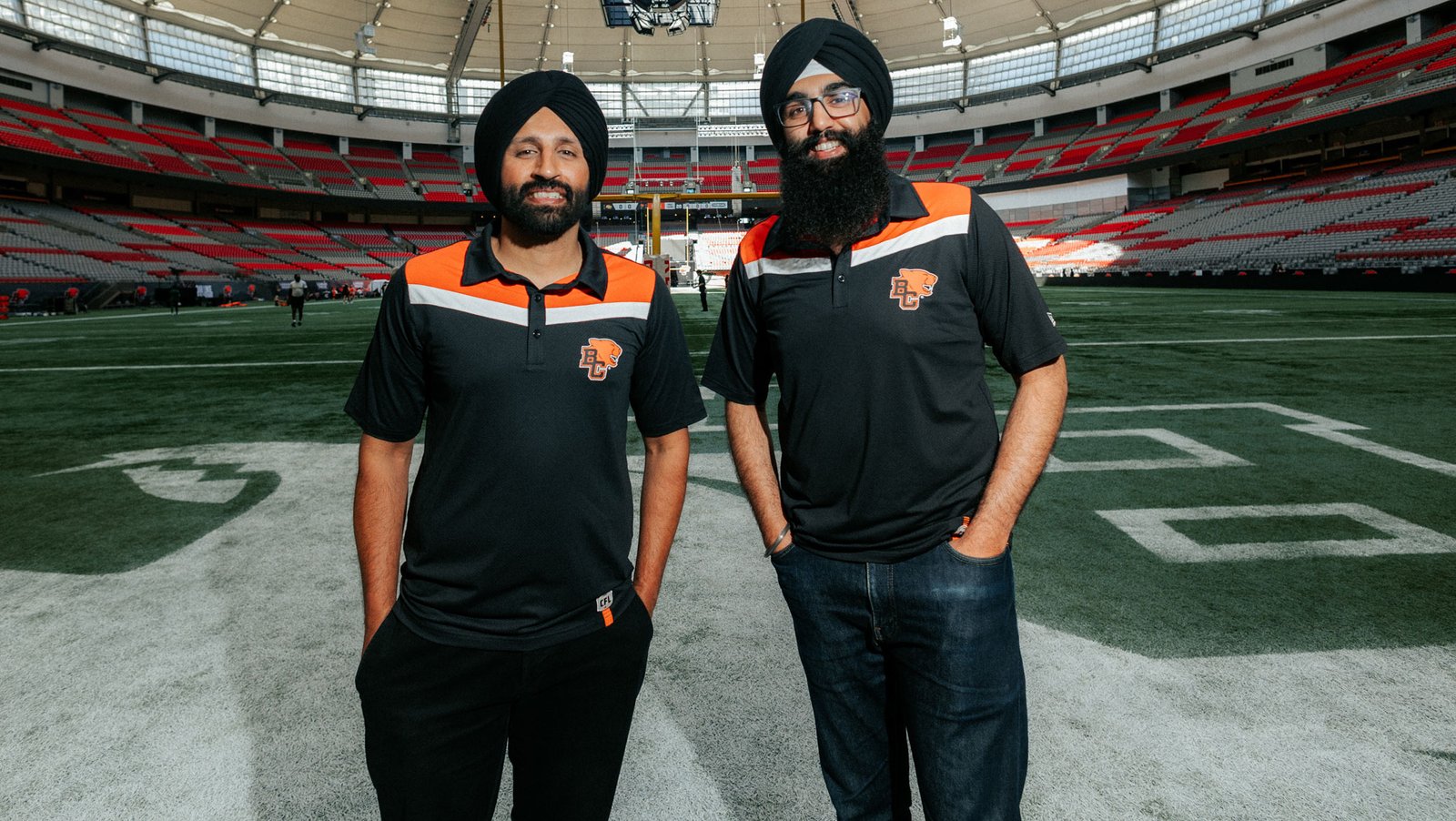
It’s Asian Heritage Month, and the Punjabi-language voices of the CFL are prepping their vocal cords for another season behind the mic.
For Manpreet Singh in Edmonton and Harpreet Pandher in B.C., calling games in Punjabi means much more than translating football terms on the fly.
It also means explaining the game in real time to new listeners — some of whom may be longtime fans, while others may never have watched a football game in their lives.
RELATED
» 3 takeaways from Wayne Moore’s journey from running back to artist
» Diversity is strength videos, stories and much more
» Subscribe to the CFL’s newsletter for exclusive offers and league updates
START WITH A LOVE OF THE GAME
Pandher — perhaps best known for his work on Hockey Night in Canada: Punjabi Edition — fondly remembers his introduction to the CFL at a game during Expo 86 in Vancouver. Singh lugged the football as a running back at Edmonton’s W.P. Wagner High School and is a long-time season ticket holder at Commonwealth Stadium.
Love for the game is crucial for fans in a culture overflowing with passion for their favourite sports teams.
“It’s a big part of the lifestyle, just being Punjabi,” Singh says. “We are very happy. We’re very excited about even the smallest things — and it really shines in sports.”
COME READY TO BUILD YOUR OWN DICTIONARY
Quarterback sneak, blitzing the quarterback, dropping back in pass protection — football is full of words and phrases that might confuse English-speaking newcomers to the game. And that confusion can be exponentially higher for those who speak a different language.
“There’s certain things that happen in football, and there’s not really words for them in Punjabi,” Singh says. “So we had to create our own language.
“Obviously, it started before the first broadcast, but then you see things as they happen live. You’ve got to adjust and provide that information at the same time.”
Our July 29th game against BC was the first professional football game ever to be called in Punjabi!
Shoutout to our announcers @HarpPandher & @TaqdeerThindal on @580_my radio.#OurTeamOurCity #GoElks #CFL pic.twitter.com/UHP81ynxsE
— Edmonton Elks (@GoElks) September 22, 2023
LEAN ON TERMINOLOGY FROM OTHER SPORTS
From a defensive perspective, the quarterback sack is one of the most exciting plays in football. So Pandher and Taqdeer Thindal borrowed a term from kabaddi, a sport popular in parts of South Asia to describe when a defensive player breaks through the offensive line and brings the quarterback to the ground.
“We just thought it sounded really good,” Pandher says. “So we always bring out the word jhaffa when there’s a sack. And we’ve had good feedback on that one, because there is a correlation of kabaddi and football being kind of similar tackling sports.”
SOMETIMES THE BEST WORD IS THE MOST OBVIOUS ONE
It can prove tempting to try to translate every football term into Punjabi, says Pandher, noting the same phenomenon exists in hockey. Even the basics presented a quandary when Pandher and Thindal called the first CFL game in Punjabi back in 2023.
Their first quandary?
“We were figuring out, like, is there a word for touchdown we could use?” Pandher says. “So we played around with it, but we were just saying, you know what? We’ll have a couple variations, but we’re going to stick with ‘touchdown,’ because if we literally translate it, it kind of gets lost.”
Singh adopts a similar philosophy in Edmonton.
“If I wanted to say ‘quarterback sneak’ in Punjabi, it’s so many words. It would have happened 10 times before I was able to say it one time,” he says. “There’s some things where there’s no way to say it in Punjabi, so we just say it in English.”
ENVISION THE AUDIENCE
Regardless of the language, the fine art of football broadcasting involves teaching people about the game in a captivating manner that doesn’t sound preachy.
“We are doing the call to people that potentially have never seen or heard anything about this sport before,” Singh says.
Pandher’s dad and many of his friends have attended BC Lions games as season-ticket holders, so they know the sport and don’t require — or desire — any extra explanation.
“For the most part, when we’re calling a game, you hear it like you would in English but in a different language,” Pandher says. “Sometimes, when we slow it down, we switch it. I feel like I’m talking to my grandparents.
“They came in the ’80s, and they never really learned English. They’re older. Some of the newer people that come, they find football one of the trickier sports to pick up on or know what the rules are.”
DO YOUR HOMEWORK AND LEARN FROM THE BEST
Success in football rests largely on practice and game planning, and the same holds true for those in the broadcast booth. The preparation for calling a game starts long before the opening kickoff — especially in a stop-and-go sport where the broadcasters often need to chat at length between plays.
“We attend practice at least once a week and find out what’s going on,” Pandher says. “We’re picking the brains of the visiting team’s radio broadcasters. There’s new players that we always want to get our pronunciations right.”
Pandher turns to veteran broadcasters like BC Lions play-by-play announcer Bob Marjanovich and analyst Giulio Caravatta for advice.
“There’s a lot of senior broadcasters who we can call anytime,” Pandher says. “They’ve been great to us.”
TURN THE VOLUME UP
Great football plays are exciting in any language. For his part, Singh still gushes over the excitement of calling the jaw-dropping, one-handed catch made in traffic last season by Winnipeg receiver Ontaria Wilson at the expense of the Edmonton Elks.
“He bobbled it twice in the air, he was in the air himself, and he managed to corral that and bring it in,” Singh says. “That was probably the coolest thing I’ve seen and called.”
Passion is a must for any Punjabi-language broadcaster.
“I’m versed in both languages,” Pandher says. “It might be a little bit over the top if you’re speaking English, but in Punjabi, it’s not. I think people appreciate the louder, energetic goal calls or touchdown calls.”
Singh agrees.
“It is kind of in the culture where things are very loud and proud. There is that loudness, the pride and just general excitement and merriment.”
