
– We take a look at four of the seven projects being presented, all narrative features at the post-production stage seeking new partners in Europe and beyond
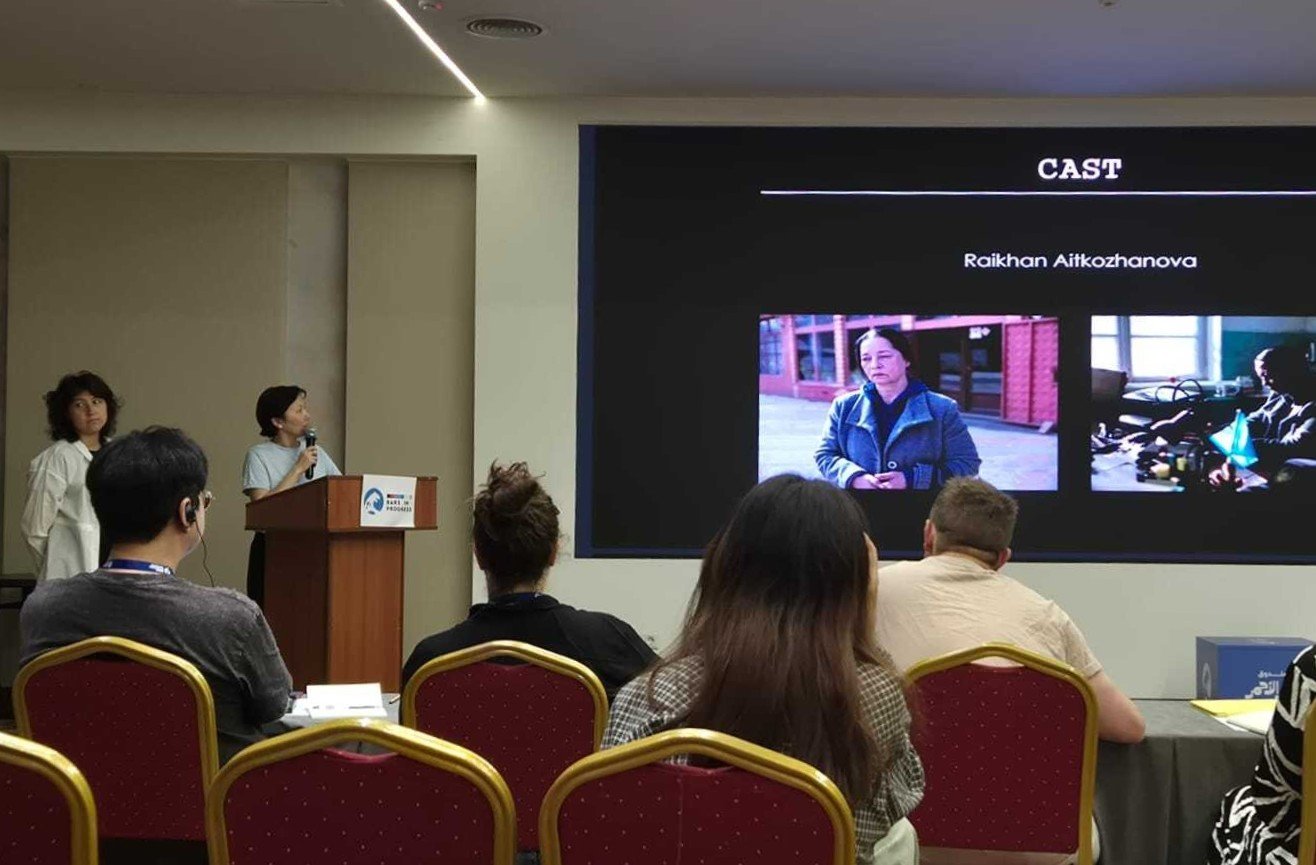
Assel Yerzhanova (left) and Assel Aushakimova during the pitch for Pay the Bill
The brand-new industry initiative Bars in Progress, hosted by the fourth Bishkek International Film Festival (7-12 June), is designed to support feature-length narrative films in post-production, guiding them “from rough cut to world premiere”. The platform offers selected Central Asian teams the chance to present their cuts and pitch to international professionals, receive feedback from experienced experts, and take part in one-on-one meetings, discussions and networking sessions.
This year’s projects, presented on 10 June, have already passed through labs, markets and support schemes, and are seeking world sales agents, festival premieres, co-producers and distribution partners from Europe and beyond.
Below, we take a closer look at four of the selected projects:
Life Says: We Must Live – Isabelle Kalandar (Tajikistan/USA)
The second instalment in Kalandar’s “exile trilogy”, Life Says: We Must Live explores loss, shame and return through the story of Farrokh, a man who, after enduring abuse in the mines and in prison, retreats alone to the Shugn Mountain to dig for rubies. When his uncle dies, he returns home and is forced to confront the people, memories and wounds he had tried to escape. Kalandar said the project is rooted in her own birthplace and in the aftermath of Tajikistan’s civil war and the collapse of the Soviet Union, which caused “mass male migration” and left behind “abandoned children, women and lost men”. Following Another Birth, which premiered in competition at Busan last year, this pic examines “what migration does to human psychology”. Shot in her mother’s village with non-professional actors, it is, in her words, “a community-made film”, currently part of the Doha Film Lab. Kalandar herself is credited as the producer.
Pay the Bill – Assel Aushakimova (Kazakhstan/Saudi Arabia/Kyrgyzstan)
Now in post-production, Assel Aushakimova’s 105-minute, Kazakh-language drama Pay the Bill follows a 65-year-old woman who receives a late-night call from the police claiming her daughter has fled a bar without paying. As she searches for answers, she finds her daughter dead at home, bruised and abandoned by her husband, while a corrupt system nudges the investigation towards cynical indifference. Aushakimova said the project is “based on a real case”, in which violence, police negligence and institutional complicity were reduced to the absurd demand that a grieving mother settle an unpaid bill. Described as a drama with elements of irony and sarcasm, the film adopts a realist visual approach built around handheld camerawork, long shots, cold tones and a simple narrative. Produced by Assel Yerzhanova, it stars Raikhan Aitkozhanova and has received support from the Red Sea Film Foundation, Shabyt Astana and CAF Pitch. The team also stressed the project’s “girl power”, with key roles held by women, including DoP Aigul Nurbolatova and production designer Ayana Nurdinova.
Warm Night, Cold Beer – Amir Amenov (Kazakhstan)
Amir Amenov’s 96-minute debut feature, Warm Night, Cold Beer, is a melancholic coming-of-age comedy unfolding over one sleepless night in today’s Almaty. Three friends spend what may be their last night drinking together while trying to dodge adulthood: Asylbek is afraid to finally meet the flight attendant he has long idealised from afar, Sanjar desperately seeks a hasty marriage before being sent to the army at dawn, and Birjan escapes family life through an affair. Producer Zarina Kissikova said the film aims to show “a different side of Kazakhstan”, away from stories of “traditions and village or nomad life”, focusing instead on “a city, young people, and the search for love and connection”. Amenov described the movie as “one night, and three friends drinking for the last time”, driven by “bittersweet humour”. Developed through the Asia Pacific Screen Lab, CAF Pitch, TIFF Writers’ Studio and Post Space Film Camp, it is now at the final stage of production.
Nariste – Radik Eshimov (Kyrgyzstan)
Radik Eshimov’s drama centres on Nazik, a young mother living in poverty with her mother-in-law while her husband works in Russia, and raising her four-month-old son under growing physical and emotional strain. When she reports that the baby has been kidnapped, the police investigation initially points to Ainura, a grieving woman struggling with alcoholism who insists the child is hers. A DNA test seems to confirm Nazik as the mother, yet the case gradually reveals a far more devastating truth: exhausted, sleep-deprived, and terrified of family and social judgement, Nazik had accidentally caused her own child’s death and stolen Ainura’s baby to replace him. Producer Askhat Tabaldiev presented the story as a tragedy of motherhood, guilt and forgiveness, showing how “a single tragic decision can forever alter the lives of several people”. The ending, he added, carries “a bittersweet sense of justice and compassion”, as one woman loses everything while another is given a chance to start again.
