
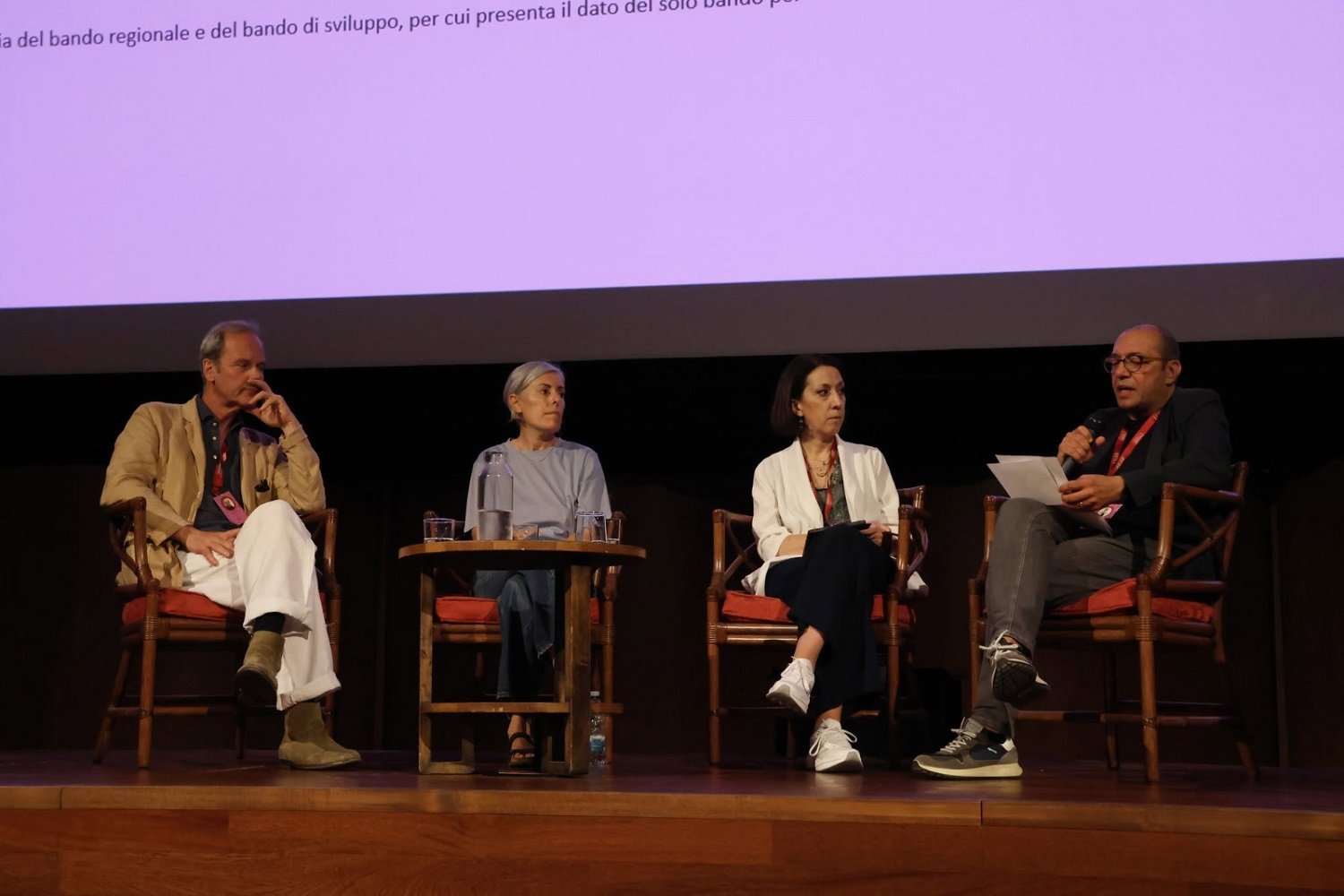
– Production and distribution strategies, public support and funding opportunities formed the focus of a panel discussion at Bio to B Industry Days Doc
l-r: Francesco Virga, Nadia Trevisan, Silvia De Felice and Fabio Abagnato (© Chiara Calò/Biografilm)
Hosted by Bio to B Industry Days within Bologna’s Biografilm (running 8-10 June), the panel discussion entitled “Italian documentaries in the European funding ecosystem” revolved around production and distribution strategies, national and regional public support, and European funding opportunities.
Bruno Zambardino, head of EU Affairs and Institutional Coordination for Italy for Movies and Film Commission, Cinecittà/Italian Ministry of Culture (TBC), gave an overview of the current state of public funding whilst also sharing some key facts and figures. Since the Film Fund was first launched in 2017, 5,300 funding requests for the development and production of documentaries have been presented in all of its areas of intervention. These 5,300 funding requests account for 30% of total requests. They reached their peak in 2023, with 948 requests. Between 2024 and 2025, fiction-related requests decreased, while those relating to documentaries rose. In terms of broadcasting methods to reach their target audiences, 65% of producers primarily wish their works to be released in cinemas. Only 28% favour TV for this purpose and just 6% prefer online platforms. So this is another factor to bear in mind. As for specific areas of intervention, the instruments attracting the greatest number of requests, 48%, are selective ones. Since its introduction, selective aid has been focused on a dedicated intervention area, favouring documentaries. Between 2017 and 2025, the Commission received no fewer than two thousand requests for selective aid alone, for documentary works. Obviously, documentaries tend to incur lower costs compared to other works. The average cost, calculated over the present decade, sits at around €250,000. The average financial aid awarded to documentaries is around €60,000. As a percentage of their cost, documentaries are given greater support than other works. What’s more, over the years , over 100 million euros have been dispensed as part of the National Cinema and Images for Schools Plan, and the documentary form played a lead role in many of these projects, not just as a theme or guiding principle in teaching activities but also as an actual product of the educational process itself.
Fabio Abbagnato, vice-president of the Italian Film Commissions and director of the Emilia-Romagna Film Commission, spoke about the relationship between the Film Commission and the documentary form. “It’s a structural relationship; both are connected to the region. It’s not just about supporting the promotion of local stories or of local producers; there’s an ongoing exchange between directors and producers and the Film Commissions. We have the job of promoting local, cultural and memorial heritage, but doing so within a national and international production system”.
“Not all directors or producers have this awareness or this thirst for a challenge. Sometimes, producers also need to exit a product. The waiting, having to pull together a bigger budget, creating broadcasting and distribution conditions which are even more demanding, requires time that not every business can spare. So the director’s narrative urgency clashes with the distribution strategy”.
According to Silvia De Felice, commissioning editor at Rai Documentari, “Rai now plays a more significant role in the international broadcasting market thanks to the creation of Rai Documentari, which entrusted us with the mission of bringing documentaries back onto general-interest networks and recuperating the investment from Rai into documentaries which had previously been lost. We made the decision to help independent productions, broadening investment to cover as many productions as possible”.
“Of the projects that we produce, only a very small number are subsequently able to find partners, even internationally. Just 10% of our projects manage to enjoy international development with another foreign broadcaster”.
“The international situation is devastating. They’ve closed and are still closing historical firms which have always been reference points for producers. More and more, among networks and broadcasters, we’re hearing that: we network to survive, so as to push at least a handful of projects forwards. Rai really feels the responsibility of being a foothold for producers. Every choice me make right now can change a company’s destiny. It’s a time when we need to be strategic, to try to invest in projects with strong international potential, which might enjoy a long-term career”.
Invited to talk about production strategies, Nadia Trevisan, a producer and co-founder of Nefertiti Film, describes herself as a hybrid producer. “I work more with fiction than with documentaries; a decision dictated by the fact that companies need cinema admissions. That said, documentaries give us a freedom and way of thinking that fiction doesn’t allow, in terms of experimentation and new talent”.
All the works that Trevisan makes “are international co-productions, partly due to the fact that we’re based in Friuli-Venezia Giulia, which is a region surrounded by borders. Every time we think about a project, we think about it in international co-production terms”. Transnational funds allowing collaboration and co-production between companies in Friuli-Venezia Giulia and others in all the Balkan countries are already in operation. “And it’s a system that works. But we do have standardisation issues. Having certain response times is an important factor, and that’s something that’s creating difficulties for us in the international arena right now, because, with significant unknowns such as these, even minority co-productions can unfortunately collapse, because it’s impossible to keep up with the international pace. So being strategic means thinking about everything you can do and everything you can avoid as early on as in the development phase, and if you manage to find a solution to a problem in advance, you’ll get to the end of the project in a more sustainable manner”.
Francesco Virga, president of Doc/it – the Association of Italy Documentary-Makers, reflected on adaptive mechanisms, on the premise that “Producing documentaries is an extreme sport”. If a documentary project’s average budget is 250,000 euros and we know that the production cycle is more or less three years, development included, “what remuneration do directors and businesses actually receive? This leads to dramatic scenarios, as Silvia De Felice has stressed, and opening up reflection on the documentary sector – which could be described as artisanal, and which is innovative in terms of languages – leads to new talent; it establishes consortium mechanisms which help to lower a whole series of fixed costs. A mature system ensures the co-existence of local and global production, and artisanal and industrial production”.
“From the data we’re seeing, on average the documentary form has benefitted from around 6.7% of the support afforded by the Ministry, in terms of tax credit and funding. Thanks to how it’s been applied, tax credit has breathed life into an array of works, some of which are very good, but structurally speaking it has capitalised the richest businesses while impoverishing small and micro-enterprises, to a certain extent. This means that, at present, given that they’re poorer, companies are investing less in development. So reflection on how we use allocations of national and region development funding should take this into consideration, in the knowledge that the development phase can be crucial to a given production’s success”.
“We’re currently seeing a systemic transformation. Care is being taken not to leave the artisanal sector totally exposed, financially speaking, but we’re seeing a shift towards the richest companies. The artisanal documentary sector – because it costs less, because it’s rooted in the company’s everyday work – innovates and brings new themes, new languages, new talent. Sometimes, the industry produces extraordinary things. It perfects processes to make them more profitable. We get the feeling that the redefinition of the MEDIA programme – a programme which has moved many resources around in recent years, especially into development and production, helping weaker but no less deserving companies with some of the more stringent criteria – will lead to a debate on whether to open up to non-independent producers by way of the new AgoraEU programme. This would clearly entail another shift of resources, on which Doc-IT, in association with other associations, would like to make its voice heard. Also on the European level, in 2026 the AVMS Directive on audiovisual media services is due to be revised (read our news), with a focus on investment quotas but also the definition of independent producers, with the possibility of including companies which are no longer independent as public funding beneficiaries. It’s important to implement processes which create a system and which are adaptive in order to promote development rather than simply survival”.
(Translated from Italian)
