
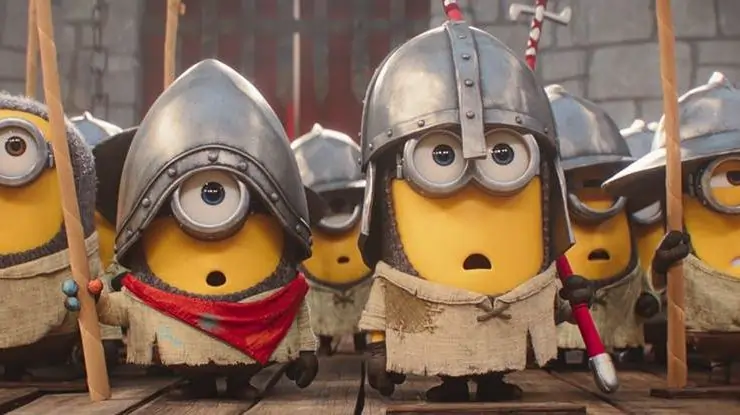
As we get closer and closer to the release of Minions and Monsters, it’s time we stop messing around and start answering the question that no one but me is asking: Do we appreciate Despicable Me as a franchise enough?
The boring (and obvious) answer is yes – the franchise has made over $12 billion. However, in this feature, I’m digging into why its wider impact on cinema should be the real story. Would we have the Super Mario Bros Movie if the Minions hadn’t been so popular? Have popular social media trends around the franchise impacted how studios market their movies? Did Gru actually steal the moon? These are all questions I’m looking to answer, and in turn, prove why we need to give the franchise more credit.
The best place to start is by taking a closer look at the rise of its production company, Illumination, as a result of the franchise’s success. When the first film was released in 2010, it made $544.2 million worldwide and was the seventh-highest-grossing film of the year. It was also the studio’s first release. Illumination, led by Chris Meledandri, had only started properly a few years prior, and the film was such a success that it allowed them to go on to create Hop, The Lorax and many other popular animated films.
It also set them on a path of proving that their low-budget approach (their films generally have a budget of between $60–80 million) to making original animated movies could easily out-earn major blockbusters.
Despicable Me 2 soon followed, which became the second-highest-grossing 2013 animated film, as well as breaking the record for the most profitable Universal Pictures film in its 100-year history at the time of release. The third became the second film from the studio to cross the $1 billion mark when it was released after the spin-off, Minions, cruised past the same total a few years prior, while Despicable Me 4 and Minions: Rise of Gru also performed unbelievably well worldwide.
In simple terms, the franchise prints money for Illumination, regularly breaks Box Office records, and, in return, puts the studio on the map.
With the consistent successful return in mind, it’s clear that the studio wouldn’t have been trusted to bring Mario back to the big screen without the success of the Despicable Me franchise. Of course, there may have been other factors in Nintendo trusting Illumination with the project, such as the ‘similar creative process‘ between Meledandri and Mario creator Shigeru Miyamoto, but their proven recipe for success was undoubtedly a key factor. Tellingly, their partnership with Nintendo accounts for the only times they’ve broken their budget model so far. First with the original film’s $100 million budget, then Super Mario Galaxy‘s $110 million. Both proved money well spent, with each crossing $1 billion worldwide.
Now that we’ve established the influence the Box Office has had, it’s also worth looking at other elements of the franchise’s wider impact, such as how the franchise changed studios’ approach to marketing. A great example of this is the trend that was created for Rise of Gru that involved hordes of teenagers going to see a film dressed in suits. This became known as ‘GentleMinions’ and was popularised by a user known as @bill.hirst. Millions of views and recreations later, it’s clear the trend helped the film maintain momentum longer than a typical release as it crossed $500 million worldwide by its fourth weekend and $700 million by its sixth.
Whilst the studios behind the film did lean into the trend as it gained momentum, it was the fans who were the catalyst for the trend’s success. It’s worth briefly pondering whether they were actually fans of the franchise beforehand or just wanted to get involved in the trend, but realistically, try telling a teenager in a three-piece suit that Gru didn’t really steal the moon.
It’s fan movements like this that leave studios in a difficult position when it comes to how they can market their films because there is no way they can determine what’s genuine support for a film anymore, or if people are just fans of the trend they are taking part in. For years, studios had dictated how films were marketed, but everything became harder to predict in the years after the pandemic, especially with the rise of social media. This was something that Sony Pictures learned with Morbius, which was released at a similar time to Rise of Gru but, in contrast, was widely panned by reviewers and audiences.
This led to jokes and parodies going viral about its quality, with the ironic hashtag #MorbiusSweep going crazy on the internet and the catchphrase ‘It’s Morbin’ Time‘ following shortly after. Sony clearly thought that this could lead to a boost in Box Office numbers and organised a 1,000+ screen re-release in the USA, but it only made them $311k, proving that trends are impossible to judge.
Interestingly, the failure of Morbius didn’t put all studios off with Barbenheimer (Barbie and Oppenheimer releasing on the same day), hitting screens the following year. The term grew rapidly on the internet in 2023 as online users enjoyed the stark contrast between the two films, sharing memes and fan-made posters encouraging a back-to-back screening of both. It easily could have been a scenario where audiences were divided on opening day about what to see; instead, the trend proved massively successful for studios, with the pair combining for the fourth-biggest opening weekend in US box office history, and both finishing 2023 among the year’s highest earners.
It echoed the same pattern GentleMinions had set a year earlier: that organic, fan-driven momentum could move as many tickets as any marketing campaign from studios. Although it helps that Barbie and Oppenheimer were good films, too.
The final area that I think is worth touching on is its success as an original property. The franchise was never based on a book, a game or anything beforehand. It was built from scratch by Illumination in its very first year of existence after Spanish animator and writer Sergio Pablos pitched an idea about a main character having villainous attributes. The studio then repeated this model of fresh properties in all its releases (with the exception of Mario). This gives the studio complete control of its image and also works as another significant element of its under-appreciated success.
A lot of studios are relying on nostalgia in order to bring in huge Box Office numbers and sales around their product, yet it’s been widely reported online that the Minions brand alone has generated over $6 billion in retail/merchandise sales. We’re also looking at a scenario where numerous major theme parks now have physical attractions based on the franchise, which is something not many other franchises can say for their original concepts. Are we doing the franchise a disservice by not including it in more conversations around its success?
After several films across fifteen years and a massive impact on the wider industry, it’s clear to me that the franchise deserves more flowers. I can’t recall a single person who credits the films with being worth watching, and yet the facts clearly speak for themselves. Yes, it’s a huge success commercially, but it’s also quietly proved that an original idea can lead to a studio being trusted with the big-screen return for one of the biggest video game characters of all time, reshape how studios think about viral marketing, and still walk away from awards season with nothing to show for it.
Whilst it’s disappointing that the franchise has never won a major industry award, despite its commercial dominance, there is still time for that to happen, especially with Minions & Monsters landing soon. So let’s all get our three-piece suits back out and go appreciate the return of one of the most under-appreciated franchises yet.
Minions and Monsters releases in cinemas on July 1st. Stay tuned for our review next week!
Discover more from
Subscribe to get the latest posts sent to your email.
