
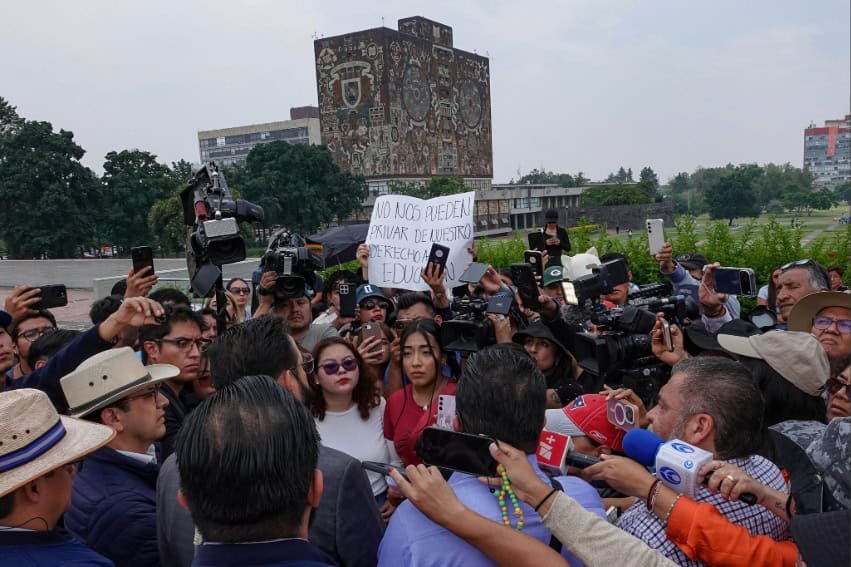
“Mexican university faces massive cheating scandal after first online entry exam.”
“UNAM: Was artificial intelligence to blame?”
These are some of the headlines that have appeared in the media in recent days amid intense and growing scrutiny of the results of the National Autonomous University of Mexico’s entrance exams, which were published earlier this month.
In this explainer, we’ll tell you everything you need to know about this “scandal,” which has also been widely referred to as a “crisis” for UNAM, Mexico’s largest and most prestigious university.
UNAM’s cheating scandal, explained
In May and June, UNAM held its exams for people vying to become students at the university, whose main campus, Ciudad Universitaria (University City), is located in southern Mexico City.
The university’s entrance exams have previously been held in large auditoriums and stadiums, but in 2026 — for the first time ever — would-be UNAM students completed the tests online. One aim of moving exams online was to save aspirants the time and money involved in traveling to an exam center. Another was to make the exams more accessible to aspirants across the country and even abroad.
More than 158,000 aspirants sat the online exams. Among them were people hoping to gain entry to high-demand UNAM degree programs that are notoriously hard to get into, such as medicine and law.
The software for the exams was provided by the Mexican company Territorium Life. It had a range of AI-powered built-in features designed to prevent test-takers from cheating — including one that prevented additional computer tabs from being opened — but there is widespread suspicion that a significant number of them did indeed cheat, including by using artificial intelligence platforms such as ChatGPT.
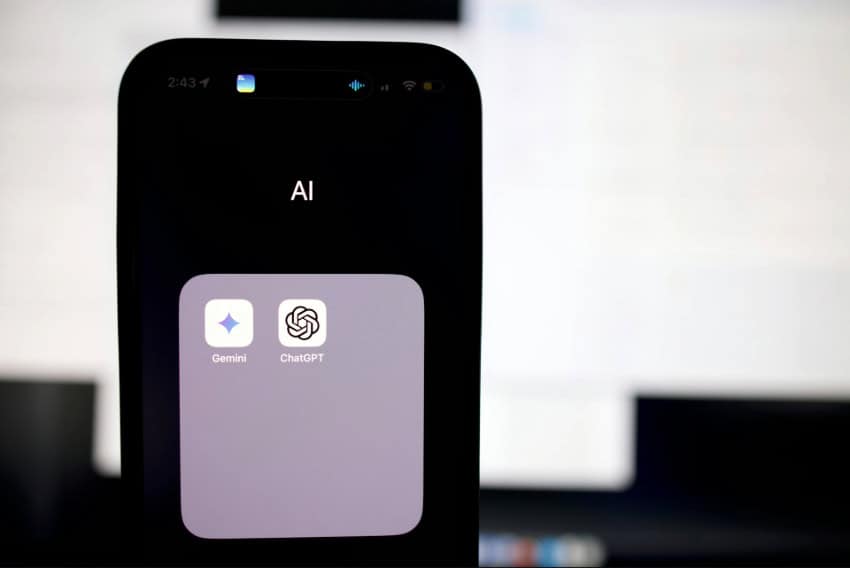
None of the software’s in-built features could physically stop people from using a second computer or a smartphone while sitting their UNAM entrance exams, although it was equipped with a camera and microphone-assisted surveillance system designed to detect irregular — i.e., deceitful — conduct.
Territorium Life said that its exam platform “operated as planned.”
Around 2% of exams have already been nullified because the software’s surveillance system, overseen by a group of human behavior experts, detected cheating.
Suspicious entrance exam results
UNAM published the results of its admission exams on July 17. The first suspicions about them emerged on social media, according to the newspaper El País.
Why were the results suspicious? In a nutshell, because they were unusually good.
In the past, the percentage of test-takers who responded correctly to more than 100 questions on 120-question multiple-choice exams was below 10%.
In 2025, the percentage of test-takers who got more than 100 questions correct on the medicine degree entrance exam was 9%. The figure this year was 29.3%.
Almost 19% of law degree candidates got more than 100 questions correct in 2026, up from just 3.7% last year. The figure for would-be UNAM science degree students rose to 30.4% from 9.7% a year earlier.
The higher incidence of excellent exam results “drastically increased the required thresholds to enter” UNAM degree programs, the BBC reported.
🎓⚠️ Especialistas alertan sobre posibles irregularidades en el examen virtual de ingreso a licenciatura de la UNAM.
Tras publicarse los resultados, se detectó un aumento atípico de aspirantes con puntajes superiores a 100 aciertos: mientras en años anteriores representaban… pic.twitter.com/y9h1LXahGw
— LuisCardenasMX (@LuisCardenasMx) July 21, 2026
The cheating allegations
The allegations that some people cheated in their UNAM entrance exams are, at this stage at least, exactly that — allegations. Nothing has yet been proven.
However, the widespread suspicion is that some, or perhaps many, aspirants used AI assistants such as ChatGPT, Gemini and Claude while completing their exams.
The news outlet Infobae reported that before the various UNAM entrance exams were held, videos on the social media platform TikTok provided a “cheating instruction manual.”
Among the advice offered on TikTok was to have “ChatGPT running on a second monitor outside the [camera’s] frame,” Infobae reported.
A test-taker could conceivably have been assisted by a second person outside the camera’s view who held up AI-generated answers on a laptop, for example.
Eduardo Backhoff, a Mexican psychologist and education assessment expert, wrote on social media that “either the exams were easier [than in previous years], the students were smarter, or they cheated.”
“The first two possibilities are highly unlikely; the last one is the only plausible explanation. In this case, those who don’t deserve it are being rewarded,” he wrote.
In a radio report, NPR journalist Eyder Peralta said that “Raul Rojas, who teaches AI at the Free University of Berlin and statistics at the University of Nevada, Reno, says when he looked at all the test scores, he didn’t find the kind of deviation you can chalk up to an easier test or perhaps a smarter class.”
Rojas told NPR that his conclusion was that “almost half of the students were cheating when taking the exam online.”
Peralta said that the tests “were open for 17 days, giving ample chance for friends or internet entrepreneurs to leak or sell test questions.”
“Blind spots in technology also allowed students to have someone else take their test,” he said.
UNAM’s response
UNAM has launched an investigation into the suspected cheating by some exam candidates and suspended the enrollment of new students shortly before the new academic year is scheduled to begin.
The university’s rector, Leonardo Lomelí Vanegas, has named a group of 16 experts in fields including education, AI and law, to examine what happened. Backhoff is a member of that group, which is expected to complete its investigation promptly.
Lomelí, UNAM rector since late 2023, said that fair access to the university’s degree programs cannot be compromised by “those aspirants who may have had some kind of help.”
He also said that none of the possible responses to the alleged cheating are ruled out — i.e., there is a chance that the exam results will be nullified and UNAM aspirants will have to sit entrance exams again.
If the results were nullified, would-be UNAM students who studied hard and did well in their exams without cheating would be unfairly penalized. However, having aspirants re-sit the exams — in person — may be the only way to ensure that the admission process is fair for everyone.

The university’s decision “could set legal, technological, educational and evaluative precedents,” said Juan Manuel Flores Ayala, an education assessment expert who was quoted in the El País newspaper.
“… I would lean toward repeating the exam and moving the semester as needed to restore credibility and provide certainty to the people UNAM serves as a public institution. There is a political and legal cost to doing so, but I think more would be gained than lost,” Flores said.
UNAM, BBC reported, also announced that it filed criminal complaints against “people and companies that offer fraudulent services” related to its entrance exams.
The university is dealing with an issue faced by education institutes around the world — students’ use (including improper and fraudulent use) of AI.
Aspirants’ views
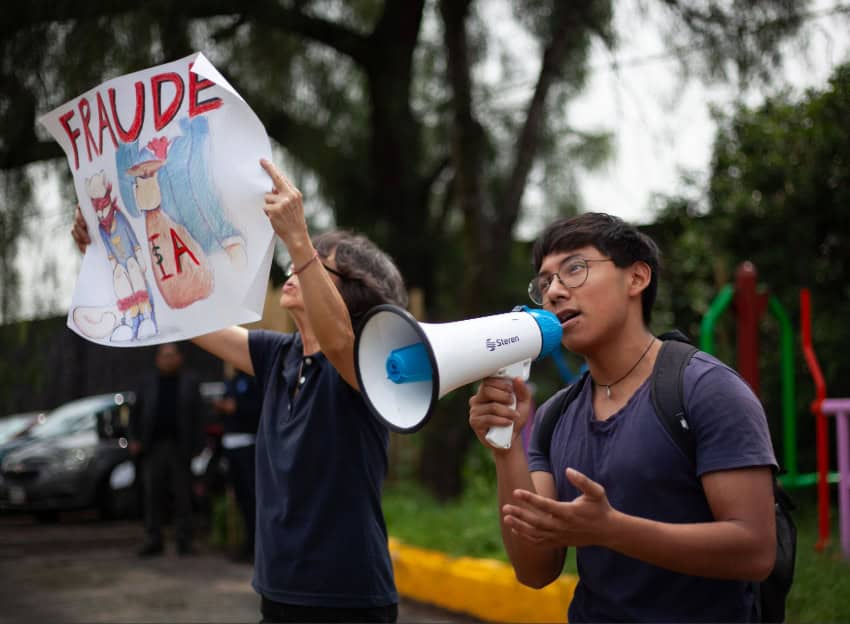
Some UNAM aspirants have protested to demand that the exams be held again. Others want the results to stand.
In the aforementioned NPR radio report, protesting test-takers can be heard chanting, “We want honesty, not artificial intelligence.”
At Ciudad Universitaria, they also demanded that an “examen presencial,” or in-person exam, be held for UNAM aspirants.
One would-be applied mathematics student, Leonardo Ruiz, told NPR that his exam results had already been invalidated.
“He assumes his exam was flagged for cheating because he scored too well, but he says he did it by studying,” NPR’s Eyder Peralta reported.
Sheinbaum weighs in
President Claudia Sheinbaum said on Tuesday that the Federal Attorney General’s Office could assist UNAM in its investigation if required.
“They have to see how this fraud was committed,” she said.
It has to be established whether “the company … [UNAM] hired” to facilitate the online exams was complicit or whether “some” of the exam candidates used AI of their own accord, Sheinbaum said.
