
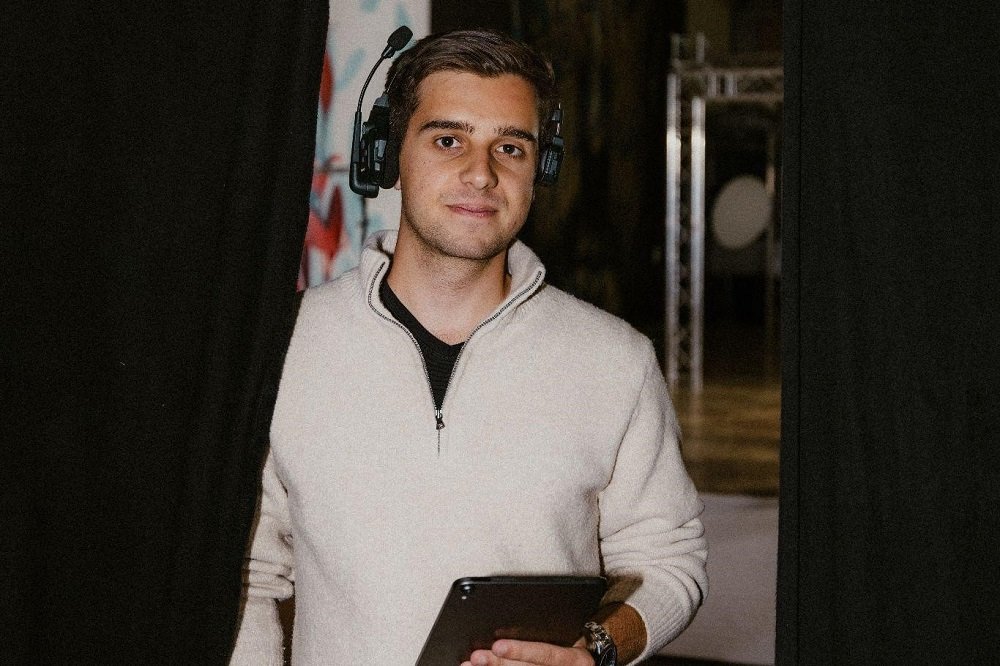
– The German film industry professional discusses where AI actually delivers on set and where it fails, and what he would tell fellow producers about it
Erik Faltermann is the founder and managing director of Erik RCT Filmproduktion GmbH, a TÜV-certified film production company based in Weinheim near Mannheim, Germany. Over the past eight years, his team has delivered more than 650 productions for clients ranging from global brands like Würth, Amazon and Red Bull to mid-sized manufacturers and public institutions across the DACH region, and has been integrating AI into paid, real-world productions since long before the current boom. He discusses where AI actually delivers on set and where it fails, and what he would tell fellow producers in 2026.
Your company was using AI in commercial productions long before the recent boom. Which AI-powered tasks consistently deliver measurable savings. And which ones still create more problems than they solve?
Erik Faltermann: The biggest lever for us wasn’t a flashy generative tool, it was integrating AI into our entire communication flow. We’ve connected AI to our email, our video calls and our phone conversations, so nothing gets lost anymore: not a single detail from clients, freelancers, suppliers or location scouts slips through the net. This allows us to generate extremely precise project briefings in a fraction of the time. Clients now regularly give us feedback along the lines of “we’re impressed by all the details you’ve thought through”, and, honestly, a good part of that is the machine listening better than any human could whilst also running a production.
The same goes for the unglamorous parts of the pipeline: subtitles are far more accurate than two years ago, and translations now handle industry-specific terminology properly, which matters a lot when you produce for engineering or manufacturing clients. And yes, we use image and video generation in post, complex animations. Or effects that a motion designer would have spent days building in After Effects two years ago, we can now create in minutes.
Where AI measurably saves time on set is preparation: our call sheets and crew briefings are extremely detailed and tailored to each role. AI generates individual briefings per department. A shoot day simply runs more efficiently. Less chaos is a time win for everyone.
And where did it create more work than it delivered? Screenwriting. We once tried having AI write a whole script, in a test project, and the experience wasn’t good. What’s missing is emotional depth, a real narrative thread, and the understanding that dialogue is connected; that a line lands differently depending on the mood it’s spoken in, what the person is wearing, how the frame is composed. Those subtle details are what make a film. That still has to come from a human. We’re still working with real screenwriters, and they make an enormous difference.
The project I’m most proud of in this context is a brand video with three shoot days for a globally known corporation. Due to an illness on the client’s side, our preparation window collapsed. We suddenly only had a few days to cast actors, scout and book locations, and organise props and equipment. Two years ago, my team and I could never have pulled off a production that size in that little time. With AI handling research, coordination and briefing at speed, it worked out excellently and the shoot ran beautifully.
There’s a lot of discussion about AI replacing creative jobs, but much less about how it changes day-to-day collaboration on set. How has AI affected roles and workflows at Erik RCT Filmproduktion?
Less than people might expect, and that’s the interesting part. On set, we still work very much the way we always have. The craft hasn’t changed: directing, cinematography, lighting, working with people in front of the camera, that’s untouched.
What has changed is everything around the set. Because our AI-generated crew briefings are so complete, we no longer need several pre-production meetings with the crew. One meeting is usually enough; on smaller projects, a phone call does it. Everything is laid out clearly for every role.
We follow an “AI-first” principle for every task where quality doesn’t suffer, which in practice means preparation and back office. Our project management team is trained to use AI for everything and to build their own agents: agents that do outreach for location rentals, that check permit requirements or drone regulations for a shoot location. Our creative team, videographers and editors are encouraged to use generative video tools for mood boards and samples, but also for individual scenes and shots that end up in final deliveries.
I’ll be honest: I expected resistance. I assumed some of our videographers and editors would push back because they’d feel their jobs were threatened. But the opposite happened, there wasn’t any resistance anywhere in the team, and I’ve been surprised by how positively it’s been embraced and how much the creatives enjoy working with generative AI.
Based on more than 650 productions, what advice would you give to independent producers in 2026? Which tools have become indispensable and where would you stick to traditional methods?
Two things have become indispensable for us. The first is building agents. AI that works in the background, makes its own decisions, researches, and prepares shoots. We use Zapier Agents for that. The second is Claude. It’s become remarkably good at assessing real film-set situations: it can estimate how long to block a slot for a shoot, and it factors in things like sun position and continuity. It’s also exceptional at working with interview transcripts. On one project we had over ten hours of interview material; we uploaded everything and it connected meaningful statements scattered across all the footage, with timecodes. That saved our editor an enormous amount of time and genuinely improved the end result.
A small example of what “build it yourself” means in practice: as a production company we run a large equipment warehouse, and we never found inventory software that really fitted film production needs. Using AI, we built our own warehouse app in a single day: pick lists for the warehouse team, repair tracking, automatic importing of new equipment orders. It cost us a few hundred euros in AI credits, once. It’s a better fit for us than any €40–50-per-month, off-the-shelf tool ever was.
Where I’d clearly stay traditional: screenwriting, as I already mentioned, and marketing knowledge and research, which still has to come from a human who truly understands the audience. And the edit itself. We stay away from tools that promise to auto-cut clips from footage or claim to “do editing”. All of that is still far too basic. Real editing, colour grading, sound design: that’s done by real people at our company, and we haven’t found any tools that come close.
If I had to give a fellow producer one piece of advice for 2026, it’s this: for every single task in your operation, ask yourself honestly: Could AI do this just as well? For many jobs on the operational side of filmmaking, the answer, these days, is yes. For some, it’s still no. But if the answer is yes, it’s become remarkably easy to build your own tools for it.
