
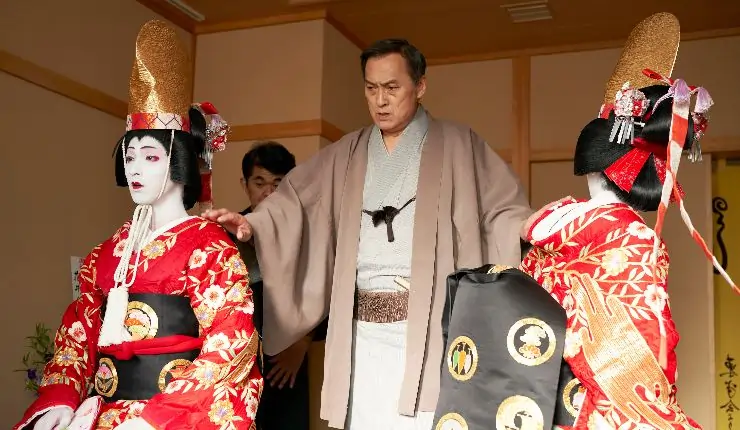
Japanese performing arts are becoming increasingly well-known due to greater media exposure and accessibility. Rakugo, for example, gained widespread attention through a highly successful manga, anime and even TikTok that showcased the beauty of solo performance art. In contrast, Lee Sang-il’s Kokuho presents a very different traditional art form: Kabuki. In 2005, Kabuki was proclaimed by UNESCO as an Intangible Cultural Heritage of Humanity.
Due to the historical ban on women performing in Kabuki theatres, Kabuki is a form of Japanese theatre in which men portray all characters, including female roles. A sprawling, dramatic epic spanning nearly 50 years, Kokuho is an ambitious yet flawed drama that nonetheless stands as a remarkable technical achievement.
Following the son of Yakuza boss Kikuo, the story begins after his family is killed by a rival Yakuza clan during an attack in Nagasaki in 1964. After the massacre, he is taken in by Hanai Hanjiro II as an apprentice and given the stage name Toichiro. Training alongside Hanjiro’s son, Shunsuke, we follow Kikuko and Shunsuke over the next fifty years as they share the ambition of becoming the greatest Kabuki performer in all of Japan.
It would also be a failing, as an East Asian cinema lover, not to address the small elephant in the room. Any fan of East Asian cinema—whether they have seen either film or not—will recognise that Kokuho takes clear inspiration from the Chinese epic Farewell My Concubine. However, I feel Kokuho does enough to distinguish itself as a unique viewing experience. Comparisons are an inevitability due to the similarities, but it will ultimately be up to audiences to decide which film they prefer.
Visually speaking, Kokuho is striking and truly elegant. The costumes and makeup stand out the most; the beautiful kimonos are utterly spellbinding, and seeing the actors adorned in these outfits and makeup transports you to a front-row seat in Japanese theatre. The performances themselves are truly transcendent in their presentation, and the lush cinematography brings elegance to every frame, beautifully showcasing the wonders of kabuki. While some of the stories are repeated throughout the film, this allows audiences to become familiar with the productions and notice when things do not inherently go as planned.
Especially early on, seeing the son of a yakuza boss slowly become a world-class performer is nothing short of thrilling. Witnessing how an outsider overcomes the odds, despite the prejudice he faces from the old guard, is brilliant. What makes the film so captivating, and at times deeply moving, are the strong performances. Ryō Yoshizawa and Ryusei Yokohama, as Kikuo and Shunsuke respectively, are truly mesmerising, delivering incredible performances both on and off the stage. It also takes immense dedication to learn how to become a skilled kabuki performer, and while I can’t fully confirm how accurate or authentic their performances are, the clearest marker of the film’s success is that it left me eager to see an actual kabuki performance.
It isn’t all magical, though. At nearly three hours, the film feels far too long, and during certain moments the quieter beats ring hollow rather than feeling dense with meaning. One particular encounter, in which Kikuo is accused of sleeping with someone solely to advance his career, should be impactful, but instead it oddly comes across as a cliché. This story beat feels less like an organic development and more like an inevitability or a required inclusion, rather than something truly meaningful to the overall narrative arc. While it does tie into the broader themes of what people are willing to do to achieve greatness, I ultimately wanted more impact from it.
Kokuho is, at times, a marvel of cinema, an enchanting and irresistible tale of Japanese theatre. When the film soars, it becomes an emotionally impactful and exquisitely told masterpiece; however, when it begins to slog, it can feel somewhat lacklustre. Even so, the final product remains a wonderful cinematic experience and a one-of-a-kind film that is absolutely worth seeing.
★★★★
In UK Cinemas from 8 May /Ryō Yoshizawa, Ryusei Yokohama, Mitsuki Takahata, Shinobu Terajima, Min Tanaka, Ken Watanabe / Dir: Lee Sang-il / Vue Lumière / 15
Discover more from
Subscribe to get the latest posts sent to your email.
