
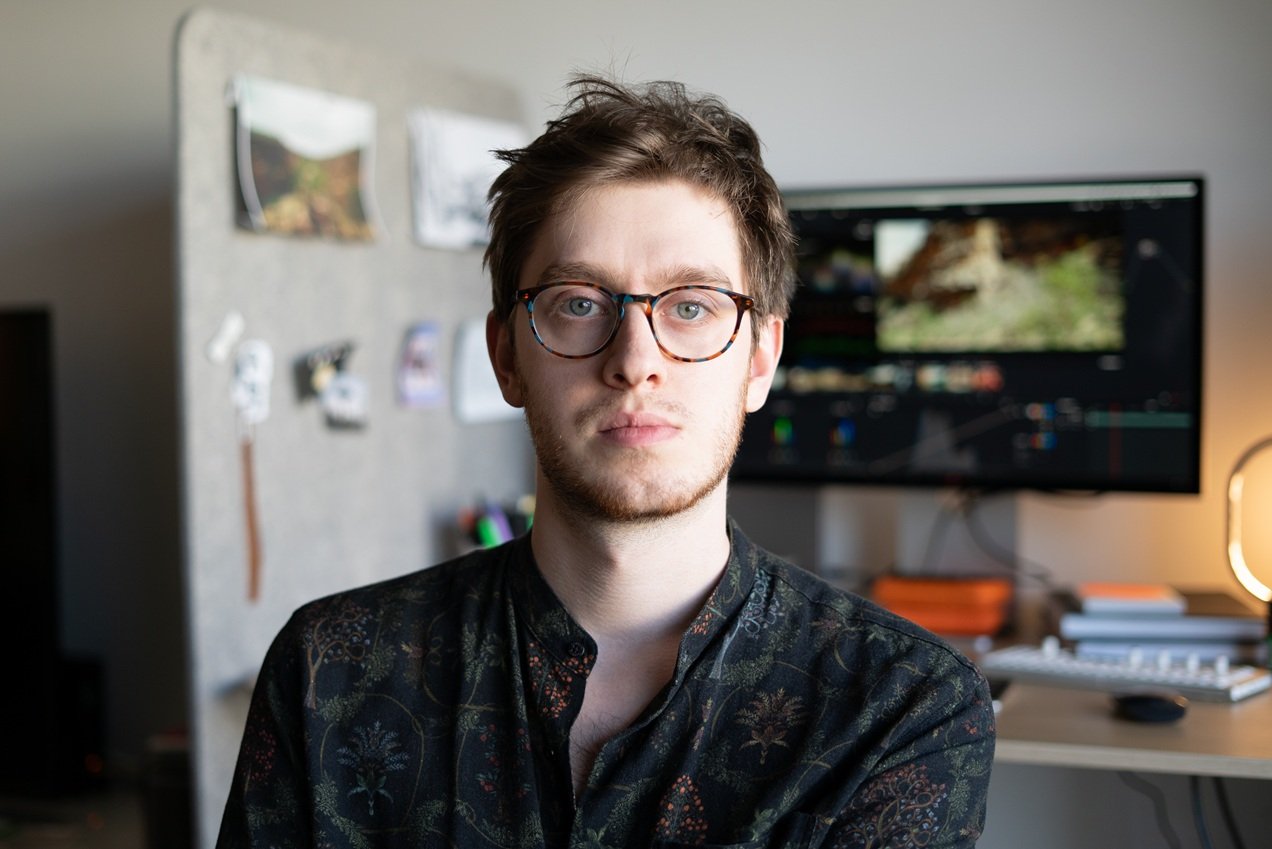
“I was trying to create these very separate environments that are occupied by the way we look at the world”
– The first-time feature director shares his ethos on analogue image-making and working between different subjectivities
Brazilian-born filmmaker Leonardo Pirondi makes his feature debut with Tropical Fractals, a texturally rich, lo-fi sci-fi movie that enjoyed its world premiere at IndieLisboa, in the festival’s national competition. Tropical Fractals oscillates between two stories: that of an archivist (Valentina Rosset) on a spaceship in a post climate-crisis world, and that of – perhaps – the last man on Earth (Ivo Müller). We spoke with Pirondi to discuss the film’s intriguing juxtapositions, and how his environments and cinematographic approaches manifest themselves as different subjectivities.
Cineuropa: Could you begin by discussing the trajectory and development of the movie, from both a creative and a practical perspective?
Leonardo Pirondi: My short films sort of bleed through fiction and documentary, and I wanted to make something in that realm. The early thread was the photogrammetry that you see in the film. This was the initial spark that led to the research aspect of this way of portraying the world. I got a new phone that had a LiDAR sensor, and then I started playing with that. I was scanning everything I had around me, like plants and cups. But then, I just wanted to make something more fictional. I began to realise how to deal with these very rudimentary CGI images. For the spaceship, I was imagining this environment where these people would be working individually, trying to fragment and almost dehumanise the subjectivity of looking into them. Then, there had to be a looser and warmer view of the man on Earth – how it would be for him to create music, for example. What is the more human subjectivity of being in this environment? There was almost no tripod used on the shots of him at first. I was trying to create these very separate environments that are occupied by the way we look at the world.
As you said, you’re working in a very analogue practice, but your film looks at life mediated through a digitised form, creating an interesting tension between technique and content. How do you see these two connecting?
Some of my earlier works, especially, deal with looking into the technology-mediated life we live right now – even though they’re shot on 16 mm. I think this film has an echo of that interest, as it’s part of my generation. This movie broaches the idea of the environmental collapse being mediated by digital technologies that are informing this future that’s being sold to us. It’s the way I’m dealing with these things, but it’s also the way I know how to make films. I work with a 16 mm camera without a video tap or anything. It’s the way I learned how to work, and it’s the way I think I always will be making film, but the focus can be placed on different subject matter.
There’s also that aspect of memory of humanity, which is being recorded through diaries and film itself. I would say that cinema as a whole is about that, right? It’s about holding on to an image of the past. There is no way you can see something instantly. You are constantly dealing with things that are changing. Some of the locations I shot were later burnt in a huge wildfire. We drove there a year later, and everything was all black. The process taking longer also allowed us to see how real the film is and to document things that may no longer exist. That’s also part of what the feature deals with.
The credits say that you draw from different archives. Where is that point of discernment for you when it comes to filming something yourself versus looking to existing work?
I would say that 98% of the film is what I shot. I can’t photograph galaxies myself, and NASA turns out to be a pretty good source for that. Yet, there are some shots of stars and such that I filmed on 16 mm on a screen, but in a video-game space, reframing it and then shooting the screen. There’s still this element of making the image, even though it’s this cumbersome process. There is one archive of these plants blooming that I couldn’t do myself. I couldn’t do better than those. There are also galaxies that I photographed from a monitor, and then it’s coloured, processed and mixed with the archival time lapses of plants. In these cases, I’m actually framing, moving and zooming. There is this aspect of directing the image as much as I can despite these impossibilities.
Could you talk about crafting the spaceship environment, which is quite minimalistic, and how you decided to portray it on screen?
That was one of the earliest things I shot. There were some limitations on what I could do for a spaceship, but it wasn’t about doing a low-budget version. It’s about the ethos of my work. I come from Brazil, and the way we think about cinema, at least in the field of Cinema Novo, is working with the resources we have. How do you rethink the cinematic image according to things that are reachable, and how do you craft that image? I thought, “I’m just going to take a more radical approach and find a language for the spaceship that doesn’t have to be grounded in anything.” It’s my spaceship. I control the universe of this film. It was essentially a black background, and we were shooting with these actors by building a jungle in my living room – reshaping plants to create an environment that would feel alive enough.
