
“The film is not interested in glorifying anyone. At its core it’s about helplessness”
– The Anifilm award winner talks puppet animation and politically charged storytelling
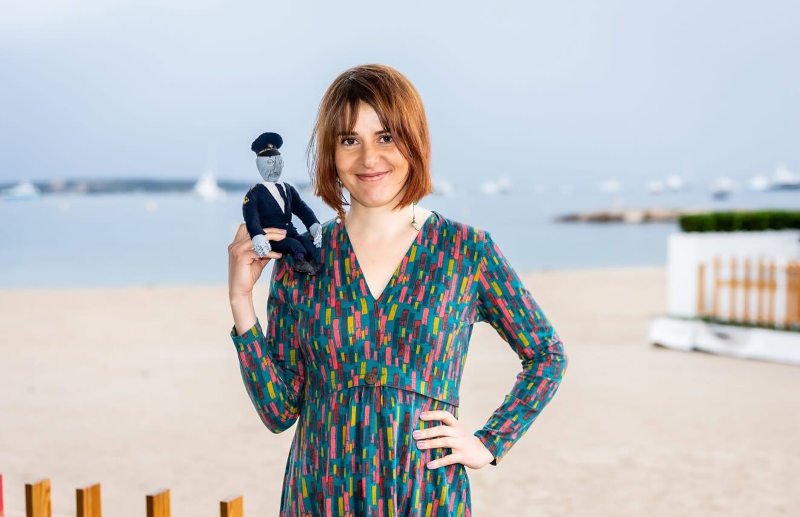
At this year’s Anifilm in Liberec, Estonia-based Armenian director Natalia Mirzoyan’s Winter in March won Best International Short Film in the competition programme. A co-production between Estonia, Armenia, France and Belgium, the animated documentary about a Russian couple leaving their home in the aftermath of the full-scale invasion of Ukraine uses textile puppets to follow a story of helplessness. Caught between opposition to the war and an inability to meaningfully resist it, their relationship slowly crumbles in the aftermath.
We sat down with the director to talk about her inspiration and the importance of this perspective.
Cineuropa: This is your first puppet animation, made while studying at the Estonian Academy of Arts. Why did you choose puppets for such a politically charged story?
Natalia Mirzoyan: Puppet animation was the reason I came to Estonia in the first place. I wanted to make puppets and learn from filmmakers like Ülo Pikkov and Anu-Laura Tuttelberg, whose work I deeply admire. Originally, I had planned to make a completely different film. But my studies coincided with the full-scale invasion of Ukraine, and suddenly every other subject felt disconnected from reality. I was deeply affected emotionally by the war, but also didn’t feel equipped to tell a Ukrainian story – those stories belong to Ukrainians. Instead, I turned to something more personally understandable: the emotional paralysis of Russians who opposed the war but felt unable to meaningfully resist it. Exploring that through the collapse of an intimate relationship felt more revealing than making a purely political testimony.
The film centres on Kirill and Dasha, a couple leaving Russia while grappling with helplessness. Since it’s a documentary film, how did you meet them, and how did the project begin?
I knew Kirill and Dasha through activist and creative circles in Saint Petersburg. Kirill is an animator, and Dasha worked at a children’s theatre. We had crossed paths at protests before. At first, I wanted to document the broader experience of Russian emigrants after the invasion began. Armenia quickly became a major destination, as Russians could enter without visas, creating a strange intersection between my everyday life there and the sudden influx of Russian exile communities. Many of the people arriving seemed visibly depressed, disoriented and suspended in a kind of emotional limbo. As I began collecting different stories, Kirill and Dasha gradually emerged as the most compelling lens through which to explore this wider emotional narrative.
The textile puppets and embroidered sets feel fragile and emotionally exposed. Was that intentional from the beginning?
My process is usually more intuitive. But it’s true that textiles naturally carry a sense of fragility. They can tear, decay, unravel or be discarded. At the same time, they are deeply intimate materials: soft, warm and close to the skin. That contradiction felt right for this story. I was also inspired by textile artists and puppet-makers whose work embraces imperfection, vulnerability and visible traces of damage. I never wanted the puppets to look polished or conventionally beautiful. At one point, I even considered gradually deteriorating the puppets throughout production by shooting the film chronologically, allowing them to physically wear down alongside the characters. In the end, though, it proved too technically difficult to realise.
When you were submitting the film for festivals, did you also worry about how the film might be received?
Film festivals are still one of the main ways animation reaches audiences, so I worried the film might feel too politically uncomfortable or risky to programme. At the same time, the film was made in Estonia, which also has history with Russian oppression. But I felt very supported in telling this perspective. The response has been unexpectedly warm. Viewers from countries dealing with authoritarianism or political repression have reached out to say the film resonated far beyond its immediate Russian context.
Did you hesitate to foreground Russian perspectives, given how sensitive the topic remains?
Of course, Russian suffering is not comparable to Ukrainian suffering. But this is also a perspective that is rarely examined, which makes it morally more difficult in some ways than telling a more straightforward victim narrative. These are not heroic characters. Kirill, for example, is passive and emotionally diminished in many ways. The film is not interested in glorifying anyone. At its core it’s about helplessness. That feeling is not uniquely Russian. Many Europeans experience a similar form of paralysis: being physically safe while watching a war continue, aware of their own distance from it and inability to meaningfully intervene. At the same time, there were also Russians who actively protested and paid a heavy price for it. Many have been imprisoned. Kirill himself was briefly detained. The film does not attempt to excuse passivity, but rather to examine what political and emotional collapse can look like from the inside.
